This manual is for NURS FPX 8022 Assessment 3, start to submission. The closing deliverable in Nursing Technology and Advanced Healthcare Information Systems typically pushes past go-live, where most drafts stop: govern the data, meet the obligations that arrive with it, and prove the thing will still be running once the project team has disbanded. Ownership with job titles, access written as roles, an evaluation threshold agreed before results exist. This manual sets out the order our doctoral desk works in, the sections that satisfy the criteria, and an annotated excerpt of governance prose. Rather it were done for you? An original premium sample drafted to your posted criteria arrives in 24 to 48 hours, and every revision after that is free. Capella's catalog lists the course as NURS-FPX8022, and some courserooms print NURS8022; both point to this same Assessment 3. In current courserooms this assessment typically appears as "Risk Mitigation Plan".
One honesty note before the manual: Capella revises courses and scoring guides over time, so always write to the exact scoring guide attached to your assessment in the courseroom. The course identity above is verified on capella.edu; the method and structure below are our tutors' approach to it, not Capella's official rubric text.
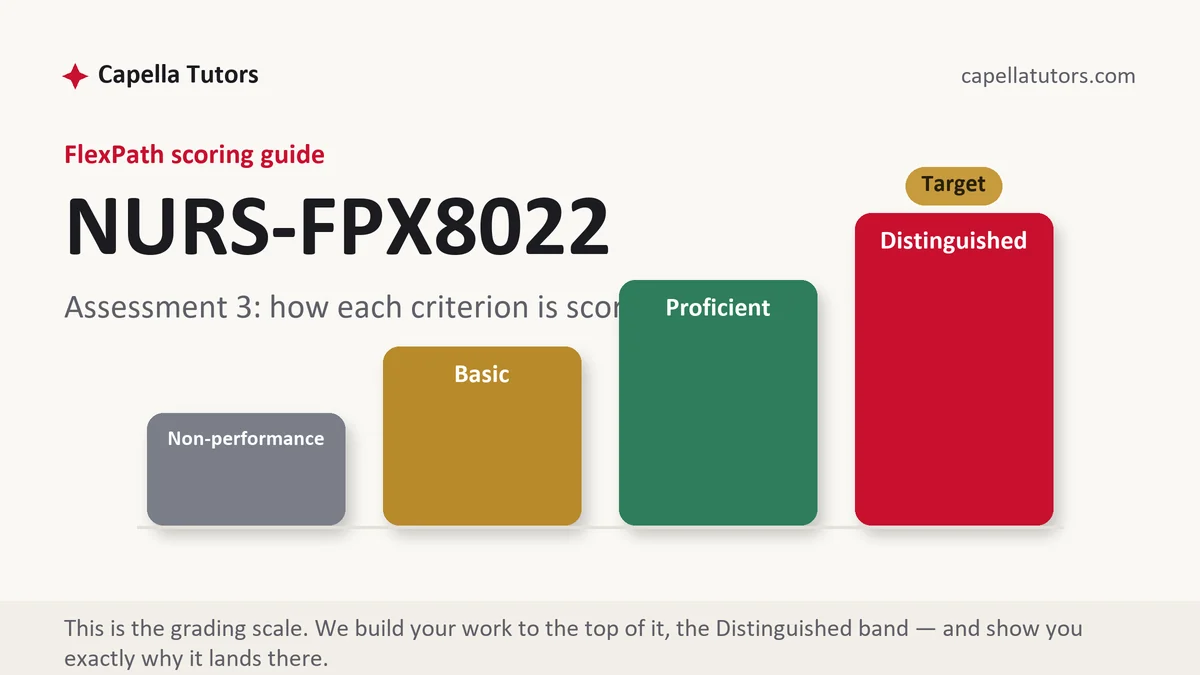
How NURS FPX 8022 Assessment 3 is scored
Every criterion in FlexPath resolves independently to one of four levels, with no letter grade produced at any point. The level wording is your instruction set:
| Level | What it means on a governance and sustainment plan |
|---|---|
| Distinguished | Every data element has an accountable owner with a job title, access is written as roles under minimum necessary, the evaluation threshold was fixed before results existed, and one unsolved exposure is named out loud. |
| Proficient | Governance, privacy and evaluation all covered accurately. Complete, and written as principles where the criterion wanted assignments. |
| Basic | A correct summary of privacy rules and good data practice with nothing attached to your own project. Reads as a textbook chapter, and scores like one. |
| Non-performance | A required element is missing altogether, most often sustainment or the plan for who maintains the measure afterwards. |
Governance criteria are graded on specificity rather than on eloquence, which makes them unusually winnable. A paragraph naming three roles, one committee and one review cycle beats a page of accurate general principle every time.
The NURS FPX 8022 Assessment 3 method, step by step
-
Classify the data before you govern it
Patient-entered data, device output, clinician documentation and administrative extracts carry different obligations and different reliabilities. Say which class each element belongs to in your first paragraph, because retention, access and consent all follow from that answer rather than from your preferences.
-
Give every element an owner with a job title
Not the informatics department, not the project team. A person's role, and what they are accountable for: the definition, the mapping, the response standard, the escalation threshold. Put them in the data dictionary where a reader can see the assignments side by side.
-
Write access as roles under minimum necessary
Describe what each role sees and, more usefully, what each role does not see. A schedule clerk who needs to know a form was submitted does not need the values inside it, and saying so demonstrates the principle better than quoting it.
-
Handle the obligations that ride along
Security risk analysis, audit logging with somebody named to review it on a cycle, a retention period drawn from policy rather than invented, and patient access consistent with the information blocking provisions. Cite each requirement to the body that publishes it, not to a summary article.
-
Plan for the day the project team disbands
Which existing report carries the measure forward, who runs it, who reviews it, and on what cadence. A measure that depends on you personally pulling a query has a sustainment plan of zero, and the criterion will find that out.
-
Name the exposure you did not solve, then self-score
The single analyst who knows how the extract is built, the vendor upgrade that will break the logic, the consent language that has not been reviewed. Volunteer one, then read the draft against each criterion, mark D, P, B or N, and rewrite anything below the top level.
A structure that maps to the criteria
These are our doctoral desk's planning lengths for a governance deliverable, not Capella rules; move the weight to wherever your scoring guide puts it.
| Section | What it must do | Guide word target |
|---|---|---|
| Scope and data classification | What data the plan governs, which class each element belongs to, and which systems hold it. | ~200 words |
| Stewardship and ownership | Element by element accountability with job titles, plus the committee the owners report into. | ~250 words |
| Access, privacy and security | Role-based permissions under minimum necessary, audit logging and its reviewer, retention, risk analysis. | ~300 words |
| Ethical and equity obligations | Consent and patient access, plus who is excluded by the design and what you do about them. | ~250 words |
| Evaluation and sustainment | Baseline, review points, the owning report after handover, and the threshold for keeping or retiring. | ~300 words |
| Residual risk and references | The exposure you have not solved, and current APA reconciled in both directions. | ~200 words |
Annotated sample excerpt
An original model passage from our doctoral desk, showing how governance detail reads when it has been decided rather than described.
Symptom severity submitted by a patient between infusion visits is neither a clinician note nor a research instrument, and this plan has to settle which it is before anybody can steward it.1 Each of the eleven reported items is held as a discrete observation with one accountable owner: the ambulatory informatics analyst owns the mapping and the retention rule, the infusion nurse manager owns the response standard, and the disease team medical director owns the escalation threshold, all three recorded in the data dictionary rather than described in a paragraph.2 Access follows minimum necessary, so scheduling sees a submitted or not submitted flag and no severity values, triage nurses see the full record only for patients on their own panel, and the audit log is reviewed monthly by the informatics analyst with an exception summary going to the ambulatory quality committee twice a year, a meeting that already exists and already keeps minutes.3
- 1Opens by classifying the data. Retention, consent and access all follow from that decision, so making it first is what keeps the rest of the plan coherent.
- 2Three named roles, three distinct accountabilities, recorded where they can be enforced. This is the sentence a governance criterion is looking for.
- 3Shows minimum necessary by saying what a role cannot see, then hangs the assurance on a committee that already meets. Invented oversight bodies do not survive the year.
The full premium sample for your exact assessment, written fresh to your scoring guide and issue, is free to request. Study it, revise it into your own voice, and submit work you understand.
The five mistakes that cost Distinguished
- Privacy law recited, not applied. An accurate summary of the rules that never touches your own data elements answers a question nobody asked.
- Ownership assigned to a department. Departments do not attend meetings; write the job title of the person who is accountable.
- Access described as appropriate. The word does no work. Say which role sees which field, and which fields it cannot see.
- Sustainment that depends on you. If the measure dies when you graduate, the plan has not been written, only performed.
- No stopping rule. A technology with no threshold for retirement will be maintained forever by people who forgot why, and the criteria expect you to prevent that.
Pre-submission checklist
- Every data element classified and assigned to a named job title
- Role-based access written as what each role sees and does not see
- Audit logging, retention and risk analysis each with an owner and a cycle
- Patient access and consent addressed against the published requirement
- The measure handed to an existing report with a named reviewer after go-live
- One unsolved exposure volunteered, and every criterion self-scored D
Governance plan due and nobody will tell you who owns what?
Send the scoring guide, the project it attaches to, and whatever you know about your committee structure. We write ownership, access and sustainment as decisions rather than as principles. Premium original sample in 24 to 48 hours from an eight-person pipeline, with free revisions until your evaluator signs it off.