This manual is for NURS FPX 8022 Assessment 2, start to submission. SAFER Guides and Evaluating Technology Usage asks you to use the SAFER Guides, the self-assessment guides published by the Office of the National Coordinator for Health IT, to evaluate how an organization uses its electronic health record: choose the guide or guides that fit the problem you identified in Assessment 1, assess the recommended practices against what the organization actually does, identify the safety gaps, and recommend improvements. The grade turns on evidence from the setting. A summary of what the SAFER Guides say scores lower than an evaluation that names which practices are in place, which are partial, and what that means for patients. Below is the method our tutors use, a structure that maps to the criteria, and an annotated sample excerpt. Prefer to hand it off? A premium original sample for this exact assessment comes back in 24 to 48 hours, revised free until it meets the guide. Capella's catalog lists the course as NURS-FPX8022, and some courserooms print NURS8022; both point to this same Assessment 2. In current courserooms this assessment typically appears as "SAFER Guides and Evaluating Technology Usage".
One honesty note before the manual: Capella revises courses and scoring guides over time, so always write to the exact scoring guide attached to your assessment in the courseroom. The course identity above is verified on capella.edu; the method and structure below are our tutors' approach to it, not Capella's official rubric text.
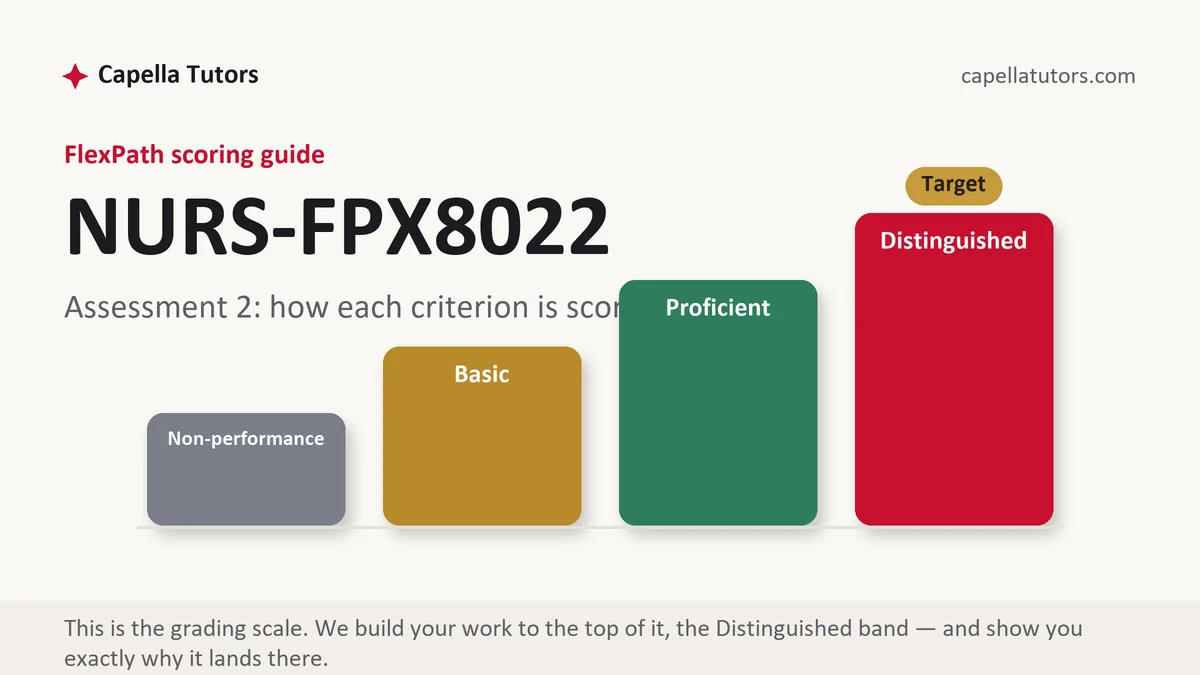
How NURS FPX 8022 Assessment 2 is scored
FlexPath does not use letter grades. Each criterion in the scoring guide lands on one of four levels, and the level descriptions are the real writing brief:
| Level | What it means on a SAFER Guides evaluation |
|---|---|
| Distinguished | The chosen SAFER Guide fits the information problem, practices are rated against the organization's real use with evidence, gaps are prioritized by patient safety risk, recommendations are specific and supported, and legal and ethical implications are addressed. |
| Proficient | The evaluation is accurate and complete, but ratings rely on general statements and recommendations are broad. |
| Basic | The paper summarizes the SAFER Guides with little evaluation of the organization. |
| Non-performance | The guide selection, the gap analysis or the recommendations are missing. |
Choose the guide that matches your Assessment 1 problem: High Priority Practices for an overview, or a focused guide such as Test Results Reporting and Follow-Up, Computerized Provider Order Entry with Decision Support, or Contingency Planning.
The NURS FPX 8022 Assessment 2 method, step by step
-
Restate the information problem
The problem from Assessment 1 and the data that showed it.
-
Select the SAFER Guide
Explain why the guide you chose addresses this problem, and cite the current edition.
-
Rate the practices
For each relevant recommended practice, state whether it is fully, partially or not implemented, with evidence from the setting.
-
Prioritize the gaps
Rank gaps by the harm they could cause and how often the situation arises.
-
Recommend improvements
Specific changes to configuration, workflow, training or monitoring, each supported by evidence.
-
Address stakeholders and obligations
Who must act on each recommendation, and the legal and ethical issues, such as privacy and liability, involved.
A structure that maps to the criteria
Word counts are planning targets our tutors use for this paper, not Capella rules; follow the length your scoring guide states.
| Section | What it must do | Guide |
|---|---|---|
| Introduction | The organization, the information problem and the guide chosen. | ~150 words |
| SAFER Guide selection | Why this guide fits the problem. | ~150 words |
| Evaluation of practices | Practices rated with evidence, often as a table. | ~350 words |
| Prioritized gaps | Gaps ranked by safety risk. | ~200 words |
| Recommendations | Specific, supported improvements and owners. | ~250 words |
| Legal and ethical issues and references | Obligations and implications, then current APA. | ~150 words |
Annotated sample excerpt
An original model excerpt from our team, written to show the register that reaches the top of the guide. Learn the moves, then write your own version.
The Test Results Reporting and Follow-Up guide recommends that abnormal results be routed to a clinician who is responsible for acting on them, with a way to track results that are not acknowledged.1 At the clinic, abnormal laboratory results route to the ordering provider's inbox, but there is no report of unacknowledged results, so a result sent to a provider on leave can sit unseen; this practice is partially implemented.2 Because the clinic's own audit found eleven abnormal results last quarter that were acknowledged more than seven days late, this gap ranks first, and the recommendation is a daily unacknowledged-results report reviewed by the nurse manager.3
- 1States what the SAFER practice recommends, briefly and accurately.
- 2Rates the organization against it with evidence from the setting.
- 3Prioritizes the gap with data and turns it into a specific recommendation with an owner.
The full premium sample for your exact assessment, written fresh to your scoring guide and topic, is free to request. Study it, revise it into your own voice, and submit work you understand.
The five mistakes that cost Distinguished
- Summarizing the guides. Evaluate the organization against them.
- A guide that does not fit the problem. Choose the guide that matches Assessment 1.
- Ratings without evidence. Say what in the setting supports each rating.
- Broad recommendations. Name the change and who makes it.
- Skipping legal and ethical issues. They are part of the course's criteria.
Pre-submission checklist
- Information problem carried from Assessment 1
- SAFER Guide selected and justified
- Practices rated with evidence from the setting
- Gaps prioritized by safety risk
- Specific, evidence-based recommendations with owners
- Legal and ethical issues, current APA references
Want the SAFER Guides evaluation done?
Send the scoring guide and your Assessment 1 problem. Our team returns a premium original evaluation in 24 to 48 hours, revised free until it meets the guide.