This manual is for NURS FPX 8022 Assessment 1, start to submission. The first deliverable in Nursing Technology and Advanced Healthcare Information Systems usually asks you to find an information problem in a real setting and prove it exists with the setting's own data, which is harder than it sounds because most drafts describe a frustration instead of counting one. The criteria want a named data element, a named source system, a defined population and a window. Below is how our doctoral desk assembles that analysis, the section order that satisfies the criteria, and an annotated excerpt at the level of detail this course rewards. Prefer to delegate it? An original premium sample keyed to the guide in your courseroom returns in 24 to 48 hours, reworked at no charge for as long as it takes. Capella's catalog lists the course as NURS-FPX8022, and some courserooms print NURS8022; both point to this same Assessment 1. In current courserooms this assessment typically appears as "Using Data to Make Evidence-Based Technology Recommendations".
One honesty note before the manual: Capella revises courses and scoring guides over time, so always write to the exact scoring guide attached to your assessment in the courseroom. The course identity above is verified on capella.edu; the method and structure below are our tutors' approach to it, not Capella's official rubric text.
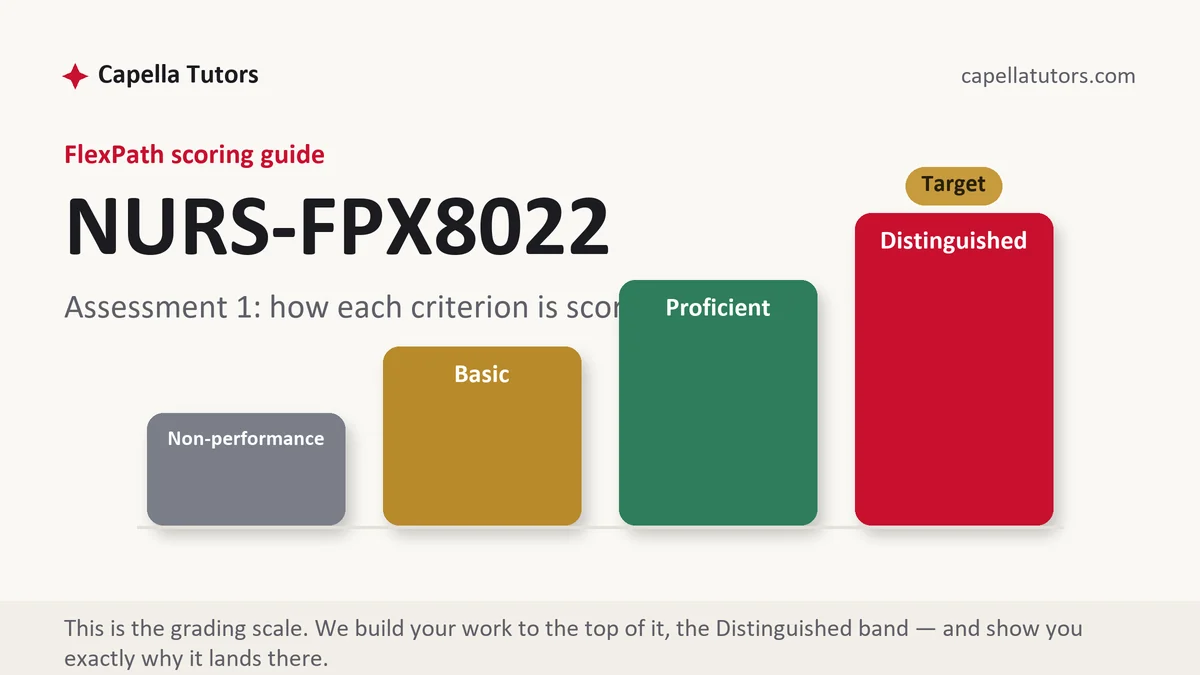
How NURS FPX 8022 Assessment 1 is scored
No letter grades exist in FlexPath. Each criterion resolves to one of four levels, and the level text is the closest thing you will get to instructions:
| Level | What it means on an informatics problem analysis |
|---|---|
| Distinguished | The problem is sized from the site's own data, every figure is traced to the field it came from, and the analysis says what the current systems physically cannot tell you. That last admission is usually the criterion's hidden requirement. |
| Proficient | The problem is described accurately and supported with data. Complete, and still resting on numbers whose origin the reader has to take on trust. |
| Basic | A clinical problem narrated with technology mentioned around it, counts unsourced or absent. The most common first attempt in an informatics course. |
| Non-performance | A required element is missing outright, most often the population definition or the window the data cover. |
One habit protects most of the grade. Decide what you are counting, and where it lives, before you decide what you think about it. A draft written the other way around ends up defending a conclusion its data cannot reach.
The NURS FPX 8022 Assessment 1 method, step by step
-
Read the scoring guide as a parts list
Copy each criterion into a document as a heading with the Distinguished wording beneath it, then mark which criteria want description, which want quantification and which want appraisal. Informatics criteria are unusually literal, and a heading structure that mirrors them is most of the battle.
-
Pick a problem you can actually count
A good candidate has a number that already exists somewhere: a queue, a reject file, a report nobody reads, an interface log. If the only evidence available is that staff find something annoying, choose a different problem, because the criteria will ask you to size it and you will not be able to.
-
Get a report before you ask for an extract
Existing reports go to a person; extract requests go to a queue that outlasts the assessment. Failing that, hand audit a defined sample and say so. A small denominator you collected yourself is gradable; a precise figure with no traceable origin is not.
-
Trace every number to a field
For each figure write the system, the screen or table, the field, and who enters it and when. A count drawn from a discrete flowsheet row, a coded order and a billing code are three different kinds of evidence with three different reliabilities, and saying which one you used is doctoral work.
-
Describe the movement, not just the systems
Say which system sends, which receives, what transports the message, and which vocabulary carries the meaning. Naming the standard is the cheapest available proof that you understand what fixing this would cost, and evaluators read it as exactly that.
-
Reconcile, then self-score
Read the draft once for nothing except whether every number still matches the field it was drawn from and every percentage still matches its denominator. Then grade yourself against each criterion, D, P, B or N, and rewrite anything short of the top level.
A structure that maps to the criteria
Word targets here are our doctoral desk's planning figures for an analysis of this scope, not Capella rules; expand wherever your guide puts the weight.
| Section | What it must do | Guide word target |
|---|---|---|
| Setting and systems | The site, the population it serves, and the systems actually in use, named rather than described generically. | ~200 words |
| The problem, counted | The failure stated with a numerator, a denominator and a window, each figure attributed to a report or an audit. | ~300 words |
| Measure specification | What you would track going forward: inclusion rules, exclusions, source system per element, collection cadence. | ~300 words |
| Exchange and standards | Sender, receiver, transport, and the code system carrying clinical meaning for each class of data. | ~250 words |
| Consequence and stakeholders | Who is harmed by the gap, who owns the fix, and what the data cannot currently tell anyone. | ~200 words |
| Conclusion and references | The single finding that justifies action, and current APA reconciled in both directions. | ~150 words |
Annotated sample excerpt
An original model paragraph from our doctoral desk. It is study material: take the level of specificity, not the scenario.
The immunization interface reports itself as healthy, which is the first thing worth distrusting.1 Between January and March the practice administered 8,412 doses and the engine transmitted 8,398 VXU messages, but the state registry posted 7,106, so 1,292 doses sit in our record and not in the registry that clinicians across the state query before they vaccinate a child.2 The acknowledgement file explains 1,124 of them: the patient identifier segment still carries a legacy medical record number retired at the 2023 conversion, and because the engine counts an application error acknowledgement as a delivered message, no human being has opened that file since the interface went live.3
- 1Opens on the failure mode instead of on the technology. The reader learns in one clause that the monitoring is part of the problem.
- 2Three counts, three systems, one stated window. The loss is visible at the exact point it occurs, which no amount of adjectives would achieve.
- 3Reaches the segment and then reaches the human process behind it. Naming both is what separates a doctoral analysis from a help desk ticket.
The full premium sample for your exact assessment, written fresh to your scoring guide and issue, is free to request. Study it, revise it into your own voice, and submit work you understand.
The five mistakes that cost Distinguished
- A problem with no count. Staff dissatisfaction is a symptom; the criteria want a number, a denominator and the period it covers.
- Systems named as brands. Saying which product the site licenses tells a reader nothing about which field holds the data or how it leaves the building.
- Evidence that only lives in free text. If the answer sits inside a nursing note, nobody will count it monthly and the analysis has no future.
- Percentages without their base. A compliance figure with no eligible population behind it is unreadable and will be read as invented.
- Silence about what the data cannot show. Every source has a blind spot, and volunteering yours is the move the top level usually pays for.
Pre-submission checklist
- Each criterion in the guide has a matching labeled section
- Every count carries a numerator, a denominator and a window
- Each figure names the system and the field it was drawn from
- Sender, receiver, transport and vocabulary all stated for the exchange
- One paragraph states what the current data cannot tell anyone
- Numbers reconciled across text and tables, self-scored D on every criterion
Informatics analysis due and no extract in sight?
Send the scoring guide, the setting, and whatever report you can actually get pulled. Eight people work the file, and the last quality pass exists only to confirm that every number still agrees with the field behind it. Sample delivered inside 24 to 48 hours, with free reworking until the criterion clears.