This manual is for NURS FPX 8006 Assessment 3, start to submission. The closing deliverable in this course usually asks for translation: appraised evidence turned into something your setting could actually do, governed by a named change model, measured with a number the organization already collects, and carrying a baseline, a target and a review date. An appraisal that ends with a conclusion about the literature has stopped halfway, and this is the deliverable where doctoral work separates from master's work. Below is the method our doctoral desk uses, a plan mapped to the criteria, and an annotated sample excerpt. Want it taken off your desk? A premium original sample keyed to this assessment returns within 24 to 48 hours, revised at no charge until the guide is cleared. Capella's catalog lists the course as NURS-FPX8006, and some courserooms print NURS8006; both point to this same Assessment 3.
One honesty note before the manual: Capella revises courses and scoring guides over time, so always write to the exact scoring guide attached to your assessment in the courseroom. The course identity above is verified on capella.edu; the method and structure below are our tutors' approach to it, not Capella's official rubric text.
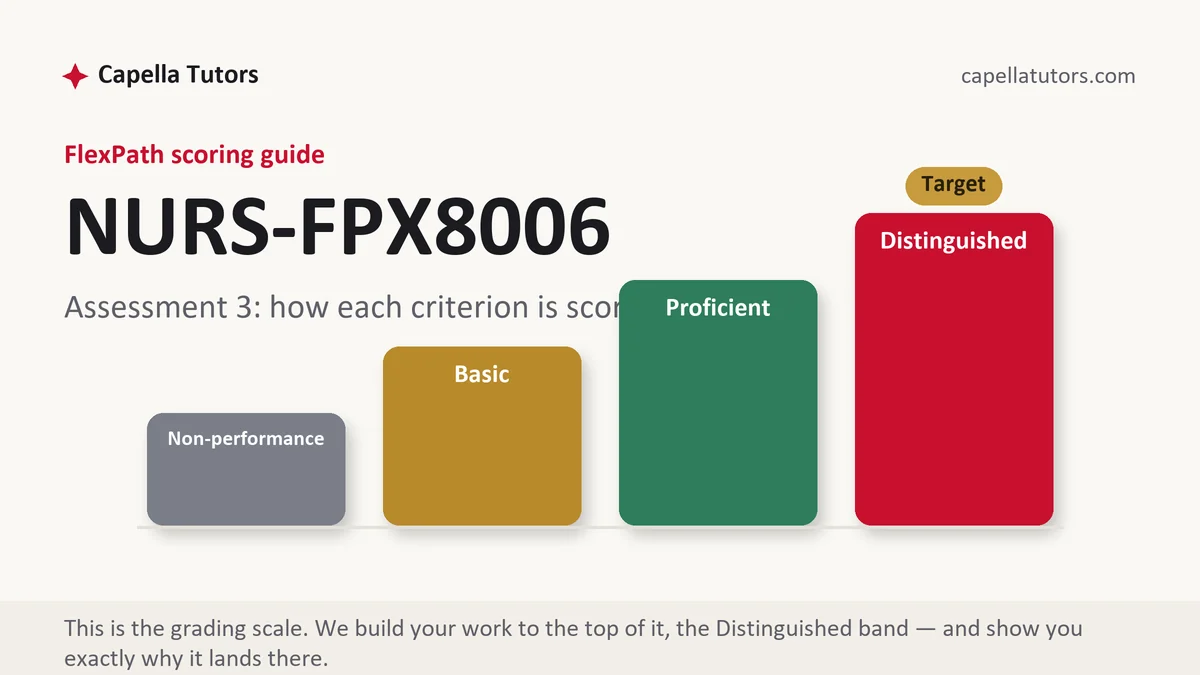
How NURS FPX 8006 Assessment 3 is scored
Criteria are marked one at a time on a four-level scale, and a strong section cannot lift a missing one. Use the wording as a build specification:
| Level | What it means on a translation plan |
|---|---|
| Distinguished | A change model is applied to your setting rather than described, the measure is one the organization already reports, a baseline exists before implementation, and the gap between the evidence and your site is named by you. That naming is usually the criterion's extra reach. |
| Proficient | A sensible recommendation with an evaluation attached. Workable, and resting on a measure nobody has confirmed can be pulled. |
| Basic | A recommendation that stops at what the literature suggests, with implementation described as education and awareness. |
| Non-performance | No evaluation plan, or no change model, leaving criteria with nothing to assess even where the appraisal was strong. |
The test that predicts this score is whether somebody could start on Monday. If the plan does not say who does what, at which point in the workflow, recorded where, the implementation criterion has nothing to grade.
The NURS FPX 8006 Assessment 3 method, step by step
-
State what the appraised evidence licenses, and what it does not
Open by carrying the appraisal forward in two sentences: the claim the body of evidence supports at the strength it supports it, and the claim you are not making. Everything proposed afterward has to sit inside the first sentence.
-
Find the measure before you design the change
Ask which existing report contains the number, who runs it, and how often. A proposal resting on data nobody can pull loses the evaluation criterion however good the reasoning is, and switching measures late rebuilds the whole plan.
-
Get the baseline in hand first
Pull the current value with its denominator and window before implementation begins. Without a baseline the project cannot report a change, and a retrospective baseline assembled afterwards is the weakest sentence in most submitted plans.
-
Apply a change model rather than naming one
Take the model's own stages and write your project into each, cited to the publication that introduced it and never to the textbook chapter summarizing it. A model mentioned once in an introduction is decoration the criteria do not pay for.
-
Write the workflow so it could be staffed
Who performs the step, at which point in the encounter, where it is recorded, who is notified when it does not happen, and what gets dropped to make room. Name the failure points yourself before a reviewer finds them.
-
Close the gap between the evidence and your site
If the strongest study ran in an academic center with a dedicated project nurse and you work in a 40-bed community hospital, that difference belongs in your own sentence, with what you would monitor to catch it early. Then self-score every criterion and submit early in the week.
A structure that maps to the criteria
The word targets are the planning split our tutors use for a doctoral translation plan of usual length rather than a Capella instruction; adjust toward the criterion your guide spends the most words on.
| Section | What it must do | Guide |
|---|---|---|
| What the evidence supports | Carry the appraisal forward as a bounded claim, with the conclusion you are declining to draw stated alongside it. | ~200 words |
| Setting and readiness | The unit, its population, the current process, and the specific barriers that will meet this change on that unit. | ~250 words |
| Change model applied | The model's stages written against your project, cited to its originating publication and not to a summary. | ~300 words |
| The workflow | Owners, triggers, documentation, escalation, and what existing work is displaced to make room. | ~300 words |
| Evaluation plan | Process and outcome measures with denominators, the baseline in hand, the window, and the body that reviews the result. | ~250 words |
| Sustainability and references | What keeps the change alive after attention moves on, plus current APA matched in both directions. | ~150 words |
Annotated sample excerpt
An original model passage from our doctoral desk, showing an evaluation plan written so an operations reviewer could sign it. Study the moves, then build yours.
The process measure is the share of step-down admissions receiving a documented delirium screen within twelve hours of arrival, pulled from the existing nursing documentation report that the quality office already runs each Monday.1 Baseline over the preceding eight weeks is 112 of 341 eligible admissions, or 32.8 percent, and the target is 75 percent by week sixteen, reviewed at the unit practice council monthly and at the quality committee at weeks eight and twenty.2 The evidence behind screening comes from units with a dedicated delirium champion, which this unit does not have, so uptake by week six is the number I would watch to detect the difference while there is still time to respond.3
- 1Names the measure, its denominator, and the report it comes out of. A measure nobody can pull is the fastest way to lose the evaluation criterion.
- 2A baseline already in hand, a dated target, and two named review bodies. Proficient plans have a target; top-column plans have a baseline and an owner as well.
- 3States the gap between the studied settings and this one, then converts that worry into an early indicator rather than into a limitations paragraph at the end.
The full premium sample for your exact assessment, written fresh to your scoring guide and issue, is free to request. Study it, revise it into your own voice, and submit work you understand.
The five mistakes that cost Distinguished
- A plan that ends at the literature. Concluding that the evidence supports a practice is the halfway point, not the deliverable.
- Education as the intervention. Teaching people about a change is a step inside implementation, never the mechanism that sustains it.
- A measure nobody can pull. If the data does not already exist somewhere, the evaluation plan is a proposal to collect data instead of a plan to evaluate.
- No baseline before implementation. Without a starting value the project cannot report change, only assertions about it.
- A change model named and abandoned. Stages that never touch your project are a citation, not an application.
Pre-submission checklist
- The bounded claim from the appraisal opens the plan, with the refused claim beside it
- Every stage of the change model is written against this specific project
- The workflow names owners, triggers, documentation and what is displaced
- The measure comes from a report that already exists, with its denominator stated
- A baseline value and a dated review body appear before implementation begins
- The evidence-to-setting gap is named, with an early indicator to detect it
Translation plan due and no measure you can defend?
Send the appraisal, the setting and the criteria. We fix the measure, the denominator and the reporting source before drafting, then return a premium original sample built to the Distinguished descriptors in 24 to 48 hours, with free rewrites until your evaluator signs off.