This manual is for NURS FPX 8006 Assessment 2, start to submission. The middle deliverable in this course usually asks you to appraise what the search returned: each study read in the order it was built, methods before findings, quality of the individual study kept apart from strength of the body of evidence, and effects converted into numbers a clinician can actually weigh. Appraisal runs on arithmetic more than on adjectives, and the criteria are checking whether you know the difference. What follows is our doctoral desk's method, a structure keyed to the criteria, and an annotated sample excerpt. Prefer to delegate? A premium original sample for this deliverable arrives in 24 to 48 hours, rewritten free until the criteria are met. Capella's catalog lists the course as NURS-FPX8006, and some courserooms print NURS8006; both point to this same Assessment 2.
One honesty note before the manual: Capella revises courses and scoring guides over time, so always write to the exact scoring guide attached to your assessment in the courseroom. The course identity above is verified on capella.edu; the method and structure below are our tutors' approach to it, not Capella's official rubric text.
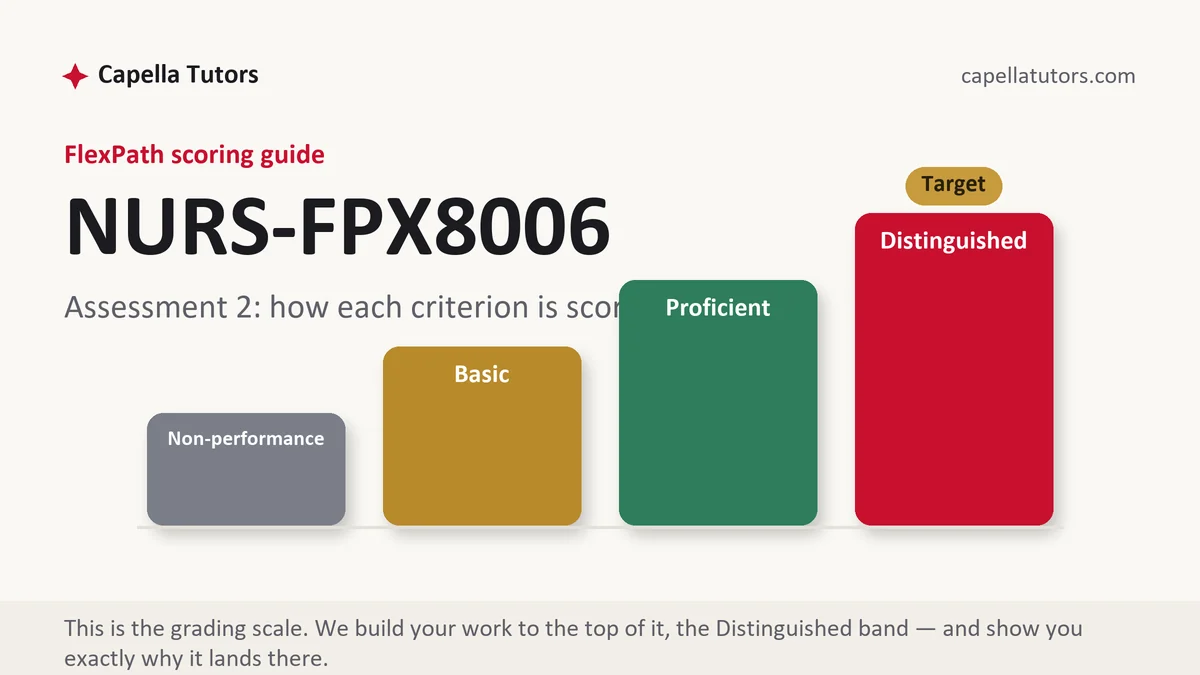
How NURS FPX 8006 Assessment 2 is scored
One judgment per criterion, four possible levels, no rounding between them. The descriptions tell you which appraisal behaviors have to be visible:
| Level | What it means on an evidence appraisal |
|---|---|
| Distinguished | Study quality and body strength are judged separately, effects are converted into absolute terms, and the disagreement in the evidence is settled on design. The extra reach lives in that adjudication; make it on purpose. |
| Proficient | Each study appraised correctly with its limitations noted. Accurate, and the reader still has to work out what the whole set adds up to. |
| Basic | Findings summarized with the word rigorous attached, methods mentioned after results if at all. Common, and the ceiling is structural. |
| Non-performance | A required element is absent, usually the evidence table or any appraisal of design at all, leaving only description on the page. |
An interval tells you what a study rules out, and that is the sentence most drafts never write. A relative risk of 0.75 with an interval from 0.58 to 0.97 supports a claim of benefit; the same point estimate spanning 0.48 to 1.18 does not, whatever the abstract says.
The NURS FPX 8006 Assessment 2 method, step by step
-
Read each paper in the order it was built
Who was enrolled, who was excluded, how many were lost by the end, what was compared, and whether the people measuring the outcome knew which group they were looking at. Only after those answers do the findings mean anything.
-
Fill the evidence table before writing a sentence
One row per study: design, setting, sample, measure, effect with its interval, and the limitation that matters most. Every claim later in your paper should be traceable to a row, and conflicting rows should sit where a reader can see them together.
-
Convert relative effects into absolute ones
An outcome in 12 percent of controls and 9 percent of an intervention group is three percentage points absolute, a quarter in relative terms, and roughly 34 patients treated for one to benefit. Then say whether 34 is worth the cost on your unit.
-
Keep study quality and body strength as two judgments
A careful review of six small unblinded trials is a careful review of weak evidence, and one large well-conducted trial can outweigh an older pooled analysis of poor ones. Effects that shrink as quality rises are the signature of bias rather than of a real benefit getting smaller.
-
Appraise qualitative work on its own terms
Sampling, saturation, reflexivity and the audit trail are the questions, not the absence of a control group. Interview studies answer things no trial can reach, including why a protocol is abandoned by week three.
-
Verify every number against its source
Check each effect size, interval and sample figure back against the full text rather than the abstract. A misquoted statistic is the one error in this course a faculty evaluator can confirm in thirty seconds. Then self-score and submit early in the week.
A structure that maps to the criteria
The figures below are our tutors' planning split for an appraisal of standard doctoral length, not a Capella requirement; weight them toward whichever criterion your guide details most heavily.
| Section | What it must do | Guide |
|---|---|---|
| Question and included set | Restate the question and say what came through screening, so the reader knows which evidence is being appraised. | ~150 words |
| Evidence table | One row per study with design, setting, sample, measure, effect and interval, and the limitation that matters most. | table |
| Appraisal of individual studies | Method before finding for each one, with the specific reason a study can or cannot support your claim. | ~400 words |
| Strength of the body | Consistency across settings, the pattern between quality and effect size, and what the set as a whole can carry. | ~300 words |
| Numbers a clinician can use | Absolute differences, numbers needed to treat, and rates given their denominators and windows. | ~250 words |
| Limits and references | Where the evidence runs out relative to your setting, plus current APA matched both ways. | ~200 words |
Annotated sample excerpt
A model appraisal paragraph from our team, written to show the arithmetic doing the work. Read it for method, then write your own against your own table.
The strongest study in this set randomized 1,340 women with hypertensive disorders of pregnancy at four hospitals to remote blood pressure monitoring or to standard postpartum follow-up, with outcome assessors blinded to allocation and 6 percent lost by the twelve-week endpoint.1 Readmission for hypertension occurred in 7.4 percent of the standard group and 4.6 percent of the monitored group, an absolute difference of 2.8 percentage points and roughly 36 patients monitored for one readmission avoided.2 It carries the claim about readmission and does not carry the claim I would rather make, since the trial ran in academic centers with a dedicated follow-up nurse and reported neither device return rates nor results by insurance status.3
- 1Design, sample, allocation, blinding and attrition arrive before a single result. This is what appraising means, and it is the order most drafts invert.
- 2Reports both group rates, then converts to an absolute difference and a number needed to treat, so a reader can weigh the effect rather than admire it.
- 3Says exactly which claim this study supports and which it cannot, naming the setting gap and the missing equity data. Volunteered limits earn the criterion.
The full premium sample for your exact assessment, written fresh to your scoring guide and issue, is free to request. Study it, revise it into your own voice, and submit work you understand.
The five mistakes that cost Distinguished
- Results before methods. A finding with no design attached cannot be appraised, only repeated.
- A p value standing in for a magnitude. Significance and magnitude are different questions, and a big sample makes the first one cheap.
- Quality and strength collapsed together. Judging the body of evidence by the best study in it overstates what the set supports.
- A rate missing its denominator or its window. Such a number cannot be compared to a benchmark or to your own baseline.
- A study met inside somebody else's review. Citing what you have not read is the fastest way to inherit an error you cannot see.
Pre-submission checklist
- Every study is introduced by design, sample and attrition before its results
- The evidence table carries an interval and a limitation for each row
- At least one effect is converted into absolute terms with a number needed to treat
- Individual study quality and overall body strength are stated as separate judgments
- Qualitative work is appraised on sampling and saturation rather than discounted
- Every statistic verified against the full text, references matched in both directions
Appraisal due and the numbers will not behave?
Send the question, the studies and the criteria. You get the evidence table as a separate file, every statistic checked back against its full text, and a premium original sample inside 24 to 48 hours from an eight-person pipeline with two quality passes.