This manual is for NURS FPX 8006 Assessment 1, start to submission. The opening deliverable in this course usually asks you to name what kind of work you are proposing, frame a practice question every element of which can be searched, and produce a search another person could run and reproduce. Getting the classification wrong is expensive, because research, evidence-based practice and quality improvement travel different review pathways and are permitted different conclusions. Here is the sequence our doctoral desk works in, a plan tied to the criteria, and an annotated sample excerpt. Rather have it built for you? A premium original sample written to this exact assessment is back inside 24 to 48 hours, with free revisions until your evaluator agrees. Capella's catalog lists the course as NURS-FPX8006, and some courserooms print NURS8006; both point to this same Assessment 1.
One honesty note before the manual: Capella revises courses and scoring guides over time, so always write to the exact scoring guide attached to your assessment in the courseroom. The course identity above is verified on capella.edu; the method and structure below are our tutors' approach to it, not Capella's official rubric text.
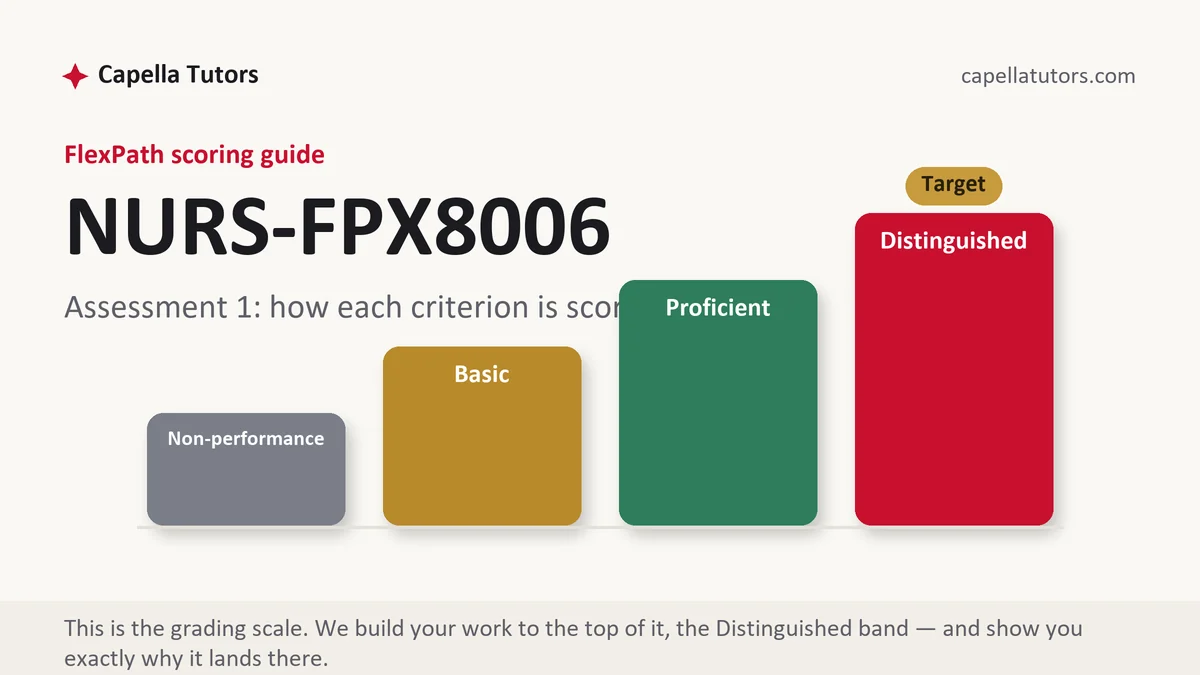
How NURS FPX 8006 Assessment 1 is scored
Each criterion gets its own verdict at one of four levels, independent of the others. The level text is a description of work you can either show or not show:
| Level | What it means on a question and search deliverable |
|---|---|
| Distinguished | The activity is classified and the label defended, the question is searchable element by element, and the search reports its exclusions with reasons attached. That last reach is written into the criterion; perform it deliberately. |
| Proficient | A sound question and a competent search described accurately. Correct, and not yet reproducible by a stranger holding only your page. |
| Basic | A topic rather than a question, and a paragraph saying which databases were used. It reads as convenience sampling of the literature. |
| Non-performance | A required element is missing, most often the screening counts or the classification of the activity itself. |
Read the criteria as verbs. Formulate, search, appraise, translate. Each one names an artifact you must produce evidence of having made, which is why this deliverable cannot be written in a single pass from reading to prose.
The NURS FPX 8006 Assessment 1 method, step by step
-
Decide what kind of work this is, and defend the label
Knowledge meant to generalize beyond your site is research. Applying existing evidence to the care your unit delivers is evidence-based practice. Moving a local process toward an accepted standard is quality improvement. Name yours in the first paragraph, then say why the other two labels do not fit.
-
Build the question so every element is searchable
The population with its boundaries, the intervention as it would actually be delivered, the comparison you measure against, the outcome with the instrument that captures it, and the window in which you expect change. A question missing any of those cannot be searched, and the vagueness travels downstream into everything else.
-
Search vocabulary and free text separately, then combine
Subject headings catch papers your keywords miss, and keywords catch papers not yet indexed. Name the databases you used, and for nursing that usually means CINAHL, MEDLINE through PubMed and the Cochrane Library, plus a guideline source.
-
Record the strings while you run them
Write down each string, the limits, and the design filters as you go. Ten minutes recorded live becomes two hours of reconstruction afterwards, and a reconstructed search is usually wrong in ways a librarian can see.
-
Keep the count trail and justify the exclusions
Records identified, records screened, full texts read, studies included, with a sentence explaining what left at each stage and why. That trail is the difference between an appraisal and a reading list, and it is cheap to produce.
-
Check the question against what you found
If the search returned four hundred records or eleven, the question is mis-scoped rather than the literature deficient. Adjust the boundaries, rerun, and report the version you kept. Then self-score each criterion and submit early in the week, since evaluations can take two business days.
A structure that maps to the criteria
These counts are the planning allocation our tutors use for a doctoral search deliverable of ordinary length rather than a Capella rule; expand whichever section your scoring guide describes in the most detail.
| Section | What it must do | Guide |
|---|---|---|
| Problem and setting | The local problem with a count, its denominator, and the report the count came out of, sized before any question is asked. | ~250 words |
| Classification of the work | Research, evidence-based practice or quality improvement, named and defended against the two labels you rejected. | ~200 words |
| The practice question | Each element specified separately, with the outcome tied to the instrument that measures it and a stated timeframe. | ~200 words |
| Search strategy | Databases, controlled vocabulary and keyword strings, limits, and the inclusion and exclusion rules written before screening began. | ~350 words |
| Screening and yield | The count at each stage with reasons for exclusion, and a short statement of what the yield says about the question. | ~250 words |
| Next steps and references | What appraisal will do with this set, plus current APA matched in both directions. | ~150 words |
Annotated sample excerpt
An original model passage from our doctoral desk, written to show what a searchable question looks like when it is fully specified. Take the structure, then write yours.
Among adult medical-surgical inpatients at a 260-bed community hospital, does a virtual nursing model in which a remote registered nurse performs admission history, discharge teaching and documentation review, compared with the current all-bedside staffing model, change time to discharge teaching completion and bedside nurse retention at twelve months?1 This is evidence-based practice rather than research: the intent is to apply findings that already exist to how this hospital staffs its units, not to produce knowledge meant to generalize elsewhere, and a determination to that effect was requested from the organization's review office before the search began.2 The search was limited to acute inpatient adult settings and to work published in the last five years, which excludes the ambulatory telehealth literature deliberately, because the staffing question there is not the same question.3
- 1Every element is present and searchable: bounded population, intervention described as it would be delivered, an explicit comparison, two outcomes with measures, and a window.
- 2Classifies the work, defends the label against the alternative, and records that a determination was sought. Doing this in the question section prevents a redesign later.
- 3States an exclusion and the reasoning behind it. A search that names what it deliberately left out reads as designed; a long reference list with no rule behind it reads as a keyword harvest.
The full premium sample for your exact assessment, written fresh to your scoring guide and issue, is free to request. Study it, revise it into your own voice, and submit work you understand.
The five mistakes that cost Distinguished
- The activity labeled wrongly. Calling practice change research, or the reverse, sends the whole proposal down a review pathway that does not fit it.
- A topic sitting where a question belongs. Nurse burnout cannot be searched; a bounded population with an intervention and an outcome can.
- An outcome with no instrument. If nothing in the question says how the outcome is measured, no search string can find studies that measured it.
- Databases named and strings withheld. A reader cannot reproduce a search from a list of database names.
- Exclusions counted but not explained. Numbers leaving at each stage mean nothing without the rule that removed them.
Pre-submission checklist
- The activity is classified in the opening and the rejected labels are addressed
- Every element of the question is separately specified and searchable
- The outcome names the instrument that captures it
- Search strings, limits and filters appear on the page, database by database
- Screening counts run from records identified to studies included, with reasons
- Self-scored at the top level on every criterion, references matched both ways
Question due and the search keeps sprawling?
Send the practice problem and the criteria. You get the search log with databases, strings, limits and screening counts, plus a premium original sample in 24 to 48 hours written to the Distinguished descriptors. Revisions stay free until the guide is met.