This manual is for NURS FPX 6626 Assessment 3, start to submission. Send the guide and we return a premium original sample inside 24 to 48 hours, revised free until it satisfies the criteria. Assessment 3 in this course usually asks for the document that decides whether coordination work happens: a proposal to people with budget authority, carrying staffing, cost, benefit, and a plan for surviving after launch. Your scoring guide decides the format, the length, and whether a presentation accompanies it. What follows is how our tutors build an executive proposal a finance reader could check, the section map the criteria imply, and an annotated excerpt. Capella's catalog lists the course as NURS-FPX6626, and some courserooms print NURS6626; both point to this same Assessment 3.
One honesty note before the manual: Capella revises courses and scoring guides over time, so always write to the exact scoring guide attached to your assessment in the courseroom. The course identity above is verified on capella.edu; the method and structure below are our tutors' approach to it, not Capella's official rubric text.
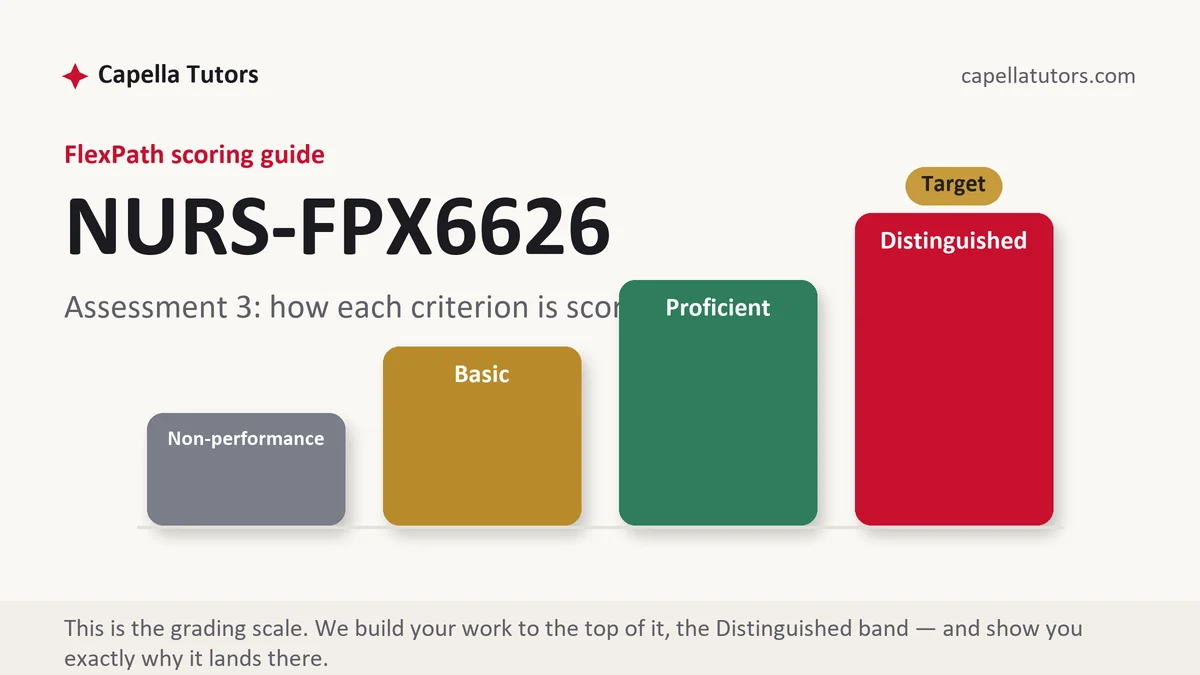
How NURS FPX 6626 Assessment 3 is scored
Levels are assigned criterion by criterion, and on an executive proposal they separate like this:
| Level | What it means on an executive proposal |
|---|---|
| Distinguished | The ask is explicit and priced, staffing is derived from activity arithmetic, hidden costs are included, the benefit case uses published figures, and sustainability is written as mechanisms with owners. |
| Proficient | A credible proposal with a budget and a benefit argument, resting on round numbers whose derivation the reader has to trust rather than check. |
| Basic | A description of a worthwhile program with one salary line and a closing paragraph about commitment to sustainability. |
| Non-performance | A required element is missing, usually the budget itself, the evaluation plan, or the sustainability section the criterion names. |
Executive criteria are graded on whether the document could be approved. State the amount, the term, and the decision you want on the first page, because a proposal that makes a reader hunt for the ask has already lost the communication criterion.
The NURS FPX 6626 Assessment 3 method, step by step
-
Open with the ask, the amount, and the return
First paragraph: what you want approved, what it costs for how long, what it is expected to produce, and when the organization would know. A safety-net system reading a proposal for a community health worker team should have all four facts before the second page, along with the population and the measure that will judge the program.
-
Build the cost side until it stops being flattering
Salary is the smallest part of an honest budget. Add benefit load as a stated percentage, recruitment, training time before productivity, supervision hours, mileage or transit costs for community visits, phones and devices, interpretation, the analyst time behind the dashboard, and any registry or platform fee. Use published wage data from federal labor statistics for the salary lines and label every estimate as an estimate.
-
Derive staffing from activity arithmetic, not from a round number
A caseload figure is a claim that needs working. Write what a community health worker does per patient per month, how long each activity takes, how much travel time a county's geography imposes, and how many patients the arithmetic therefore allows. Then state what happens at referral peaks and during a vacancy, since a plan that only works fully staffed has never worked anywhere.
-
Make the benefit case with published figures and visible arithmetic
Show the calculation rather than asserting a return. Use peer-reviewed evaluations of community health worker programs for effect direction and magnitude, published avoided-cost figures for the value of a prevented admission, and the payer mix that decides who actually captures the saving. Say plainly which portion of the benefit accrues to the system, which to the payer, and which to the patient, because a proposal that hides that split invites the one question it cannot answer.
-
Write sustainability as mechanisms with owners and dates
Sustainability is not a commitment, it is a set of artifacts: the role written into a job description rather than carried as a special assignment, the workflow embedded in orientation, the measures moved onto a standing dashboard with a named owner, an annual review with authority to stop the program, and a named successor for your own role. Attach a date and an owner to each one.
-
Have someone check the arithmetic, then self-score the proposal
Give the budget to a colleague who has no stake in it and ask them to find a number that does not follow from the numbers above it. Fix what they find. Then read each criterion, mark your own level honestly, and rewrite anything short of the top before submitting early enough to use the evaluator's comments inside the same session.
A structure that maps to the criteria
Planning proportions our tutors use for a master's executive proposal, not Capella requirements; your scoring guide decides the weighting.
| Section | What it must do | Guide |
|---|---|---|
| Executive summary and ask | The decision requested, the amount, the term, the expected result, and the date it would be known. | ~200 words |
| Problem and population | The coordination gap in numbers, the patients it harms, and the organizational exposure it creates. | ~250 words |
| Program design in brief | Roles, the coordination activities they perform, and the referral and eligibility logic, at proposal depth. | ~300 words |
| Staffing and budget | Activity arithmetic behind the caseload, then full cost lines with sourced wage data and labeled assumptions. | ~350 words |
| Benefit case and evaluation | The calculation, its sources, who captures the benefit, and the measures that will judge the program. | ~300 words |
| Sustainability and references | Mechanisms with owners and dates, the stopping condition, and APA 7 sources including agency and wage data. | ~250 words |
Annotated sample excerpt
An original excerpt from our team, showing a budget passage written to be checked rather than believed. Adapt the method to your own numbers.
Each community health worker carries an average of six contacts per patient per month, roughly forty minutes of contact and twenty minutes of documentation and follow-up per contact, which consumes about six hours per patient per month.1 Against 120 available productive hours per month after supervision, training, and county travel time estimated at 15 percent, the arithmetic supports an active caseload of twenty patients per worker, not the thirty a round number would suggest.2 Two workers therefore cover forty active patients, and at a referral rate of eighteen per month with an average enrollment of four months the program reaches steady state in the second quarter, at which point the waiting list becomes the argument for a third position rather than a reason to raise caseloads.3
- 1The caseload is derived, not asserted, and the derivation is visible in one sentence. Budget criteria at master's level are graded on exactly this, whether a reader can reproduce your number.
- 2The estimate is stated as a percentage and the flattering alternative is named and rejected. Choosing the less convenient number and showing why is what makes the rest of the budget credible.
- 3The growth path is written as a decision the executive committee will face, which turns arithmetic into planning and sets up the sustainability section that follows.
The full premium sample for your exact assessment, written fresh to your scoring guide and issue, is free to request. Study it, revise it into your own voice, and submit work you understand.
The five mistakes that cost Distinguished
- The single-line budget. One salary, no benefit load, no training time, no devices, no analyst hours, no interpretation costs.
- Round-number caseloads. A ratio asserted because it sounds standard, with no activity arithmetic anywhere behind it.
- Borrowed savings. A published avoided-cost figure applied to your population with no adjustment and no note of who captures it.
- Unsourced wages. Salary lines invented rather than taken from published wage data, which is the first number a finance reader checks.
- Sustainability as sentiment. A closing paragraph about ongoing commitment, with no job description, no dashboard owner, and no stopping condition.
Pre-submission checklist
- The ask, the amount, the term, and the expected result all on the first page
- Every cost line present, including training time, devices, travel, and analyst hours
- Caseload derived from activity arithmetic a reader could reproduce
- Wage and avoided-cost figures cited to published sources, assumptions labeled
- Benefit split stated between system, payer, and patient
- Sustainability written as mechanisms with owners and dates, plus a stopping condition, and the draft self-scored
Proposal going to people who read budgets?
Send the scoring guide, the program you are proposing, and any cost ceiling you have been given. A premium original sample comes back inside 24 to 48 hours with the arithmetic visible, the sources named, and sustainability written as mechanisms, then revised free until it meets your guide.