This manual is for NURS FPX 6626 Assessment 2, start to submission. Hand it to us and a premium original sample arrives inside 24 to 48 hours, written to your scoring guide and revised free until it lands in the target column. Assessment 2 in this course usually asks for the leadership work itself: a change plan, a governance structure, or an implementation strategy for a coordination program you do not have the authority to command into existence. Your scoring guide decides the deliverable and its audience. Below is how our tutors build a change plan that survives a real organization, the section map the criteria imply, and an annotated excerpt. Capella's catalog lists the course as NURS-FPX6626, and some courserooms print NURS6626; both point to this same Assessment 2.
One honesty note before the manual: Capella revises courses and scoring guides over time, so always write to the exact scoring guide attached to your assessment in the courseroom. The course identity above is verified on capella.edu; the method and structure below are our tutors' approach to it, not Capella's official rubric text.
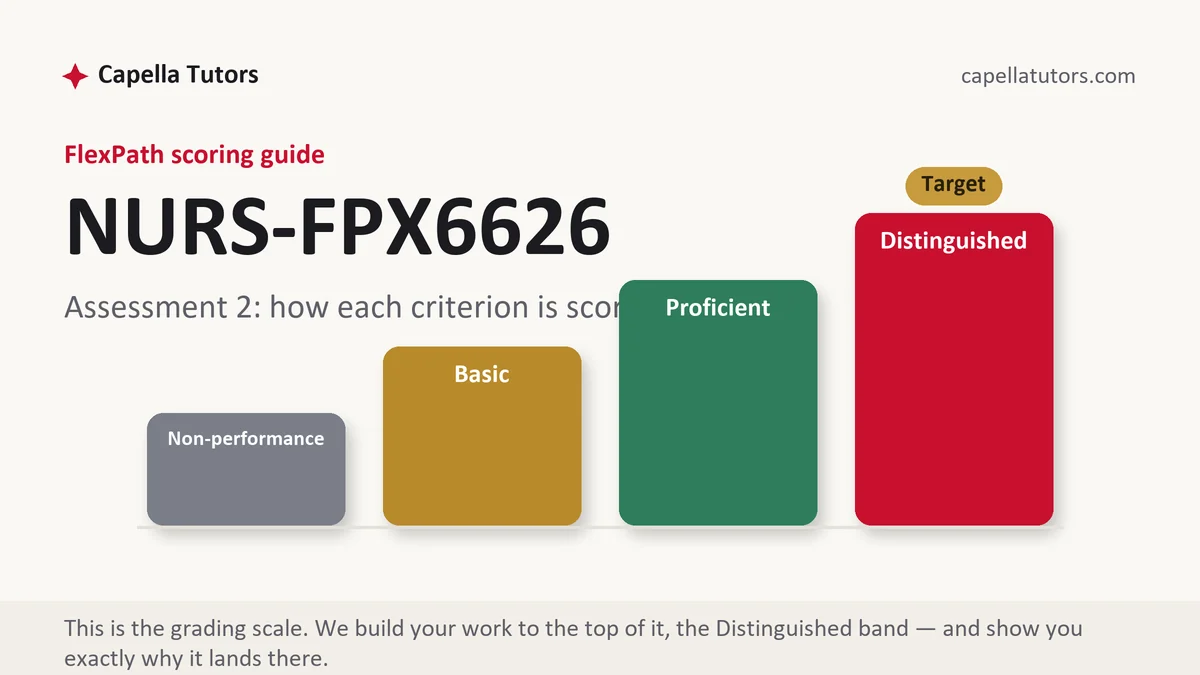
How NURS FPX 6626 Assessment 2 is scored
Each criterion lands on one of four levels, and on a change and governance plan they read like this:
| Level | What it means on a change leadership plan |
|---|---|
| Distinguished | One framework drives the sequence, governance is written as a charter with decision rights and a tie-breaker, resistance carries a name and a reason at every stage, and the plan states what happens when a partner declines. |
| Proficient | A coherent staged plan with a governance structure and stakeholder attention, assuming cooperation at the points where the plan most needs to survive refusal. |
| Basic | A framework named in a literature review, a timeline of activities, and a closing paragraph about the importance of leadership support. |
| Non-performance | A required element never appears, commonly the governance detail, the stakeholder strategy, or the framework the criterion asks you to apply. |
The criteria are testing whether you understand influence without authority. A plan whose hardest sentence is about scheduling has not met the subject of the course, and a plan that says what happens when the hospitalist group refuses has.
The NURS FPX 6626 Assessment 2 method, step by step
-
Choose one framework, attribute it properly, and say why it fits
Pick a single change framework and cite the work that introduced it rather than a secondary description: Lewin's field theory writing for unfreezing and refreezing, Kotter for a staged organizational sequence, Rogers for adoption across many individuals. Then justify the fit in one sentence. A joint program between a health system and a managed care plan, where two organizations must align before anyone changes a habit, is a coalition problem rather than an adoption problem.
-
Write the governance charter before the timeline
Charter first: purpose, membership by role from both organizations, meeting cadence, what the group decides versus what it recommends, who breaks a tie, and where a deadlock escalates. Two-organization programs fail at exactly this seam, so name the escalation path to a specific executive on each side. A timeline written before a charter is a list of hopes with dates attached.
-
Stage the plan and give every stage a named resistance
Work the framework stage by stage, and at each stage write who resists, why they are right to worry, and what you will do about it. Hematology clinicians will resist a case manager rewriting a pain plan they defend against skepticism daily. The plan's utilization review nurses will resist a program that lowers admissions they are measured on approving. Resistance with a face and a reason is what the criterion pays for.
-
Decide in advance what happens when a partner declines
Write the refusal branch. If the emergency departments will not adopt the shared individualized care plan, the program runs on outpatient infusion access and clinic outreach alone, at reduced effect, and the plan says so with the revised expectation attached. Leaders who name a fallback read as credible; plans that assume universal participation read as first drafts.
-
Build the communication plan by audience and forum
Different audiences need different arguments in different rooms. Executives need the contract and penalty exposure, clinicians need the case for their own patients, front-line staff need to know what changes on their Tuesday. Specify the forum and the frequency for each, since a message with no forum is a message nobody receives.
-
Run the plan through a bad quarter, then self-score
Test it against three plausible shocks: a key champion leaves, the payer delays the data feed by four months, and a merger consumes executive attention. Adjust the sequence so the plan degrades rather than dies. Then walk the guide criterion by criterion, give yourself an honest level on each, and spend your last day on whichever one came out weakest.
A structure that maps to the criteria
Section proportions our tutors plan around for a master's change plan, not Capella rules; the criteria in your guide decide what grows.
| Section | What it must do | Guide |
|---|---|---|
| Case for change | The coordination gap, the population, and the contractual or financial exposure that makes acting urgent now. | ~250 words |
| Governance | The charter: membership by role, decision rights, cadence, tie-breaking authority, and escalation on both sides. | ~300 words |
| Framework and stages | One cited framework applied stage by stage, with the objective and the artifact each stage produces. | ~400 words |
| Stakeholders and resistance | Named resistance at each stage, the reason behind it, and a specific affordable response. | ~350 words |
| Refusal branches and communication | What the plan becomes if a partner declines, plus the message, forum, and frequency for each audience. | ~250 words |
| References | APA 7, frameworks cited to their originating publications, agency material credited to the issuing body. | as needed |
Annotated sample excerpt
An original excerpt from our team showing how a stage of a change plan reads when the resistance is real. Reuse the pattern, not the sentences.
Stage three builds the coalition inside the health system, and the person who has to be won is the hematology section chief, not the chief nursing officer who already agreed.1 Her objection is specific and legitimate: an earlier utilization program applied a length-of-stay target to patients in vaso-occlusive crisis, and she reads shared case management as that program returning under a friendlier name.2 The response is structural rather than persuasive. The charter gives her section a standing seat with authority over individualized pain plan content, the case managers hold no utilization targets and their goals appear in the charter appendix, and the first quarterly report includes the two measures she chose herself.3
- 1The stage names the individual who matters and dismisses the easy win. Identifying whose agreement is load-bearing is the leadership judgment the criterion is written to detect.
- 2The objection is grounded in a specific institutional history and conceded as legitimate. Resistance treated as rational produces responses that work; resistance treated as an obstacle produces a communication plan that does not.
- 3The response is written into governance rather than into tone. Structural answers to political problems are what separate a leadership plan from a persuasion essay.
The full premium sample for your exact assessment, written fresh to your scoring guide and issue, is free to request. Study it, revise it into your own voice, and submit work you understand.
The five mistakes that cost Distinguished
- The decorative framework. A change model summarized in the literature review, then abandoned when the plan section starts.
- Frameworks from second hand. Lewin or Kotter cited through a textbook, when both are available in the writing that introduced them.
- Governance as a meeting. A steering committee named with no decision rights, no tie-breaker, and no escalation path.
- Generic resistance. Staff may be resistant to change, with nobody named and no reason given that anyone could answer.
- No refusal branch. A plan that assumes every department participates, which is the assumption the course exists to remove.
Pre-submission checklist
- One framework chosen, cited to its original publication, and justified in a sentence
- Governance written as a charter with decision rights, tie-breaker, and escalation named
- Every stage carries a named resistance, its reason, and a specific response
- The refusal branch written, with the reduced expectation stated openly
- Communication specified by audience, message, forum, and frequency
- The plan tested against three shocks, APA 7 verified, draft self-scored at the top level
Change plan due and the politics are the hard part?
Send the scoring guide and the two organizations or departments involved. A premium original sample comes back inside 24 to 48 hours with the charter written, the stages worked, and the resistance named, then revised free until it clears your guide.