This manual is for NURS FPX 6426 Assessment 3, start to submission. Our desk turns this deliverable into a premium original sample within 24 to 48 hours, with revisions running at no charge until your guide is met. Assessment 3 of NURS FPX 6426 moves from what is needed to how it goes live and what happens afterward. Your scoring guide decides the format, and the assessment usually asks for an implementation plan with the operational half attached: the sequence and the cutover, the testing that proves the build matches the requirements, the training and support model, and the monitoring and optimization work that runs once the project team has gone. Capella's catalog lists the course as NURS-FPX6426, and some courserooms print NURS6426; both point to this same Assessment 3.
One honesty note before the manual: Capella revises courses and scoring guides over time, so always write to the exact scoring guide attached to your assessment in the courseroom. The course identity above is verified on capella.edu; the method and structure below are our tutors' approach to it, not Capella's official rubric text.
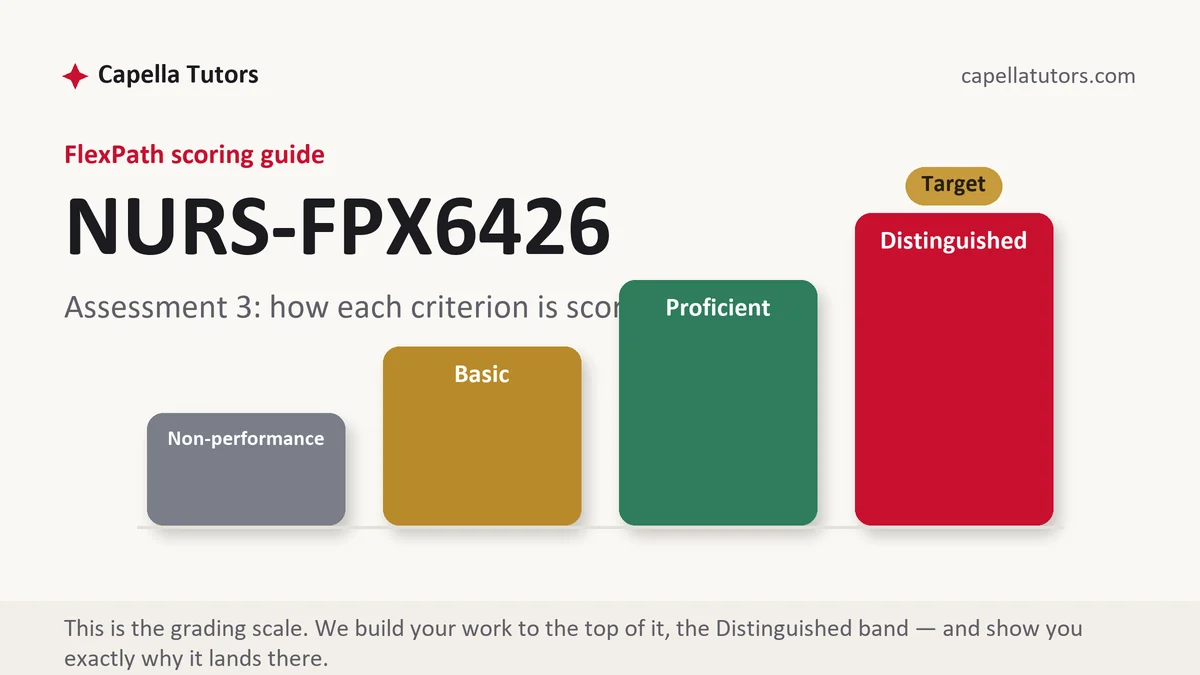
How NURS FPX 6426 Assessment 3 is scored
Four levels per criterion, and on an implementation plan the levels sort by whether the plan anticipates its own failures:
| Level | What it means on an implementation and optimization plan |
|---|---|
| Distinguished | Testing traced to requirements, a cutover with a rollback point and a named decider, a support model with hours and escalation, and an optimization schedule with the metrics that trigger a change. |
| Proficient | A sequenced plan with training and go-live support described. Competent, and short of the top, because the plan assumes it works. |
| Basic | A phase list with dates and responsibilities, described at a level anyone could have written before the analysis. Frequent, and capped. |
| Non-performance | A required element is unaddressed, most often the evaluation approach or the risk mitigation. |
Implementation is where informatics projects are judged, and the judgment happens in the first two weeks. Plans that treat go-live as the finish line produce a system that technically works and operationally does not, which is why the optimization half of this deliverable carries as much weight in the criteria as the launch half.
The NURS FPX 6426 Assessment 3 method, step by step
-
Trace every test to a requirement
Build the test plan as a table with the requirement, the test, the expected result, the tester, and the date. Every requirement gets at least one test, and every test names the requirement it proves. Untraced testing is how a build passes and still fails the people who asked for it, and traceability is inexpensive to add while the requirement set is still open.
-
Test the exception paths, not the happy path
The main workflow will work. Write scenarios for the situations that break systems: the patient who is not in the schedule, the device that will not pair, the reading that arrives outside the plausible range, the order placed while the patient is being transferred, the shift change mid-task. The SAFER guides published by ONC on healthit.gov are a useful frame for the safety-relevant cases people forget.
-
Choose the cutover shape and name the rollback
Say whether you are piloting, phasing by unit, or going live everywhere at once, and defend the choice against one alternative. Then write the rollback: the point after which reverting becomes impossible, who decides before that point, and what condition would trigger the decision. A cutover with no rollback decision is a plan that has made its riskiest choice by omission.
-
Design support around the first two weeks
Specify who is available, in person or by phone, on which shifts, for how many days, and how a nurse reaches them in under two minutes. Include the night and weekend coverage that is usually left out, and name the escalation path for an issue that cannot be fixed at the elbow. Support intensity in the first fourteen days predicts adoption more reliably than the quality of the training deck.
-
Make optimization a schedule, not a promise
Set the review points, at two weeks, six weeks, and three months, and say which metrics get reviewed at each: adoption against an eligible denominator, task completion time against baseline, exception path usage, and the volume and category of support tickets. State the threshold at each review that would trigger a build change rather than more training.
-
Write the evaluation so it could show failure
Name the outcome measure, its denominator, the baseline you established in the analysis phase, the target, the review date, and the person who reports it. Then say how you would tell a genuine improvement from a change in documentation practice, and what result would count as the project not having worked. Cite the peer-reviewed implementation literature and AMIA or HIMSS material in current APA.
A structure that maps to the criteria
Word targets below are our tutors' planning proportions for a plan of this scope, not Capella rules; expand wherever your scoring guide asks for more.
| Section | What it must do | Guide |
|---|---|---|
| Scope and sequence | What goes live, where, in what order, and the reason that order was chosen over an alternative. | ~250 words |
| Test plan traced to requirements | Requirement, test, expected result, tester, and date, including the exception scenarios. | ~300 words |
| Cutover and rollback | The cutover shape, the point of no return, the decider, and the trigger condition for reverting. | ~250 words |
| Training and support model | Who is trained how, then coverage by shift and day for the launch period, with escalation. | ~250 words |
| Monitoring and optimization | Review points with the metrics reviewed at each and the threshold that triggers a build change. | ~250 words |
| Evaluation, risks, references | Outcome measure with baseline and target, the failure signal, top risks, and current APA sources. | ~250 words |
Annotated sample excerpt
An original model excerpt from our team, written the way an implementation plan reads when it has been used before. Study the structure, then write your own around your own launch.
Cutover is phased by clinic rather than by cohort: the two obstetric practices with the highest postpartum volume enroll first, then the remaining four at two-week intervals, chosen over a single launch because the blood pressure cuff supply chain and the nurse triage queue can both be observed under load before they carry all six sites.1 The point of no return is the moment the triage queue routes readings to the new work list, and until then the obstetric medical director may revert with one phone call; the stated trigger is any reading above the escalation threshold that reaches a nurse more than 30 minutes after transmission, in more than 2 of the first 50 transmissions.2 The two-week review examines enrollment as a share of eligible postpartum discharges, transmission rate per enrolled patient per week, and the median minutes from transmission to nurse acknowledgment, with the rule agreed in advance that acknowledgment time above 30 minutes sends the work to build rather than to a training refresher.3
- 1States the cutover shape, defends it against the alternative, and names the two things being observed under load. The reasoning is what earns the criterion, not the sequence itself.
- 2Fixes the point of no return, the single person who may revert before it, and a numeric trigger with a denominator. A rollback written this precisely can actually be used at two in the morning.
- 3Sets the review metrics with denominators and pre-commits to the layer of the fix. Deciding in advance that a threshold sends work to build prevents the reflex of blaming adoption.
The full premium sample for your exact assessment, written fresh to your scoring guide and issue, is free to request. Study it, revise it into your own voice, and submit work you understand.
The five mistakes that cost Distinguished
- Testing the happy path only. The main workflow always passes, and the failures that reach patients live in the exception paths nobody wrote a scenario for.
- Untraced tests. A test plan that cannot be matched to the requirement set proves the build works without proving it does what was asked.
- No rollback decision. A plan that does not name the point of no return and its decider has made its highest-consequence choice by leaving it out.
- Support that ends at five. Launch coverage without nights and weekends guarantees that the shift with the least help forms the first opinion of the system.
- Optimization as good intentions. We will monitor and adjust has no review date, no metric, and no threshold, and the criterion treats it as the absence of a plan.
Pre-submission checklist
- Cutover shape chosen and defended against one alternative
- Every requirement matched to at least one test, with tester and date
- Exception and safety scenarios written, not only the main workflow
- Point of no return, rollback decider, and numeric trigger condition stated
- Support coverage specified by shift and day for the launch period, with escalation
- Review points with metrics, denominators, and thresholds that route work to build
Want the implementation plan drafted?
Send the scoring guide, the change going live, and your requirement set if you have one. Our writers build the traceability table, the cutover and rollback language, and the optimization schedule the criteria look for, then two quality reviewers grade the draft the way a Capella evaluator would. Inside 24 to 48 hours, with free revisions.