This manual is for NURS FPX 6426 Assessment 2, start to submission. Hand this one to us and a premium original sample lands inside 24 to 48 hours, revised free until it meets your guide. Assessment 2 of NURS FPX 6426 is the analysis-phase deliverable. Your scoring guide decides the format, and the assessment usually asks you to convene the people affected by a system change, elicit what they actually need from it, and write the result as requirements: current state described with evidence, needs separated from wants, conflicts between stakeholders named, and each requirement written so that someone could later test whether it was met. Capella's catalog lists the course as NURS-FPX6426, and some courserooms print NURS6426; both point to this same Assessment 2. In current courserooms this assessment typically appears as "Needs Assessment Meeting with Stakeholders".
One honesty note before the manual: Capella revises courses and scoring guides over time, so always write to the exact scoring guide attached to your assessment in the courseroom. The course identity above is verified on capella.edu; the method and structure below are our tutors' approach to it, not Capella's official rubric text.
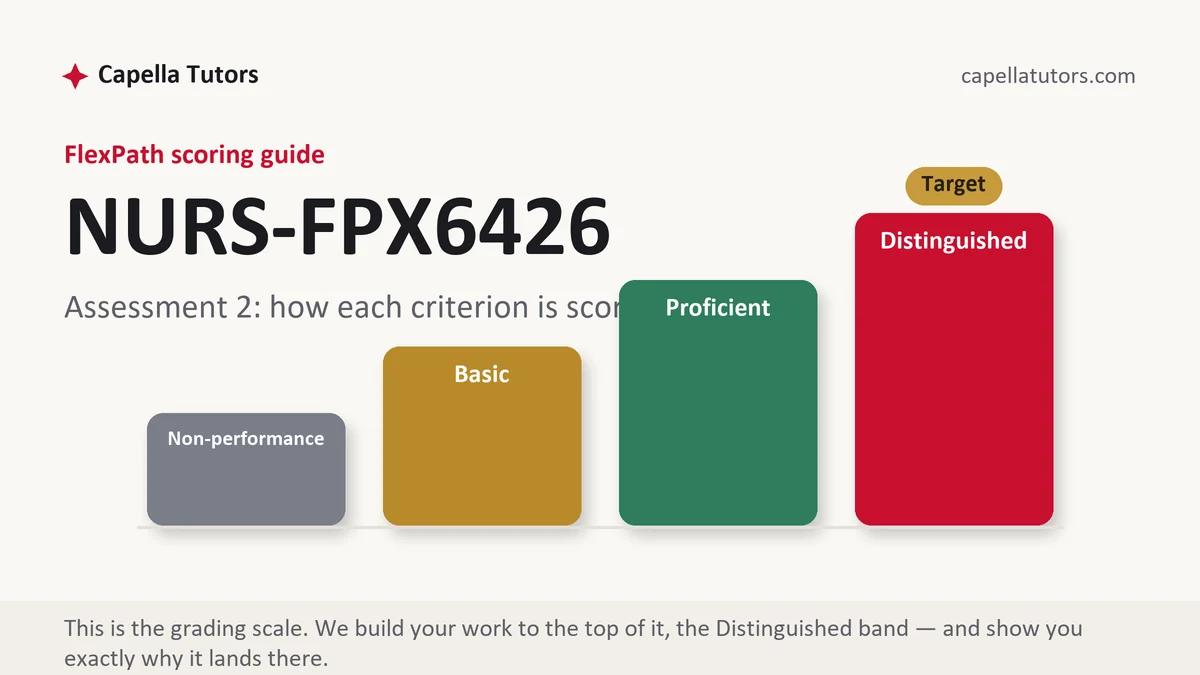
How NURS FPX 6426 Assessment 2 is scored
Four levels per criterion. On a needs assessment the levels separate on whether the output is testable:
| Level | What it means on a stakeholder needs assessment |
|---|---|
| Distinguished | Current state evidenced with counts rather than opinion, each requirement written with an acceptance test, conflicts between stakeholder groups named and adjudicated, and the requirements ranked with the ranking rule stated. |
| Proficient | Stakeholders consulted broadly and needs documented clearly. Careful work, and one move short, because no requirement can be verified after build. |
| Basic | A summary of what everyone said, organized by group, with themes drawn out. Thorough, readable, and capped, since a theme cannot be built. |
| Non-performance | A required element is absent, most often the current-state analysis or the prioritization of needs. |
The reason requirements get written badly is that agreement feels like progress. A room that agrees the process should be easier has agreed to nothing testable, and the build that follows satisfies everyone's memory of the meeting differently. Requirements with acceptance tests are how a needs assessment survives contact with a project plan.
The NURS FPX 6426 Assessment 2 method, step by step
-
Evidence the current state before the meeting
Walk in with numbers: how long the task takes now, how many steps it involves, how often the exception path is used, how many people touch it. Measured current state changes the conversation from complaint to specification, and it gives you the baseline every later evaluation will be compared against. Say how you measured, over what window, and with what denominator.
-
Invite the groups who will absorb the change
Include the people whose work the change makes harder, not only the sponsors who want it. A needs assessment missing the downstream group is the one that produces a requirement set nobody can implement. Record who you invited, who attended, who declined, and which perspective is therefore underrepresented in your findings.
-
Separate the need from the solution
Stakeholders arrive with solutions. Trace each one back to the need underneath it, because a stated solution forecloses design options that may be better and cheaper. Behind a request for a new field there is usually a need to know something at a moment; write the need, and note the proposed solution separately as an input rather than as a requirement.
-
Write each requirement with an acceptance test
The pattern is simple and rarely used: the system shall do X, so that Y, verified by Z. If you cannot write Z, you do not yet have a requirement. An acceptance test also settles disputes without another meeting, because the argument moves from whether a need was met to whether the test passed.
-
Name the conflicts and adjudicate them
Two stakeholder groups will want incompatible things, and the needs assessment that hides that will hand the conflict to the build team. State the conflict, state the interests on both sides, and either resolve it with a stated rule or escalate it to a named decision-maker with a date. This paragraph is where graduate-level judgment is most visible.
-
Rank the requirements and publish the rule
Sort into must, should, and could, and say what determined the sort: patient safety first, then regulatory obligation, then effort against benefit. A ranking with no rule reads as preference. Support the method with recognized material, including AMIA and HIMSS publications on requirements and system selection, the ONC SAFER guides on healthit.gov for safety-relevant requirements, and peer-reviewed informatics literature, in current APA.
A structure that maps to the criteria
The proportions below are how our tutors plan a needs assessment of this length, not Capella requirements; your scoring guide sets the real structure.
| Section | What it must do | Guide |
|---|---|---|
| Purpose and current state | The change under consideration, and the measured baseline with method, window, and denominator. | ~300 words |
| Stakeholders consulted | Groups invited, attended, and declined, with the perspective each one carries and the gaps that remain. | ~200 words |
| Needs elicited | Needs traced back from proposed solutions, grouped by the moment of care they belong to. | ~250 words |
| Requirements with tests | Each requirement written as shall, so that, verified by, and traceable to the stakeholder who raised it. | ~300 words |
| Conflicts and adjudication | Incompatible needs stated, interests named, and each one resolved by rule or escalated with a date. | ~250 words |
| Ranking, limits, references | The priority sort with its stated rule, what the assessment could not reach, and current APA sources. | ~200 words |
Annotated sample excerpt
A model excerpt from our writers, showing what a requirement looks like once it can be verified. Take the pattern and build your own from your own meeting.
Current state, measured across 210 infusion appointments in four weeks: check-in takes a median of six minutes and nine screens, and 38 of the 210 patients waited for a chair that the schedule showed as available, because chair release is recorded by the nurse at the end of documentation rather than at the moment the patient leaves.1 Requirement 4 therefore reads: the system shall show chair status from a release action available at the chairside, so that scheduling reflects availability within two minutes of a patient leaving, verified by ten observed departures in which the schedule updates inside the two-minute window.2 This conflicts with the pharmacy team's requirement that no chair be released until the final infusion record is complete, which protects their reconciliation; the conflict goes to the ambulatory operations director on August 29, with the interests recorded as scheduling accuracy against documentation completeness rather than as a disagreement between two departments.3
- 1Gives the baseline with a denominator, a window, and the mechanical reason for the failure. The measurement is what turns a complaint into a specification.
- 2Writes the requirement as shall, so that, verified by, with a numeric acceptance test. After build, this requirement can be passed or failed without a meeting.
- 3Names the conflicting requirement, states both interests in terms of the work rather than the departments, and escalates to one person with a date. Adjudication written this way is what the top of the guide rewards.
The full premium sample for your exact assessment, written fresh to your scoring guide and issue, is free to request. Study it, revise it into your own voice, and submit work you understand.
The five mistakes that cost Distinguished
- Current state described from memory. A baseline built on impressions cannot support the evaluation that comes later, and the criterion asks how you measured.
- Solutions recorded as requirements. Writing add a field forecloses the design before analysis is finished, and it hides the need that would have justified something better.
- Requirements with no test. Improve efficiency cannot be verified, so it will be declared satisfied by whoever benefits from declaring it.
- Conflicts smoothed over. An unnamed conflict is inherited by the build team at the point where it is most expensive to resolve.
- A ranking with no rule. Priorities presented without the principle that produced them read as the writer's preference rather than as analysis.
Pre-submission checklist
- Current state measured, with method, window, and denominator stated
- Stakeholders invited, attended, and declined all recorded, with remaining gaps named
- Needs traced back from proposed solutions and kept separate from them
- Every requirement written as shall, so that, verified by, with a testable condition
- Conflicts named with interests on both sides, resolved by rule or escalated with a date
- Requirements ranked, the ranking rule published, sources cited in current APA
Need the needs assessment written?
Send the scoring guide and the change you are analyzing, with any baseline numbers you hold. We return measured current state, requirements written with acceptance tests, and the conflict adjudication the criteria are looking for, inside 24 to 48 hours, with two quality passes and free revisions.