This manual is for NURS FPX 6426 Assessment 1, start to submission. Give us the scoring guide and this deliverable returns as a premium original sample within 24 to 48 hours, kept in revision at no cost until the guide is satisfied. Assessment 1 of NURS FPX 6426 opens the course with logistics that turn out to be governance. Your scoring guide decides the fields, and the assessment usually asks you to arrange and document the conversation that establishes your project: which system change you will manage, which life cycle phase you are entering it at, who holds which decision, and what the gate schedule looks like between now and the end of the course. Capella's catalog lists the course as NURS-FPX6426, and some courserooms print NURS6426; both point to this same Assessment 1.
One honesty note before the manual: Capella revises courses and scoring guides over time, so always write to the exact scoring guide attached to your assessment in the courseroom. The course identity above is verified on capella.edu; the method and structure below are our tutors' approach to it, not Capella's official rubric text.
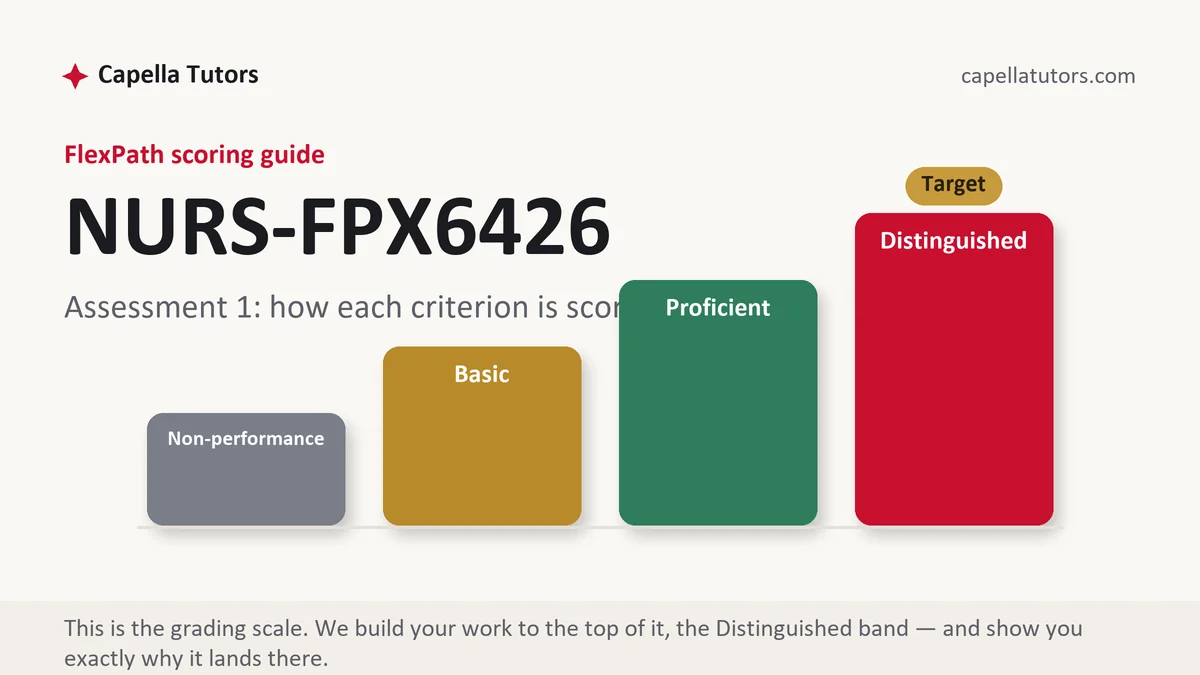
How NURS FPX 6426 Assessment 1 is scored
FlexPath resolves each criterion to one of four levels, and on a charter record the levels sort by how much authority the document actually distributes:
| Level | What it means on a project charter conversation record |
|---|---|
| Distinguished | The project is placed in a named life cycle phase, decision rights are assigned person by person, the gate schedule carries dates, and the record states what would stop the project rather than only what would advance it. |
| Proficient | The project, the participants, and the schedule are documented completely. Organized work, still short of the top, because nobody in it can say no. |
| Basic | A well-kept account of an enthusiastic kickoff, with roles described as involvement. Common, and it caps the criterion, since involvement is not authority. |
| Non-performance | A required element is absent, usually the confirmed attendees or the project scope. A charter with no scope has chartered nothing. |
Life cycle management is the discipline of knowing which phase you are in and refusing to do the next phase's work early. A charter that fails to place the project in a phase produces a course project that designs before it analyzes, which is the most expensive ordinary mistake in health informatics and the one these criteria are built to catch.
The NURS FPX 6426 Assessment 1 method, step by step
-
Place the project in a phase and say so
Name the life cycle model you are working in and the phase you are entering, whether planning, analysis, design, implementation, or evaluation and maintenance. Then state what belongs to that phase and what you are deliberately deferring. A charter that claims all phases at once is a charter that will be rewritten in week five.
-
Convert roles into decision rights
Involved, engaged, and supportive describe feelings. Write instead who approves the requirement set, who approves the build, who approves go-live, who can pause the project, and who arbitrates when two of those people disagree. One person per decision, with a named deputy. Ambiguous authority is what turns a schedule into a negotiation.
-
Set gates with entry and exit conditions
Each gate needs a date, a decider, and a written condition for passing. Requirements signed by the two unit directors is a condition; requirements complete is a wish. Include at least one gate whose condition could fail, because a gate schedule with no possible failure is a timeline wearing a governance costume.
-
Write the stop condition
State what would justify halting the project: a dependency that does not land, a resource withdrawn, a safety signal, a regulatory change. Naming a stop condition early is what makes it possible to use one later, and it reads at graduate level as the single clearest sign that the writer has managed a project rather than described one.
-
Record the dependencies you do not control
List every external item the project needs and who owns it: an interface build, a vendor release, a network change, a policy revision, a training window. For each one, note the date you need it and the date its owner has committed to. The gap between those two dates is your real risk register, and it belongs in the record while people are still in the room.
-
Distribute, log, and cite
Send the charter record to every attendee, invite correction, and log the date. Anchor the role you are taking in the ANA informatics scope and standards material, and cite project and governance sources properly, including AMIA and HIMSS material on informatics project governance and ONC resources on healthit.gov, all in current APA. Administrative deliverables at this level are still graded on their scholarly footing.
A structure that maps to the criteria
The word targets below are our tutors' planning proportions for a charter record, not Capella rules; where your scoring guide supplies a template, the template wins.
| Section | What it must do | Guide |
|---|---|---|
| Project and phase | The system change in scope, the life cycle model, and the phase you are entering it at. | ~200 words |
| Attendees and decision rights | Each participant with the specific decision they hold and their named deputy. | ~200 words |
| Scope and deferrals | What this project includes, what it excludes, and which phase work is deliberately postponed. | ~200 words |
| Gate schedule | Each gate with its date, decider, and written passing condition, including one that could fail. | ~250 words |
| Dependencies and stop condition | External items with owners and committed dates, and what would justify halting the project. | ~250 words |
| Follow-up and sources | Distribution, correction window, next meeting, and standards cited in current APA. | ~150 words |
Annotated sample excerpt
An original model excerpt from our team, written the way a project record earns its authority. Study the moves and build your own charter around your own project.
The project is the virtual nursing admission documentation program on the two medical units at the west campus, entered at the analysis phase, with design work explicitly deferred until the requirement set is signed.1 Decision rights as agreed: the two unit directors jointly approve the requirement set, the clinical informatics manager approves the build, the chief nursing officer approves go-live, and any one of the three may pause the project in writing; the vice president for patient care services arbitrates a split between the directors, and the informatics manager's deputy is the senior analyst on the ambulatory team.2 Three gates carry dates: requirements signed by August 22, a workflow validation session completed with at least eight bedside nurses by September 12, and a go-live decision on October 6 whose stated condition is that the documentation time observed in validation is no longer than the current process, which is the condition most likely to fail.3
- 1Names the phase and the deferral in the same sentence. Refusing design work before requirements are signed is the life cycle discipline the criteria are testing for.
- 2Assigns each decision to one person, records the pause right, names the arbitrator, and gives one deputy. Nothing in this list requires a later conversation to interpret.
- 3Attaches a testable condition to each gate and identifies which condition is at risk. A gate that could fail is what distinguishes governance from a schedule.
The full premium sample for your exact assessment, written fresh to your scoring guide and issue, is free to request. Study it, revise it into your own voice, and submit work you understand.
The five mistakes that cost Distinguished
- No phase named. A project that does not say where it is in the life cycle will design before it analyzes, and the criterion for project planning reads that omission accurately.
- Roles instead of rights. Listing stakeholders as involved leaves every real decision unassigned and every disagreement unresolvable.
- Gates without conditions. A date with no written passing test is a calendar entry, and calendar entries do not govern anything.
- Dependencies without owners. An interface the project needs, with no named owner and no committed date, is the risk that arrives as a surprise in week nine.
- No stop condition. Projects that cannot be halted get finished regardless of what the analysis finds, and naming the halt condition early is what prevents that.
Pre-submission checklist
- The life cycle model and the entering phase named, with deferred work stated
- Every decision assigned to one person, with a deputy and a named arbitrator
- Scope and exclusions written, each exclusion with a reason
- Gates dated, with written passing conditions and one condition identified as at risk
- External dependencies listed with owners, needed dates, and committed dates
- Record distributed with the date logged, standards and governance sources in current APA
Want the charter record built with you?
Send the scoring guide and one line about the system change you are managing. Our informatics writers hold graduate nursing credentials and have chartered projects in real organizations, so the decision rights and gate conditions arrive already written in usable form. Inside 24 to 48 hours, two quality passes, free revisions until it meets the guide.