This manual is for NURS FPX 6422 Assessment 2, start to submission. This deliverable comes off our desk as a premium original sample inside 24 to 48 hours, with revisions free until it meets your guide. Assessment 2 of NURS FPX 6422 sits between arranging the project and analyzing anything. Your scoring guide decides the artifact, and the assessment usually asks you to establish the protections that govern the work before clinical data is touched: the training that qualifies you to handle it, the determination of whether your project is quality improvement or research, and the governance under which the data will move, be held, and be destroyed. Capella's catalog lists the course as NURS-FPX6422, and some courserooms print NURS6422; both point to this same Assessment 2. In current courserooms this assessment typically appears as "CITI Training".
One honesty note before the manual: Capella revises courses and scoring guides over time, so always write to the exact scoring guide attached to your assessment in the courseroom. The course identity above is verified on capella.edu; the method and structure below are our tutors' approach to it, not Capella's official rubric text.
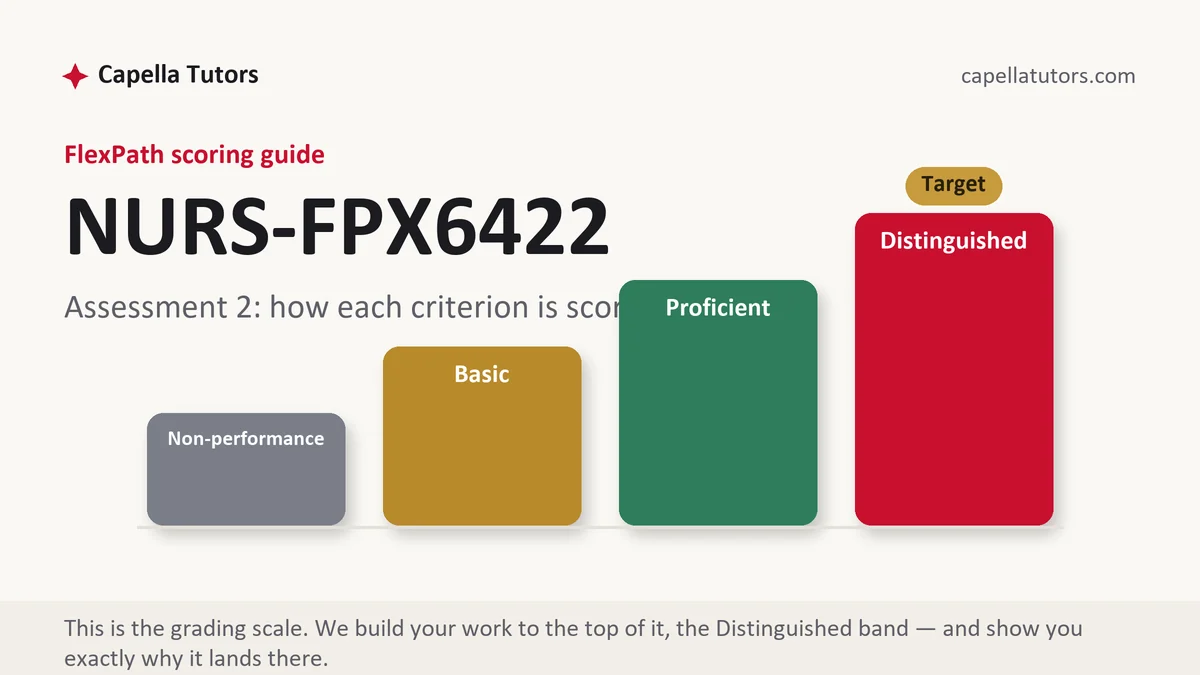
How NURS FPX 6422 Assessment 2 is scored
Four levels, one per criterion, and on a protections deliverable the levels sort by whether the writer applied the framework or summarized it:
| Level | What it means on a protections and data-governance deliverable |
|---|---|
| Distinguished | The quality-improvement or research determination is reasoned rather than asserted, every protection has an owner and an end date, and the writer names a foreseeable harm their own project could do and how it is mitigated. |
| Proficient | Protections are described accurately and the determination is stated. Complete, and short of the top because no risk specific to this project is ever named. |
| Basic | A correct account of research ethics principles with the writer's project attached at the end. Textbook accuracy, capped criterion. |
| Non-performance | A required element is missing, commonly the data handling plan or the determination itself. Absence, not weakness, sets the floor. |
The reason this deliverable exists ahead of the analysis is practical. Once you hold an extract, the decisions about de-identification, storage, and disclosure have already been made by default, and defaults are where informatics projects generate their real harms. Writing the protections first is the difference between a governed project and a governed-afterward project.
The NURS FPX 6422 Assessment 2 method, step by step
-
Reason the determination, do not declare it
Quality improvement and human subjects research are distinguished by intent and generalizability, not by topic or method. Walk the reader through it: whether you are testing a change inside your own system to improve it, whether findings are meant to contribute generalizable knowledge, whether individuals are being assigned to anything. Then state who at your organization makes that determination formally, because in practice it is never the student.
-
Complete the training and cite it as an artifact
Human subjects protections training is documentation, not a formality. Record the modules, the completion date, and the certificate identifier, and then write two sentences on what the training changed about your plan. A protections section that reports training without a single consequence for the project is the version that reads as compliance theater.
-
Write the data handling plan as a sequence
Follow the data from extract to destruction: which fields leave the source system, which identifiers are removed and by whom, whether a link key exists and who holds it, where the file lives, who has access, how long it is retained, and the destruction date. Name the safeguard family under the HIPAA Security Rule that each step satisfies, and give the file a minimum-necessary justification field by field.
-
Name a harm your own project could cause
Every informatics analysis can hurt someone: a unit identified by inference in a small sample, a clinician recognizable from a workflow observation, a patient group whose data quality problem becomes a story about their reliability. State one such harm concretely and say what you changed to prevent it. Evaluators at graduate level read this as the most credible paragraph in the document.
-
Screen the data for equity before you analyze it
If your project touches a model or a score, look at how it performs across the groups it will be applied to before you look at how well it performs overall. Report performance by subgroup with denominators, and remember that a model can hold its overall accuracy while failing badly in a group too small to move the average. Describe the disparity you find in associative language until a design supports more.
-
Cite the governance layer properly
The protections literature has an authoritative core: the Belmont principles, the Common Rule, the HIPAA Privacy and Security Rules, ONC material on healthit.gov, and professional standards including the ANA informatics scope and standards. Peer-reviewed informatics journals and AMIA position papers carry the arguments about algorithmic fairness and secondary data use. Cite regulations and reports in APA 7 form and keep empirical sources current.
A structure that maps to the criteria
These proportions are our tutors' planning targets for a protections document, not Capella requirements; your scoring guide decides the final format.
| Section | What it must do | Guide |
|---|---|---|
| Project and data in one paragraph | What you will analyze and which data it requires, tight enough that a reviewer could rule on it. | ~150 words |
| Determination and its reasoning | Quality improvement or research, argued from intent and generalizability, with the formal decider named. | ~250 words |
| Training and its consequences | Modules completed, date, identifier, and the two things the training changed in your plan. | ~200 words |
| Data handling plan | Extract to destruction, step by step, with owners, safeguard families, and a minimum-necessary justification. | ~300 words |
| Risks and mitigations | One foreseeable harm named concretely, plus the equity screen and what it showed. | ~250 words |
| Governance, limits, references | Which committee holds the project, what the protections cannot prevent, and current APA sources. | ~200 words |
Annotated sample excerpt
An original model excerpt from our team, written the way a governance committee reads. Learn the sequence, then write your own protections around your own data.
Before evaluating the readmission risk model's overall performance, we examined how it behaves in the groups it will be applied to, because a score can hold its accuracy across a whole population while failing inside a group too small to move the average.1 In the 11,204 index admissions from last year, the model's positive predictive value was 0.31 overall, 0.33 among patients with commercial coverage, and 0.19 among the 1,878 patients whose records list a preferred language other than English, which is an association in retrospective data rather than evidence that the model treats those patients differently.2 The foreseeable harm is specific: if the care management team continues to work the score from the top down, the group with the weakest predictive value receives the fewest outreach calls, so we have asked the population health committee to hold any workflow change until the subgroup review is repeated on a fresh quarter.3
- 1States the order of operations and the reason for it. Checking subgroups before overall performance is a discipline the criterion rewards, and the sentence explains why rather than asserting best practice.
- 2Reports each figure against its own denominator and then refuses the causal reading in the same sentence. Associative evidence described in associative language is the clearest signal of graduate training in the whole page.
- 3Names a harm the project itself could cause, traces it through the workflow that would deliver it, and attaches a governance hold with a named committee. Concrete beats conscientious.
The full premium sample for your exact assessment, written fresh to your scoring guide and issue, is free to request. Study it, revise it into your own voice, and submit work you understand.
The five mistakes that cost Distinguished
- The determination asserted. Writing that the project is quality improvement, with no reasoning from intent and generalizability, leaves the criterion's main question unanswered.
- Training with no consequence. A completion date and a certificate number, and nothing in the plan changed by either, reads exactly as the box-ticking it is.
- De-identification as a word. Saying data will be de-identified without naming the fields removed, the key holder, and the retention period is not a plan.
- Risk in the abstract. General statements about protecting confidentiality carry no weight beside one named harm this specific project could do.
- Overall metrics only. A single accuracy figure hides the subgroup where the tool fails, and at master's level an unexamined aggregate is treated as an unfinished analysis.
Pre-submission checklist
- The determination reasoned from intent and generalizability, with the formal decider named
- Training documented with date and identifier, plus two concrete changes it produced
- Data traced from extract to destruction with owners, retention, and destruction date
- Minimum-necessary justification given field by field for the extract
- One project-specific harm named, with its mitigation and the committee holding it
- Subgroup performance reported with denominators, described in associative language
Need the protections document written?
Send the scoring guide and the data your project needs. A research analyst assembles the regulatory and peer-reviewed layers before drafting starts, a subject-matched writer builds the document criterion by criterion, and two quality passes follow. Delivery inside 24 to 48 hours, revisions free until it meets target.