This manual is for NURS FPX 6422 Assessment 1, start to submission. Hand this one to us and a premium original sample arrives inside 24 to 48 hours, revised free until your guide is satisfied. Assessment 1 of NURS FPX 6422 opens the course with a working document rather than a paper. Your scoring guide decides the fields, and the assessment usually asks you to arrange and then document a scheduled conversation that settles what system you will study, which workflow you will follow, who will let you observe it, and what you are permitted to look at. Get the unit of analysis wrong here and every later deliverable inherits the error. Capella's catalog lists the course as NURS-FPX6422, and some courserooms print NURS6422; both point to this same Assessment 1.
One honesty note before the manual: Capella revises courses and scoring guides over time, so always write to the exact scoring guide attached to your assessment in the courseroom. The course identity above is verified on capella.edu; the method and structure below are our tutors' approach to it, not Capella's official rubric text.
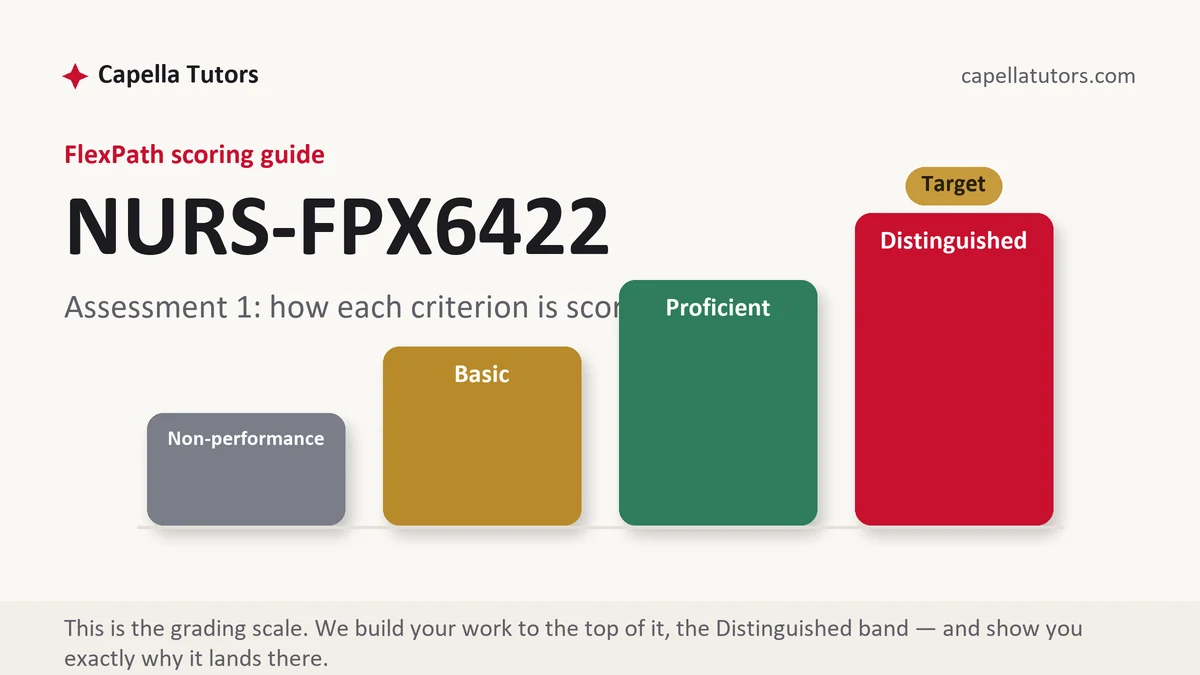
How NURS FPX 6422 Assessment 1 is scored
Grading runs criterion by criterion against four levels, with no letter grade anywhere in the process, and on a scoping record the levels separate on how much of the project the document actually settles:
| Level | What it means on a project scoping and access record |
|---|---|
| Distinguished | One system and one workflow are named, the unit of analysis is defined, observation and data access are approved by named people with dates, and the record states what the group decided not to study. |
| Proficient | The conversation is documented fully and the project is described clearly. Thorough work, still lacking the boundaries that make a scope enforceable. |
| Basic | A courteous account of a productive discussion, with the project described in general terms. It reads well and it caps the criterion, because nothing in it is binding. |
| Non-performance | A required element is absent, most often the confirmed attendee list or the approvals. An unwritten approval scores as no approval. |
Course-level context matters here. NURS FPX 6422 sits in Capella's 27-point FlexPath MSN as a 2-point specialization course, and it is graded on your ability to analyze a live clinical information system rather than to recount using one. A scoping record that leaves the system, the workflow, and the observation rights vague forces that analysis to be written from memory, which is where these courses go wrong.
The NURS FPX 6422 Assessment 1 method, step by step
-
Name the system and the module, not the category
Scheduling system is a category. The specific self-scheduling module, in the specific instance, at the specific sites, is a system you can analyze. Write the vendor-neutral description of it in one sentence, along with the version or release cycle if you can get it, because release timing determines whether a finding you make in week three still exists in week ten.
-
Define the unit of analysis out loud
Decide what one observation is: one shift assignment created, one swap request completed, one open shift filled, one nurse's session. Every later measurement depends on this choice, and groups that skip it end up with counts that cannot be added together. Write the unit into the record as a sentence, not an assumption.
-
Settle observation rights before analysis rights
Workflow analysis means watching people work, and watching people work needs permission from someone who can grant it: a manager for the unit, a charge nurse for the shift, and the users themselves. Record who approved observation, for which sites, in which weeks, and what you agreed not to record. The absence of this paragraph is the most common reason a course project stalls in week four.
-
Ask for the report extract in the same conversation
System data and observed behavior answer different questions, and you need both. Specify the fields, the window, the aggregation level, and the approving owner while the right people are still in the room. Add one sentence on de-identification: what identifiers come out, who holds the key if there is one, and where the extract will live.
-
Write the exclusions down
A scope is defined by what it excludes. State the sites, populations, and questions that are out, and give the reason for each. Exclusions recorded in advance protect you from a faculty question later about why an obvious comparison is missing, and they are the clearest evidence in the document that the group actually made decisions.
-
Set gates, then send the record
Attach a date and a decider to every open item, distribute the notes to attendees, and log the distribution date. Ground the role you are playing in the ANA informatics scope and standards material rather than describing yourself as a liaison, and cite that standards document as a report in APA 7. Administrative deliverables at graduate level are still scored on scholarly support.
A structure that maps to the criteria
The word targets below are the proportions our tutors plan to for a record of this type, not Capella rules; if your scoring guide supplies a template, follow the template.
| Section | What it must do | Guide |
|---|---|---|
| Project purpose | The clinical information system, the module, the sites, and the question the project will answer. | ~150 words |
| Attendees and authority | Everyone present, named with what they can approve: build, schedule, data, or access to staff. | ~120 words |
| Unit of analysis and measures | What one observation is, what will be counted, and over which window. | ~250 words |
| Observation and data access | Who approved watching whom, where, and when, plus the extract fields and their de-identification handling. | ~250 words |
| Scope and exclusions | What is in, what is out, and the stated reason for each exclusion. | ~200 words |
| Gates, follow-up, sources | Dated decision points with named deciders, distribution of the record, and standards cited in current APA. | ~200 words |
Annotated sample excerpt
A model excerpt from our writers, showing how much a single paragraph of a scoping record can actually settle. Study the pattern and build your own around your own project.
Scope: the self-scheduling and shift-swap module of the nurse scheduling system being replaced across the four inpatient units at the north campus, with go-live set for November 3.1 The unit of analysis is one completed swap request, defined as a request that reaches a final approved or denied state, and the measures are median hours from submission to final state and the proportion of requests reaching a final state within 72 hours, counted over the six weeks before and the six weeks after go-live.2 Approvals recorded today: the nurse manager for 2 North and 2 South authorized bedside observation during day shift in weeks two and three, the scheduling system administrator approved a de-identified extract of request timestamps and states with no employee identifiers, and the group excluded the float pool, because its requests route through a separate approval chain and would not be comparable.3
- 1Fixes the system, the module, the sites, and the date in one sentence. Nothing in the later project has to be guessed at from this description.
- 2Defines one observation before naming any measure, then gives both measures a denominator and a symmetric window. Pre-and-post windows of equal length are the detail evaluators check.
- 3Records three different approvals with their scope, and states an exclusion with its reason. The reason is what turns an exclusion into an analytic decision rather than an omission.
The full premium sample for your exact assessment, written fresh to your scoring guide and issue, is free to request. Study it, revise it into your own voice, and submit work you understand.
The five mistakes that cost Distinguished
- A category instead of a system. Analyzing the scheduling system rather than a named module leaves every later finding unlocatable, and the criterion for scope notices immediately.
- No unit of analysis. Counts that mix requests, shifts, and users cannot be combined, and the error surfaces in the assessment where it is most expensive to fix.
- Observation assumed. Watching clinicians work without recorded permission is both an integrity problem and a scoring problem, since the criterion asks who approved what.
- Asymmetric windows. Six weeks before compared against three weeks after produces a difference that means nothing, and reviewers spot the mismatch faster than any other flaw.
- Exclusions left silent. An unexplained gap in the scope reads as an oversight; the same gap with a one-line reason reads as judgment.
Pre-submission checklist
- The system, module, sites, and release timing named in the opening section
- One observation defined explicitly before any measure is introduced
- Observation approvals recorded with approver, sites, and weeks
- Extract fields, window, and de-identification handling stated with the approving owner
- Exclusions listed with a reason attached to each
- Dated gates with named deciders, record distributed, standards cited in current APA
Want the scoping record built with you?
Send the scoring guide and a sentence about the system you are studying. Our informatics writers hold graduate nursing credentials and have run these conversations in real organizations, so the draft comes back with the scope already written in enforceable terms. Two quality passes before you see it, delivery in 24 to 48 hours, and revisions at no cost until the guide is met.