This manual is for NURS FPX 6222 Assessment 5, start to submission. The last graded deliverable in NURS FPX 6222 usually asks you to lead rather than to analyze. Your scoring guide decides the medium, and the assessment typically wants a vision for a change carried to the people who would have to make it, most often as a presentation with speaker notes. The criteria are reading for three things: whether the change is anchored in a named change framework and actually run through it, whether the resistance you would meet is described honestly, and whether the vision ends in measures with owners rather than in aspiration. Underneath are the method, the structure, and an annotated excerpt. Want it built for you? A premium original sample lands in 24 to 48 hours, revised free until your guide is satisfied. Capella's catalog lists the course as NURS-FPX6222, and some courserooms print NURS6222; both point to this same Assessment 5. In current courserooms this assessment typically appears as "Planning for Change: A Leader's Vision".
One honesty note before the manual: Capella revises courses and scoring guides over time, so always write to the exact scoring guide attached to your assessment in the courseroom. The course identity above is verified on capella.edu; the method and structure below are our tutors' approach to it, not Capella's official rubric text.
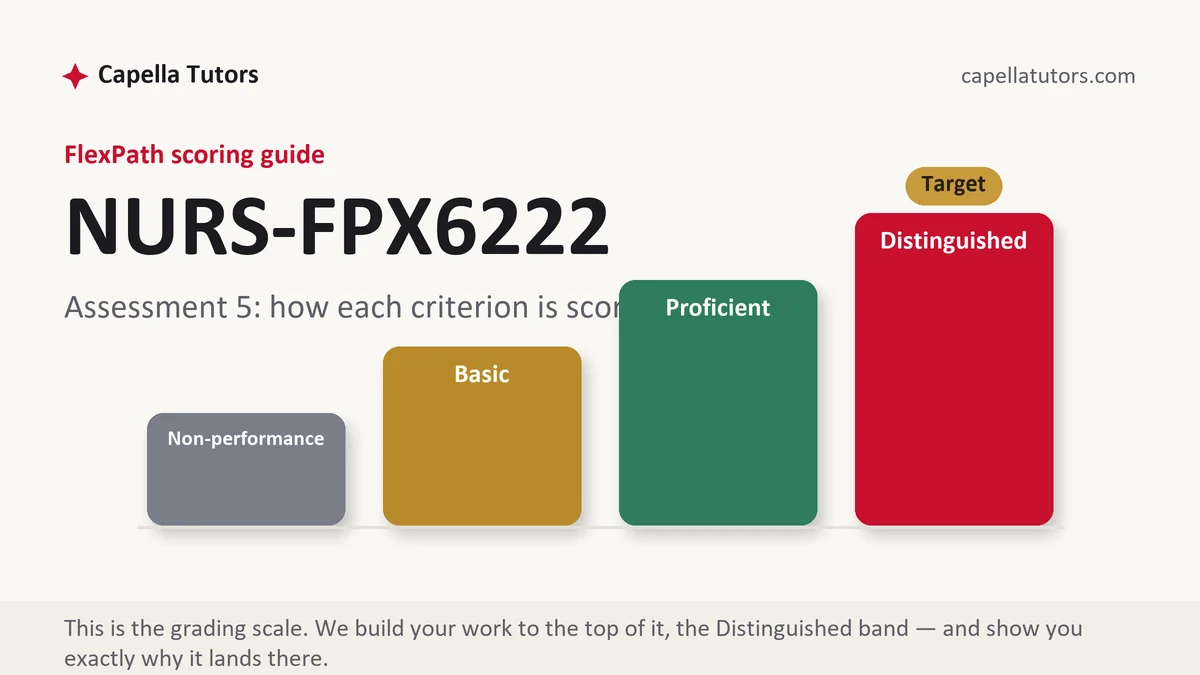
How NURS FPX 6222 Assessment 5 is scored
Criteria are scored individually against four levels, and on a change presentation the levels turn on whether the change has been thought through to Monday:
| Level | What it means on a change leadership presentation |
|---|---|
| Distinguished | A named change model is used rather than cited, resistance is described as a rational response with a specific answer, the measures carry baselines and owners, and the speaker notes argue in full sentences with their citations inside them. |
| Proficient | A clear vision, well supported, with a real plan behind it. What holds it below the top is that resistance is acknowledged in general terms rather than answered in particular. |
| Basic | Enthusiasm with a framework named on one slide and never used again. The change reads as inevitable, which is how staff know it has not been planned. |
| Non-performance | A required element is missing, most often the speaker notes or the evaluation measures, and the criterion drops to the floor. |
Choose the change framework for what it does, then let it do it. A stage model is useful when sequencing and urgency are the problem. An implementation framework is useful when the barrier is adoption at the front line. A rapid-cycle method is useful when the intervention itself is uncertain and needs testing. Naming three models is not scholarship; running one of them properly is, and evaluators can tell the difference by the second slide.
The NURS FPX 6222 Assessment 5 method, step by step
-
Decide what the change is, in one sentence, before you design anything
Every clinician on the service will use one agreed labor management pathway and one agreed indication list for the primary cesarean decision, reviewed monthly against a reported rate. That sentence can be argued with, which is what makes it a change. A vision of improving perinatal outcomes cannot be argued with, and it cannot be implemented either.
-
Anchor the urgency in something external
Internal enthusiasm decays. Payment model movement, a public reporting obligation, an accreditation requirement, or a purchaser's contract condition supplies urgency that outlasts your presence on the project, and the criteria reward a case built on it. Cite the payment or reporting rule from its primary source rather than from a summary of it.
-
Run the change model through the actual work
If you use a stage model, say who forms the guiding coalition and what each member contributes, what the short-term win is and by when, and where the change gets written into policy so it survives the champion leaving. A model applied to the specific service, with names by role and dates, is the difference between using a framework and mentioning one.
-
Describe resistance as rational and answer it in particular
Clinicians resist changes that add documentation, remove judgment, or transfer risk to them without support. Name the objection you would actually hear, in the words you would actually hear it in, then answer it with the mechanism that removes the reason for it. An audience that hears its own objection stated fairly will listen to the answer; an audience told that change is difficult will not.
-
Build the measurement into the vision
Two or three measures, each with a definition, a baseline with its period, a target, a source the organization already produces, an owner by role, and a review forum. Include one balancing measure that would reveal harm from your own change, because a change plan that can only look successful is not a plan, it is advocacy.
-
Write speaker notes that carry the argument
Notes are graded as prose, so each one states the claim, supplies the evidence with its citation, and hands over to the next slide. Keep peer-reviewed research for anything causal and use primary documents for obligations and definitions. Then check the mechanics, since legible type, adequate contrast, sourced figures, and a reference slide in current APA all sit inside the communication criterion.
A structure that maps to the criteria
Slide and note targets our tutors plan against for a presentation of this kind, not Capella rules; follow your guide where it fixes a count.
| Section | What it must do | Guide |
|---|---|---|
| The change, stated | The change in one arguable sentence, the service it applies to, and who is in the room. | 1 slide, ~130 words of notes |
| Why now, from outside | The external driver, cited from a primary source, and the internal baseline it collides with. | 2 slides, ~300 words of notes |
| The framework at work | The change model applied to this service, with the coalition, the sequence, and the policy anchor. | 2 to 3 slides, ~330 words of notes |
| Resistance and answers | The objections in the words they will be raised in, each with the mechanism that answers it. | 2 slides, ~280 words of notes |
| Measures and governance | Measures with definitions, baselines, targets, owners, a balancing measure, and the review forum. | 1 to 2 slides, ~250 words of notes |
| The ask and references | What you want decided, by when, and a reference slide in current APA. | 1 to 2 slides, ~180 words of notes |
Annotated sample excerpt
An original model excerpt from our team, pitched where the top of the guide sits. These are speaker notes, which is where the case is made.
The reason to move this quarter is not on our dashboard, it is in the contract: the service enters a bundled maternity arrangement with its largest commercial purchaser in January, and under a bundle the primary cesarean rate stops being a quality indicator and becomes a cost driver.1 Our primary rate across one thousand nine hundred and forty births is twenty-seven and four tenths percent against the twenty-three and six tenths the state perinatal collaborative reports as its target, and at the four thousand one hundred dollar variable cost difference finance calculates per case, the seventy-four case gap carries about three hundred and three thousand dollars a year that the bundle will hold us to rather than reimburse.2 The objection I expect from this room is the one I would raise: that a rate target in a contract will be felt on the labor floor as pressure to delay a decision that should be made on the monitor, so the pathway we are proposing sets no unit target at all and instead requires a second obstetric opinion only for the two indications where our own case review found the widest variation.3
- 1Urgency comes from a contract rather than from the presenter's conviction, which is the version that survives after the project ends. Naming the date makes the sequencing argument for you.
- 2Rate, denominator, comparison source, and the finance office's own cost figure are all present, and the arithmetic from a three and eight tenths point gap to seventy-four cases to the annual figure is visible. Sourced beats asserted every time in front of a clinical audience.
- 3The objection is stated in the clinicians' own terms and conceded as legitimate, then answered by a design choice that removes the pressure. Refusing a unit-level target while still addressing the variation is the kind of specific answer the top of the guide rewards.
The full premium sample for your exact assessment, written fresh to your scoring guide and issue, is free to request. Study it, revise it into your own voice, and submit work you understand.
The five mistakes that cost Distinguished
- A framework named and abandoned. One slide of change theory followed by generic implementation leaves the criterion that rewards application with nothing to grade.
- Resistance treated as ignorance. Clinicians resist for reasons. Stating the reason and removing it is the work; describing change as hard is not.
- Urgency built on internal enthusiasm. Payment terms, reporting obligations, and accreditation requirements outlast champions, and they can be cited.
- No balancing measure. A plan that cannot show its own harm cannot be trusted, and experienced evaluators look for the measure that would reveal it.
- Notes that narrate the slide. The argument and the citations live in the notes. Reading the bullets aloud forfeits the communication criterion.
Pre-submission checklist
- The change stated in one arguable sentence on the opening slide
- An external driver cited from a primary source, set against an internal baseline
- One change framework applied to the actual service, with coalition, sequence, and policy anchor
- Each objection written in the words it will be raised in, with the mechanism that answers it
- Measures with definitions, baselines, targets, owners, a review forum, and one balancing measure
- Full-sentence speaker notes with citations inside them, and a reference slide in current APA
Presenting a change vision for 6222?
Send the prompt, the criteria, the service, and any figures you can share. We build the deck and the notes together, anchor the urgency in a sourced external driver, run one change framework through the real work, answer the objection you would actually hear, and close on measures with owners. Inside 24 to 48 hours, two independent reads before it leaves the studio, and revisions until the guide is satisfied.