This manual is for NURS FPX 6222 Assessment 2, start to submission. The gap analysis is where NURS FPX 6222 starts grading you as a manager of quality rather than a participant in it. Your scoring guide fixes the format, and the assessment usually asks you to take one process in one setting, compare what happens to what is supposed to happen, and account for the distance between them in a way that points at a control rather than at a person. Two things decide the score: whether the gap is measured against a sourced standard, and whether your explanation of it reaches the latent conditions instead of stopping at the sharp end. Below sit the method, a criterion-mapped structure, and an annotated excerpt. Want it drafted? A premium original sample is back in 24 to 48 hours, revised free until the guide is satisfied. Capella's catalog lists the course as NURS-FPX6222, and some courserooms print NURS6222; both point to this same Assessment 2. In current courserooms this assessment typically appears as "Quality and Safety Gap Analysis".
One honesty note before the manual: Capella revises courses and scoring guides over time, so always write to the exact scoring guide attached to your assessment in the courseroom. The course identity above is verified on capella.edu; the method and structure below are our tutors' approach to it, not Capella's official rubric text.
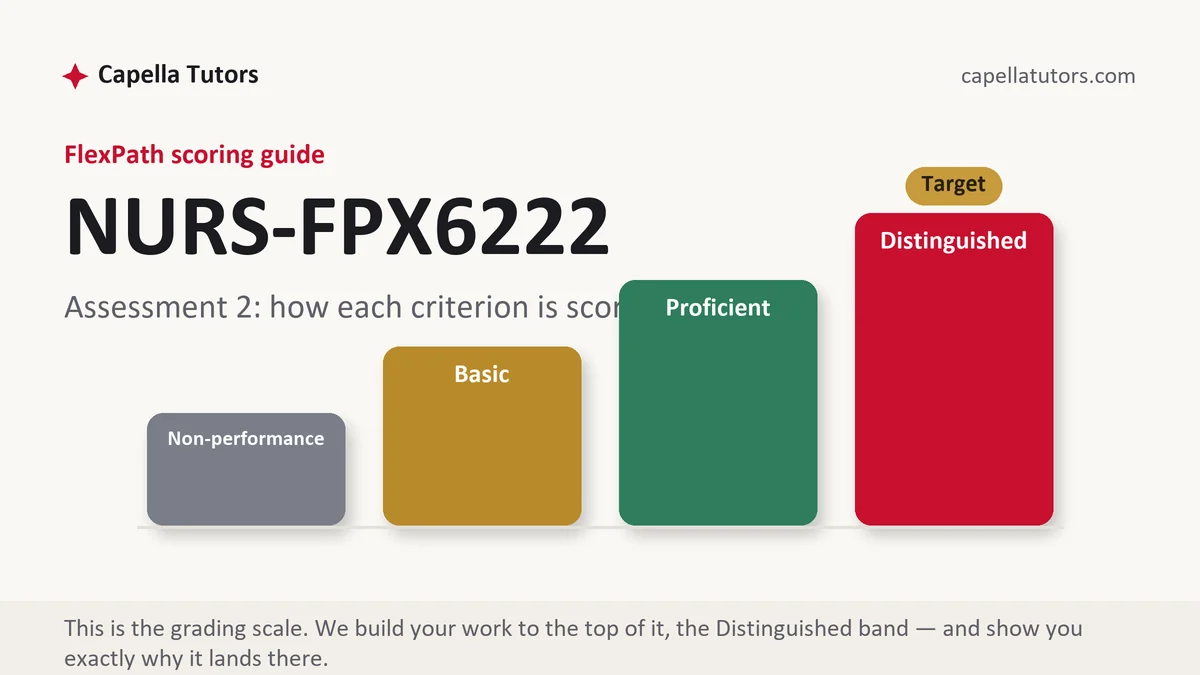
How NURS FPX 6222 Assessment 2 is scored
Each criterion in the guide is placed on one of four levels independently of the others, and on a gap analysis the levels separate measurement from impression:
| Level | What it means on a quality and safety gap analysis |
|---|---|
| Distinguished | The gap is quantified against a standard whose source is named, the contributing factors are ordered by leverage with latent conditions separated from active failures, and the proposed controls are rated for strength with owners and dates attached. |
| Proficient | An accurate, complete analysis with a real gap and sensible recommendations. The ordering is what is missing: factors are listed rather than ranked, so the reader cannot see which one you would fix first. |
| Basic | A description of a problem with education proposed as the remedy. Common, plausible on the page, and the weakest control on the list. |
| Non-performance | A required element is absent, most often the standard the current state is being compared against, which leaves the analysis with nothing to be a gap from. |
One convention carries more weight in graduate quality writing than any other: source the standard rather than asserting it. Compare against a published measure specification, a professional society recommendation, an accreditation requirement, or your own organization's policy, and cite the document. Master's evaluators check what you compared to before they weigh what you concluded, because a gap analysis without a named standard is only a description with a complaint attached.
The NURS FPX 6222 Assessment 2 method, step by step
-
Pick one process, not one category of harm
Infection prevention is a domain; the skin preparation and antibiotic timing steps in colorectal cases are a process. Analyses that take a domain end up unable to say what should change, because domains have no steps to compare. Write the process as a sequence before you write anything else, and the comparison becomes possible.
-
Establish the standard and cite it
Find the document that says what should happen: the surgical care measure specification, the professional society guideline, the accreditation standard, the manufacturer's contact time, or your organization's own policy. Quote the requirement precisely, including timing windows, because most real gaps live in the timing rather than in the omission.
-
Measure the current state rather than describing it
Audit a defined sample, count, and report the denominator. Twenty-two of thirty observed cases is a finding; usually compliant is a rumor. Where the organization already produces the rate, take it from the surveillance report and state the period, the risk adjustment, and the comparison group so the reader knows what kind of number they are holding.
-
Ask why the workaround is rational
Every persistent gap makes sense to the person producing it. Trace the conditions that make the shortcut reasonable: a kit that arrives without the correct agent, a first case scheduled so tightly that the timing window cannot be met, a documentation field nobody reads. Latent conditions are the ones worth naming, because they are the ones a manager can actually change.
-
Rate every proposed control for strength
Say out loud where each action sits: forcing functions and standardized kits at the strong end, protocol and policy change in the middle, reminders and education at the weak end. Propose at least one strong control and describe the weak ones as supplements to it. Then give each action an owner by role and a due date, since an action assigned to the unit cannot be followed up.
-
Close with the audit that proves the fix landed
Name the measure, its numerator and denominator, the sample size, the frequency, who receives the result, and the threshold that triggers escalation. Sustainment is where most improvement work quietly fails, and the criterion that rewards evaluation is asking whether anybody would notice if the change decayed in month five.
A structure that maps to the criteria
Word targets our tutors plan against for an analysis of this kind, not Capella rules; weight the sections your own guide weights.
| Section | What it must do | Guide |
|---|---|---|
| Setting and process | The organization and the specific process, written as a sequence of steps with the volume it runs at. | ~230 words |
| The standard | What is supposed to happen, quoted precisely from a named source, including timing and exclusions. | ~200 words |
| The measured current state | The audit or surveillance result with its numerator, denominator, period, and comparison group. | ~280 words |
| The gap and what it costs | The distance expressed in the measure's own units, converted into events and dollars where the organization holds a figure. | ~250 words |
| Contributing factors | Factors ordered by leverage, with latent conditions distinguished from active failures. | ~300 words |
| Controls, audit, references | Actions rated for strength with owners and dates, the sustainment audit, and current APA both ways. | ~250 words |
Annotated sample excerpt
An original model excerpt from our team, written at the level the top of the guide describes. Study the moves, then measure your own process.
The service performed two hundred and sixty-eight colorectal procedures in the twelve months to May and recorded twenty-one surgical site infections, a rate of seven and eight tenths per hundred procedures against the risk-adjusted comparison the infection prevention department reports from national surveillance, which places the expected count near fifteen.1 Six infections above expectation is a small number that behaves like a large one: at the twenty-two thousand four hundred dollars per case the finance office uses for an infection of this type, the excess carries about one hundred and thirty-four thousand dollars a year, before any readmission penalty exposure is considered.2 The audit narrows where that excess is produced. Antibiotic redosing was documented in twenty-two of thirty observed cases longer than four hours, and in six of the eight missed cases the anesthesia record shows the case began within twelve minutes of room turnover, which is the condition rather than the cause.3
- 1Rate, denominator, period, and the source of the comparison all appear in one sentence. An evaluator can tell immediately what kind of number this is, which is what a sourced standard buys you.
- 2The excess is converted into money using a figure the organization itself holds, and the sentence says whose figure it is. Pricing a gap is what moves a quality paper from advocacy to management.
- 3The audit result carries its denominator and then names the condition producing the failure rather than the staff who produced it. Calling turnover pressure the condition is the sentence the top of the guide is written for.
The full premium sample for your exact assessment, written fresh to your scoring guide and issue, is free to request. Study it, revise it into your own voice, and submit work you understand.
The five mistakes that cost Distinguished
- No standard named. Without a cited requirement there is no gap, only a description. This is the fastest route to a Basic on the analysis criterion.
- A domain instead of a process. Categories of harm have no steps, so nothing can be compared and nothing can be redesigned.
- Compliance reported without a denominator. Mostly compliant is not a measurement. Twenty-two of thirty is, and it can be re-audited in ninety days.
- Education as the whole remedy. Another module for staff who already knew the requirement is the weakest control available and the most common recommendation submitted in this course.
- Actions with no owner and no date. An action assigned to leadership or to the unit cannot be chased, and the accountability criterion is looking for a role.
Pre-submission checklist
- One process written as a sequence of steps, with its annual volume
- The standard quoted precisely from a named and cited source, timing included
- The current state measured with numerator, denominator, period, and comparison group
- The gap converted into events and, where a figure exists, into dollars with its source
- Contributing factors ranked, with latent conditions separated from active failures
- At least one strong control, every action owned by a role with a date, and a sustainment audit defined
Gap analysis open in 6222?
Send the prompt, the criteria, and the process or measure you want to work on. We locate the standard and cite it, build the current state from a defensible sample, rank the contributing factors, and rate every proposed control for strength with owners and dates. Back inside 24 to 48 hours, checked twice before delivery, revised free until your guide is satisfied.