This manual is for NURS FPX 6112 Assessment 3, start to submission. Send the scoring guide and we build the comparison, the criteria, the evidence, the costs, and the recommendation, returned in 24 to 48 hours with revisions until every criterion clears. Assessment 3 of NURS FPX 6112 usually asks you to compare types of simulation technology and recommend one for a defined teaching need. The comparison is the assessment. Two products described in sequence, however accurately, does not answer a criterion that uses the word compare. Below are the method, a structure built from the criteria, and an annotated sample excerpt. Capella's catalog lists the course as NURS-FPX6112, and some courserooms print NURS6112; both point to this same Assessment 3. In current courserooms this assessment typically appears as "Comparison of Types of Simulation Technology".
One honesty note before the manual: Capella revises courses and scoring guides over time, so always write to the exact scoring guide attached to your assessment in the courseroom. The course identity above is verified on capella.edu; the method and structure below are our tutors' approach to it, not Capella's official rubric text.
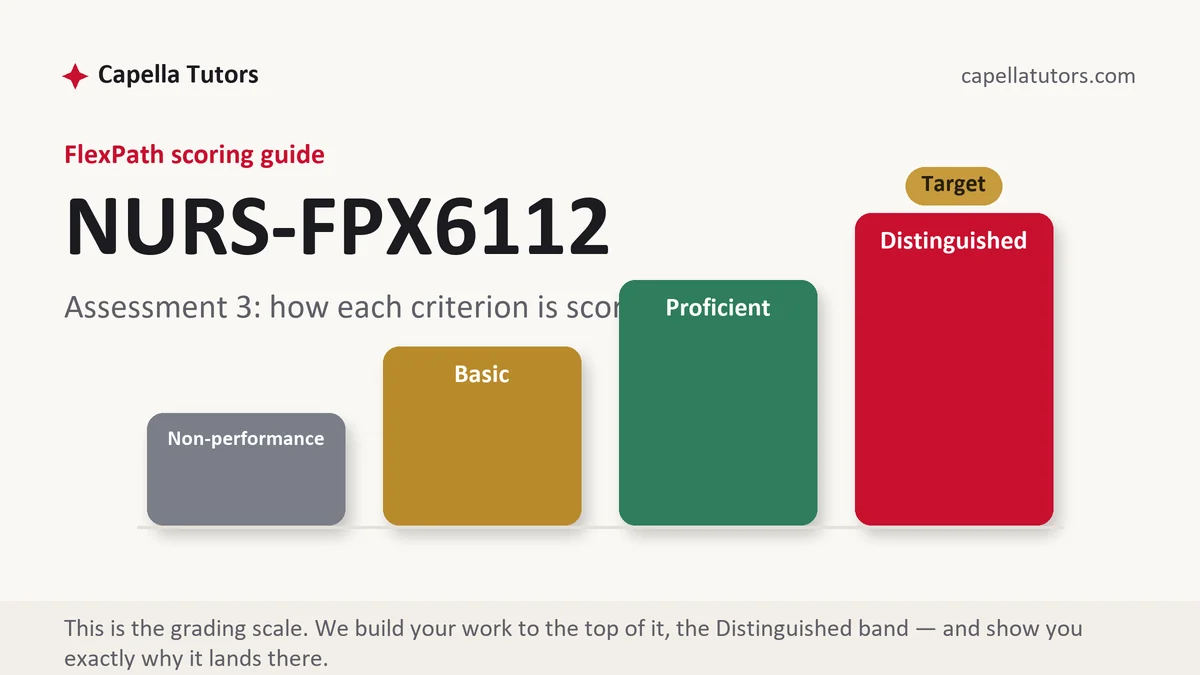
How NURS FPX 6112 Assessment 3 is scored
Each criterion lands on one of four levels, and the level text describes what a defensible comparison contains:
| Level | What it means on a technology comparison |
|---|---|
| Distinguished | The options are judged on the same declared criteria, the evidence for each is weighed by study design and population rather than counted, cost is expressed per learner contact hour, and the recommendation names what the rejected option would have done better. |
| Proficient | Accurate accounts of each option and a sound recommendation. The comparison runs in parallel rather than head to head on shared criteria, which is the step to the top column. |
| Basic | A summary of each technology with a preference at the end, and cost mentioned as expensive or affordable rather than calculated. |
| Non-performance | Only one option is genuinely evaluated, or the recommendation is made with no criteria stated anywhere in the document. |
The comparison that scores is the one that names a real tradeoff. Standardized participants give unmatched authenticity for communication objectives and cost salary per encounter, so they do not scale. Screen based virtual scenarios scale to any number of learners at any hour and cannot assess touch, tone, or a hand on a shoulder. Manikin based work sits between them and consumes a room, a technician, and a calendar. A recommendation that pretends its option has no cost is the one evaluators mark down.
The NURS FPX 6112 Assessment 3 method, step by step
-
Extract the criteria and declare your comparison dimensions
Build the section list from the scoring guide, then state the dimensions you will compare on before describing anything: objective fit, evidence base, learner capacity, faculty burden, cost per learner contact hour, accessibility, and data returned for evaluation. Declared dimensions are what make the rest of the document a comparison rather than two reviews.
-
Define the teaching need in one measured sentence
The comparison needs a target. Say which learners, which objective, and what is currently going wrong, with a number: a proportion of preceptors who avoid corrective feedback conversations, a check off failure rate, a documented delay in escalation. Without the number, both options look equally reasonable and the recommendation has nothing to stand on.
-
Match affordance to the objective's domain
Ask what the objective requires the learner to do. Psychomotor precision requires equipment and repetition. Interpersonal performance under discomfort requires a human being who can react unpredictably. Clinical reasoning under changing conditions requires a case that responds. Where you argue this, name the theoretical frame you are using, whether the experiential cycle Kolb described or the technological pedagogical content knowledge framework from Mishra and Koehler, and cite it where the argument uses it.
-
Weigh the evidence rather than listing it
The literature comparing simulation types disagrees, and handling that is the analysis criterion. Some comparisons find higher clinical judgment scores with greater fidelity, while others find the difference disappears when debriefing quality is held constant, which points at facilitation rather than hardware as the active ingredient. Rank the studies by design and population before you decide, then say plainly what the evidence still cannot settle.
-
Calculate cost per learner contact hour
This single number resolves most arguments in the room. Take acquisition or licensing, faculty and technician time, consumables, and room use, divide by the learner contact hours the option delivers in a year, and show the arithmetic. A standardized participant program at a salary per encounter and a screen based license at a seat price become directly comparable only once the denominator is learner contact hours.
-
Recommend, concede, and stage the decision
State the recommendation in one sentence, name what the rejected option would have done better, and stage the implementation so the concession is partly recovered. Then say how you will know: a knowledge or performance measure with a threshold and a retention point, not a satisfaction score. Conceding the strength of the option you turned down is reliably the move that earns Distinguished.
A structure that maps to the criteria
Word figures are our tutors' planning targets for a comparison of this type, not Capella rules; expand where your scoring guide asks for more.
| Section | What it must do | Guide |
|---|---|---|
| Teaching need, measured | The learners, the objective, and the current failure expressed as a number. | ~200 words |
| Comparison dimensions declared | The criteria you will judge on, stated before either option is described. | ~150 words |
| Option one against the dimensions | Affordances, evidence, capacity, faculty burden, accessibility, and data returned. | ~300 words |
| Option two against the dimensions | The same dimensions in the same order, so the comparison is readable. | ~300 words |
| Cost per learner contact hour | The arithmetic shown for both options, including faculty and technician time. | ~200 words |
| Recommendation and concession | The choice, what the rejected option did better, the staged plan, and the learning measure. | ~250 words |
| References | Current APA, frameworks cited to primary sources, standards as organizational reports. | as needed |
Annotated sample excerpt
Our writers built this model around the arithmetic, which is the part of a comparison most learners leave out.
The objective is that preceptors conduct a corrective feedback conversation with a struggling new graduate, and 19 of the 34 preceptors credentialed last year told the department they avoid that conversation entirely, so the comparison is between standardized participants and a screen based role play product.1 Standardized participants cost 95 dollars per encounter plus 12 hours of faculty facilitation for a cohort of 34, which comes to roughly 38 dollars per learner contact hour and cannot run outside business hours; the licensed product costs 41 dollars per seat annually with no facilitation once built, roughly 7 dollars per learner contact hour, and runs at 0300 for the night shift preceptors who are half the cohort.2 The product wins on arithmetic and loses on the thing that matters most here, since no scripted branch reacts to a preceptor's tone the way a trained participant does, so I am recommending the product for the first two practice cycles and one standardized participant encounter as the summative measure.3
- 1Anchors the comparison in a measured teaching need before any technology appears, which is the order the criteria assume.
- 2Shows the arithmetic on both options and converts price into cost per learner contact hour, then adds the access dimension that price alone hides.
- 3Concedes the rejected option's real advantage and stages the recommendation so both are used where each is strongest. Naming the concession is the Distinguished move.
The full premium sample for your exact assessment, written fresh to your scoring guide and issue, is free to request. Study it, revise it into your own voice, and submit work you understand.
The five mistakes that cost Distinguished
- Two reviews, no comparison. Sequential descriptions with a preference at the end is the most common Basic submission on this assessment.
- Cost as an adjective. Expensive and affordable are not comparisons, and cost per learner contact hour turns the argument into arithmetic anyone can check.
- Fidelity as a proxy for quality. Recommending the more realistic option without reference to the objective's domain ignores the whole point of the course.
- Evidence counted rather than weighed. Four studies on one side and one on the other decides nothing unless design and population are ranked first.
- A recommendation with no concession. An option presented as strictly better than the alternative reads as advocacy, and the judgment criterion goes unearned.
Pre-submission checklist
- Teaching need stated with a number before any technology is named
- Comparison dimensions declared up front and applied to both options in the same order
- Affordance matched to the objective's domain, with the framework cited where used
- Evidence ranked by design and population, with the unsettled question named
- Cost per learner contact hour calculated and shown for both options
- Recommendation with a stated concession, a staged plan, and a learning measure with a threshold
Comparison due, with a cost table you have not built?
Send the scoring guide, the objective in trouble, and any pricing you have. We declare the dimensions, run both options against them, calculate cost per learner contact hour, and write the recommendation with its concession named. Delivery in 24 to 48 hours, revisions until you hit your target, and the first premium sample is on us.