This manual is for NURS FPX 6112 Assessment 2, start to submission. Hand it over and you get a premium original sample written to your scoring guide in 24 to 48 hours, revised free until the criteria clear. Assessment 2 of NURS FPX 6112 usually asks you to evaluate a virtual simulation or online learning activity against the objectives it claims to serve, which means judging a product rather than describing it. The criteria want criteria: a stated basis for the evaluation, applied consistently, with accessibility treated as a graded requirement rather than a closing courtesy. The method, the structure, and an annotated sample excerpt come next. Capella's catalog lists the course as NURS-FPX6112, and some courserooms print NURS6112; both point to this same Assessment 2. In current courserooms this assessment typically appears as "Evaluation of a Virtual Simulation Scenario".
One honesty note before the manual: Capella revises courses and scoring guides over time, so always write to the exact scoring guide attached to your assessment in the courseroom. The course identity above is verified on capella.edu; the method and structure below are our tutors' approach to it, not Capella's official rubric text.
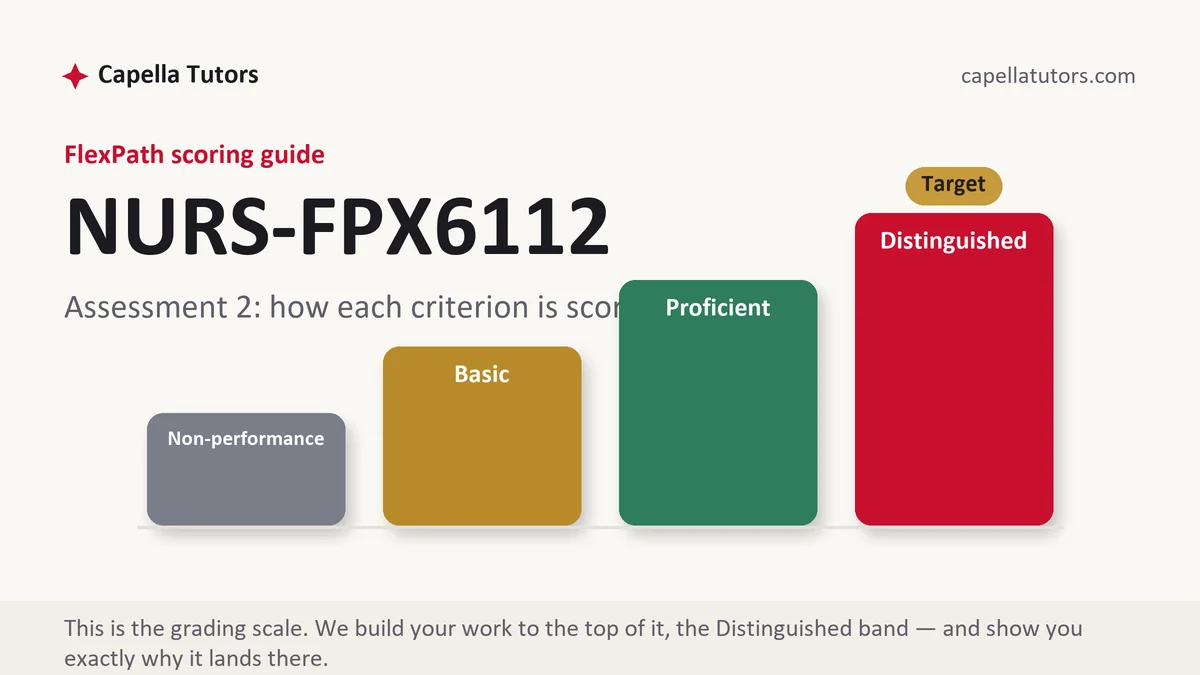
How NURS FPX 6112 Assessment 2 is scored
Each criterion resolves to one of four levels, and the level language tells you what an evaluation has to do:
| Level | What it means on an evaluation of a virtual simulation |
|---|---|
| Distinguished | The evaluation runs on stated criteria drawn from published standards, every judgment cites evidence from the product itself, accessibility is tested against specific success criteria, and the recommendation says what to keep, what to fix, and what the fix costs. |
| Proficient | A thorough and accurate evaluation with sound conclusions. The judgments rest on the writer's expertise rather than on declared criteria, which is the difference at the top. |
| Basic | A description of the product's features with a favorable verdict, and accessibility handled in a sentence of goodwill. |
| Non-performance | A required criterion is unanswered, most often the accessibility review or the evaluation of learning outcomes, and an unanswered criterion scores below a weak answer. |
Two habits separate the top column here. The first is declaring your evaluation criteria before you judge anything, so the reader can check your reasoning rather than trust it. The second is testing accessibility rather than asserting it: captions present and accurate, contrast measured against the 4.5 to 1 ratio for body text, every interaction reachable by keyboard, no instruction that depends on color alone, and a request for the vendor's accessibility conformance report if one exists.
The NURS FPX 6112 Assessment 2 method, step by step
-
Turn the criteria into an evaluation instrument
Read the scoring guide, then build the thing it is asking for: a short instrument with your evaluation dimensions as rows. Alignment to objectives, fidelity appropriate to the cognitive level, feedback quality, debriefing support, accessibility, data the product returns to faculty, and cost per learner. Score each dimension and write the evidence beside it. The instrument is what turns an opinion into an evaluation.
-
Name the objectives the product is supposed to serve
An evaluation with no target is a review. State the course, the module, and the specific objectives the activity is meant to reach, at the level they are written. Then judge the product against those objectives rather than against its own marketing, which is what the alignment criterion is asking you to do.
-
Judge fidelity against cognitive level, and cite the theory
More realism is not automatically better. Where the objective is clinical judgment, the product needs a case that changes in response to decisions and a debriefing structure, and the theoretical warrant is the simulation theory associated with Jeffries plus the clinical judgment model Tanner described. Where the objective is recall, high fidelity adds cognitive load without adding learning, and the load argument traces to Sweller. Cite these where you use them.
-
Evaluate the feedback and the debrief, separately
In a virtual product these are two different things. Feedback is what the software tells the learner during and after the case, and it can be immediate, specific, and tied to the decision or it can be a score. Debriefing is what a facilitator does afterwards, and the product either supports it with a transcript, a decision log, and prompts or it does not. Judge both, because the debrief is where consolidation happens and a product that blocks it is expensive.
-
Test accessibility against named success criteria
Work through the interface rather than the brochure. Captions on all narrated content, transcripts available, text contrast at the published ratio, full keyboard operation with a visible focus indicator, labeled form controls for screen reader users, no timing that cannot be extended, and no meaning carried by color alone. Cite the web content accessibility guidelines and the federal accessibility standard by name, record what you found, and say which barrier you would remediate first.
-
Recommend with a cost and an evaluation plan
Close with a decision: adopt, adopt with modifications, or reject, plus what the modifications cost in faculty hours and licensing. Then say how you would know it worked, using knowledge or performance measures rather than reaction. Where you propose a scored instrument, prefer one with published reliability evidence, and say what the reported values do and do not establish.
A structure that maps to the criteria
Planning figures our tutors use for an evaluation of this shape rather than Capella rules; your scoring guide decides the real weighting.
| Section | What it must do | Guide |
|---|---|---|
| Product and context | The activity evaluated, the course it sits in, and the learners it serves, with numbers. | ~200 words |
| Objectives under evaluation | The specific objectives the activity claims to reach, quoted at their stated level. | ~150 words |
| Evaluation criteria declared | The dimensions you will judge on and where each one comes from. | ~200 words |
| Findings by dimension | Each dimension judged with evidence taken from the product itself. | ~350 words |
| Accessibility review | Named success criteria tested one by one, with what passed, what failed, and the priority fix. | ~250 words |
| Recommendation and evaluation plan | Adopt, modify, or reject, with costs, plus how learning would be measured afterwards. | ~250 words |
| References | Current APA, simulation theory to primary sources, accessibility standards as organizational reports. | as needed |
Annotated sample excerpt
A model paragraph from our team, written at the standard an accessibility criterion is graded against. Study how each judgment carries its evidence.
The virtual patient module carrying the head to toe assessment objectives in the redesigned online course fails three of the accessibility criteria I tested, and the failures are not cosmetic.1 Narrated auscultation segments ship without captions or transcripts, which removes the entire module from a learner with hearing loss and also from the 96 learners in this cohort who complete coursework on night shift in shared spaces without audio; the abnormal findings are flagged by red highlighting with no text label, so a learner with red green deficiency receives no cue at all; and the timed reassessment screen cannot be extended, which the guidelines treat as a failure rather than a design preference.2 The first remediation is the captions, because the vendor's conformance report already claims them, which converts this from a development request into a contract conversation my program can win in a week.3
- 1States the number of failures and refuses the softening language, which is the register an accessibility criterion is graded in.
- 2Names each failure, the population it excludes, and the standard it breaches, then adds the unexpected beneficiary of a fix. Specificity here is what moves the criterion out of Basic.
- 3Prioritizes one remediation on grounds of leverage rather than severity and identifies the mechanism that delivers it. A fix with a route is worth more than a list of complaints.
The full premium sample for your exact assessment, written fresh to your scoring guide and issue, is free to request. Study it, revise it into your own voice, and submit work you understand.
The five mistakes that cost Distinguished
- A feature tour with a verdict. Describing what the product contains and then approving it is not an evaluation, and the analysis criterion says so.
- Undeclared criteria. Judgments with no stated basis leave the evaluator no way to check your reasoning, which caps the criterion at Proficient.
- Fidelity treated as quality. Arguing that a more realistic product is a better product, without reference to the objective's cognitive level, is the classic error in this course.
- Accessibility as reassurance. One sentence saying the product is accessible, with nothing tested and no standard named, is the most expensive sentence on the page.
- Satisfaction as evidence. A recommendation evaluated by whether learners liked it measures reaction, and reaction is the weakest evidence any model recognizes.
Pre-submission checklist
- Product, course, and learner numbers named in the opening
- The specific objectives under evaluation stated at their written cognitive level
- Evaluation dimensions declared with their source before any judgment appears
- Every judgment carrying evidence taken from the product itself
- Accessibility tested against named success criteria, with a prioritized remediation
- Recommendation costed, with a learning measure rather than a satisfaction measure attached
Evaluating a product you barely have time to open?
Send the scoring guide, the objectives the activity is meant to serve, and access details if you have them. We build the evaluation instrument, judge every dimension against evidence, run the accessibility criteria one by one, and cost the recommendation. Inside 24 to 48 hours, revised until the criteria clear, first premium sample free.