This manual is for NURS FPX 6112 Assessment 1, start to submission. Send the scoring guide and we build the setup document with you, the site, the mentor, the technology you can actually reach, the objectives, and the minuted call, back inside 24 to 48 hours with revisions until it clears. Assessment 1 of NURS FPX 6112 opens the technology course by settling logistics that decide everything after it: which platform or equipment you have permission to use, who administers it, what the licensing allows, and what you agreed with faculty and your mentor. Learners lose weeks here by assuming access. The method, a criterion built structure, and an annotated sample excerpt follow below. Capella's catalog lists the course as NURS-FPX6112, and some courserooms print NURS6112; both point to this same Assessment 1. In current courserooms this assessment typically appears as "Conference Call Scheduling and Notes".
One honesty note before the manual: Capella revises courses and scoring guides over time, so always write to the exact scoring guide attached to your assessment in the courseroom. The course identity above is verified on capella.edu; the method and structure below are our tutors' approach to it, not Capella's official rubric text.
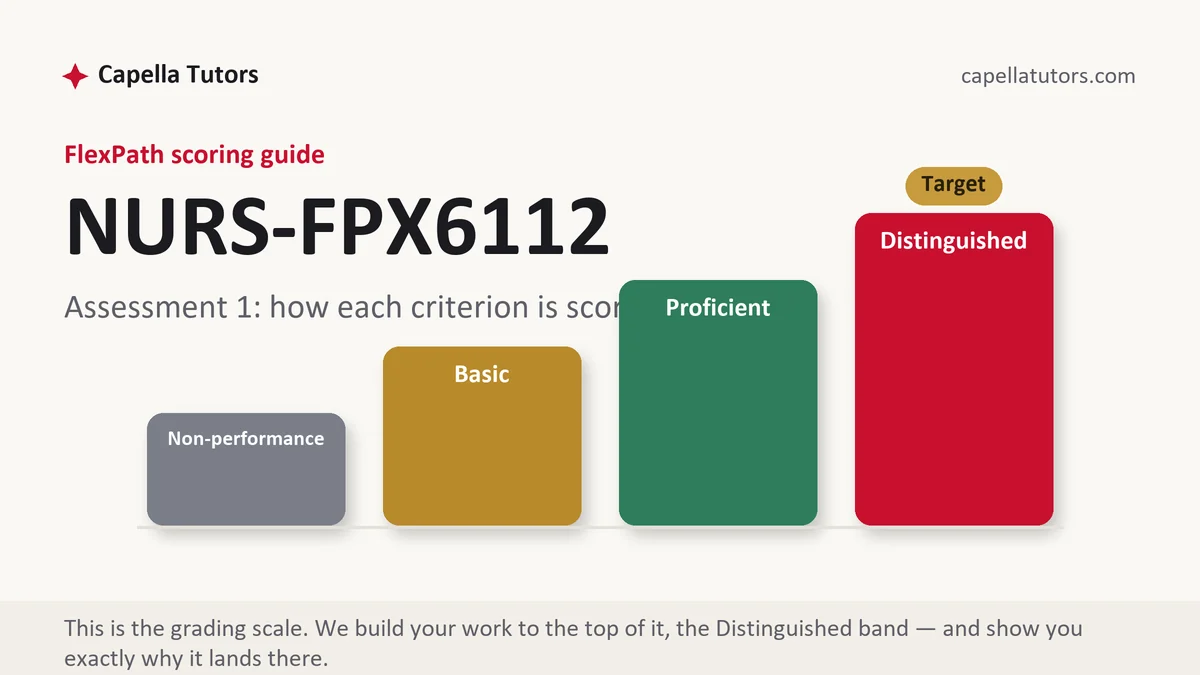
How NURS FPX 6112 Assessment 1 is scored
FlexPath grades criterion by criterion, and each one settles on one of four levels whose wording is your brief:
| Level | What it means on a technology practicum setup document |
|---|---|
| Distinguished | Access to the specific platform or equipment is documented with the administrator named, the licensing and scheduling limits are stated, the objectives are measurable against artifacts, and the plan says what happens if the vendor contract or the sim calendar closes on you. |
| Proficient | A complete, workable set of arrangements with a qualified mentor and sound objectives. The plan takes access for granted rather than proving it, which is the step the top column wants. |
| Basic | A site, a mentor, and a technology named in general terms, with objectives written as intentions and no mention of accounts, licenses, or calendars. |
| Non-performance | A required element is missing, most often the mentor's qualifications or the documented meeting, and a missing element scores below a weak one. |
Technology access is administrative before it is pedagogical. A simulation center runs on a booking calendar that fills a term ahead, a learning platform needs a designer or builder role that nobody grants casually, and a virtual patient product is licensed by seat with an expiry date. Naming the administrator for each of those is worth more in this document than any statement of enthusiasm for innovation.
The NURS FPX 6112 Assessment 1 method, step by step
-
Build headings from the criteria, not from a form
Copy each criterion out with its verb and let it become a heading. Setup deliverables invite form filling, and a filled form can miss a criterion entirely. Where the guide asks you to describe the intended project, describe the work and its artifact, not the department that houses it.
-
Choose technology you can put your hands on this term
Write about the manikin in your skills lab, the module builder in your employer's learning platform, the virtual patient product your program already licenses, or the audience response tool you have used in an inservice. Then say what you have: an account, a role, a booking window, a seat license. A tool you have only read about produces a paper that reads as though you had only read about it.
-
Name the administrator and the limits, in writing
Beside each technology, put the person who controls it, the level of access you were granted, and the boundary. The simulation coordinator who owns the calendar, the instructional designer who can promote you to builder, the informatics educator who holds the vendor relationship. Then the constraints: bookable hours, seat count, whether recording is permitted, whether student data can leave the platform.
-
Vet the mentor for technical standing
Your mentor needs both graduate preparation and current responsibility for the technology in question. State degree, certification if held, role, and the authority they hold over the tool: whether they can approve a booking, grant a builder role, or authorize a pilot with real learners. Enthusiastic sponsorship without authority stalls at the first request.
-
Write objectives against a simulation or teaching standard
Anchor the set in a published framework so the evaluator can see the level. Where simulation is the technology, the healthcare simulation standards published by the international simulation association give you design, prebriefing, debriefing, and evaluation language, and the simulation theory associated with Jeffries gives you the theoretical frame. Each objective needs an observable verb and the artifact that proves it: a built module, a written scenario with a debriefing plan, a completed accessibility review.
-
Hold the call and minute what was refused
Take an agenda covering access, licensing, learner involvement, recording and privacy, hours verification, and checkpoints. Write the record with date, attendees and roles, agreements, refusals, and the next review date. Refusals matter here more than in most setup documents, because a plan built around equipment you were not granted is a plan that fails in week four.
A structure that maps to the criteria
Word targets are our tutors' planning figures for a setup document of this shape, not Capella rules; your scoring guide decides the real weighting.
| Section | What it must do | Guide |
|---|---|---|
| Setting and learners | The program or department, the learners, and the teaching that already happens there, with counts. | ~200 words |
| Technology and access status | The specific platform or equipment, the administrator, the access granted, and the licensing limits. | ~250 words |
| Mentor and authority | Degree, role, and the decisions your mentor can actually make about the technology. | ~150 words |
| Project scope and artifact | What you will build, what the setting keeps, and what you are explicitly not attempting. | ~200 words |
| Objectives and evidence | Measurable objectives anchored in a published simulation or teaching standard, each with its artifact. | ~250 words |
| Hours, privacy, and the meeting record | Hours by week, how learner data and recordings will be handled, and the minuted call. | ~250 words |
| References | Current APA for standards and frameworks, cited as organizational reports where appropriate. | as needed |
Annotated sample excerpt
An original model from our writers, set where a top criterion description asks you to write. Take the pattern and fit it to the technology you hold.
The practicum sits in a simulation center serving 96 prelicensure students per term across four clinical courses, and the technology in scope is the center's mid fidelity manikin platform used for recognition of patient deterioration.1 Access is real rather than assumed: the simulation coordinator has granted me four bookable four hour blocks between weeks three and nine, the vendor scenario editor under my mentor's institutional license, and permission to record debriefings for scoring but not for distribution, with recordings deleted after 30 days under the center's own policy.2 Two limits shape the project, so I am stating them now: the editor license expires in eleven weeks, and the center cannot release student identifiers, which is why my evaluation artifact is an aggregate performance summary rather than paired individual scores.3
- 1Fixes the setting with a learner count and names the specific equipment rather than a category of simulator, so every later objective has something concrete to attach to.
- 2Documents access as granted permissions with a name behind them, including what is not permitted. Recording and distribution limits are the detail evaluators look for and learners omit.
- 3States two hard constraints and shows the project design already bending to them, which is the anticipation the top column rewards on a setup deliverable.
The full premium sample for your exact assessment, written fresh to your scoring guide and issue, is free to request. Study it, revise it into your own voice, and submit work you understand.
The five mistakes that cost Distinguished
- Access taken on trust. A plan that expects a simulation calendar or a builder role to open on request is the most common reason a technology practicum stalls.
- A tool from a brochure. Writing about a product you have never operated shows up immediately in the integration sections, which need failure modes and orientation detail.
- A mentor without authority. Support from someone who cannot approve a booking or a license is sponsorship, not supervision.
- Silence on recording and privacy. Simulation and platform work generates learner data, and a setup document that ignores handling rules invites a judgment mark down.
- An unminuted call. The documentation criterion asks for a record with attendees, agreements, and refusals, not for confirmation that a meeting happened.
Pre-submission checklist
- Setting named with learner counts and the teaching that already runs there
- Specific technology named, with administrator, access level, and licensing limits
- Mentor's degree, role, and authority over the technology all stated
- Objectives measurable, anchored in a published simulation or teaching standard, each tied to an artifact
- Recording, privacy, and data handling addressed explicitly
- Call minuted with date, attendees, agreements, refusals, and the next checkpoint
Access questions holding up your practicum?
Send the scoring guide, the technology you can reach, and your mentor's role. We write the access and licensing section properly, anchor the objectives in published simulation standards, and build the fallback for the constraint most likely to bite. It lands inside 24 to 48 hours, revisions run until faculty approves, and the opening sample is free.