This manual is for NURS FPX 6100 Assessment 4, start to submission. We build the slides and the speaker notes together, to your scoring guide, back in 24 to 48 hours with free revisions until the criteria clear. Assessment 4 of NURS FPX 6100 usually asks for a presentation that proposes a change to an educational practice and defends it on legal and ethical grounds, delivered to an audience you name and evidenced in speaker notes rather than on the slides. It is the assessment where learners lose points to format rather than content, because a presentation is graded on what the notes argue, not on what the bullets list. The method, the structure, and an annotated sample of speaker notes are below. Capella's catalog lists the course as NURS-FPX6100, and some courserooms print NURS6100; both point to this same Assessment 4. In current courserooms this assessment typically appears as "Legal/Ethical Change Presentation".
One honesty note before the manual: Capella revises courses and scoring guides over time, so always write to the exact scoring guide attached to your assessment in the courseroom. The course identity above is verified on capella.edu; the method and structure below are our tutors' approach to it, not Capella's official rubric text.
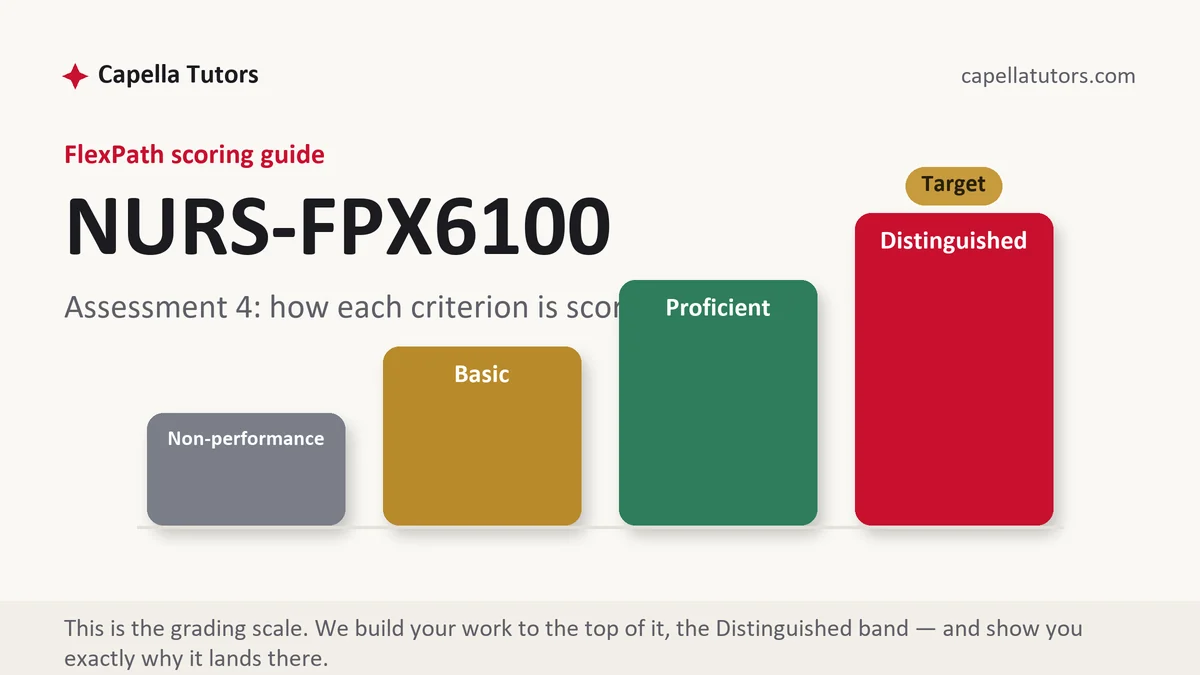
How NURS FPX 6100 Assessment 4 is scored
Every criterion resolves to one of four levels. On a presentation, the level language is applied to the notes as much as to the slides:
| Level | What it means on a legal and ethical change presentation |
|---|---|
| Distinguished | The legal exposure and the ethical obligation are analyzed separately and then reconciled, the change is specified precisely enough to be implemented next term, and the strongest objection from the audience is answered on the slide where it would be raised. |
| Proficient | The change is justified with accurate law and sound ethics, and the presentation would persuade. The two frames are handled in parallel rather than brought into contact with each other. |
| Basic | A description of a problem with a general call for improvement, legal and ethical language used as adjectives, and speaker notes that read the slide aloud. |
| Non-performance | One frame is absent, most often the ethical analysis, or the presentation has no speaker notes and therefore no argument to grade. |
Keep the two frames distinct while you draft. Legal analysis asks what an institution can be held to: due process, disability accommodation, records privacy, contract language in a handbook. Ethical analysis asks what it owes regardless of exposure: fairness to the individual learner, honesty about competence, and the obligation to future patients. Recommendations that are legally safe and ethically indefensible are common in nursing education, and pointing at one is a strong move.
The NURS FPX 6100 Assessment 4 method, step by step
-
Build the deck from the criteria, one slide family each
Turn each criterion into a slide or a short run of slides, and title those slides in the criterion's own verb. Evaluators grade a presentation by looking for the criterion, and a slide titled Legal Analysis is found in two seconds while the same content buried under Background is not found at all.
-
Choose a practice that actually carries risk
The change needs legal and ethical weight, so pick something with both: how clinical failure is documented and appealed, how accommodations are handled in a skills lab, how a remediation plan is recorded, how references are given for a student who was dismissed. A proposal to add a discussion board has no legal dimension and the criteria will show that.
-
Separate the law from the ethics, on paper, before you draft
Two columns. On the left, what the institution is exposed to: academic versus disciplinary due process, notice and an opportunity to respond, accommodation obligations under disability law, education records privacy, the handbook as a quasi-contract. On the right, what is owed anyway: consistency between learners, transparency about the standard, and the duty to patients who will be cared for by whoever passes.
-
Specify the change to the level of a document
Proposals fail when they stop at intent. Say which document changes, which sentence in it, who approves the change, in which committee, by which date, and what happens to learners already in the pipeline. A change specified to the level of a paragraph and a signature reads as executable; a change described as improving the process does not.
-
Anchor the instrument in evidence, not preference
If your change touches how learners are evaluated, name the instrument and its psychometric record. Published clinical evaluation tools such as the Creighton competency instrument report interrater reliability evidence, which is the sort of citation that ends an argument about consistency. Pair that with the AACN Essentials for the competency language and the ANA Code of Ethics for the obligation to patients.
-
Write the notes as prose and answer the objection out loud
Speaker notes are the paper. Write them in complete sentences with citations inside the reasoning, roughly 100 to 150 words per slide, and keep the slide itself to a claim and a short amount of supporting text. Then find the slide where a faculty member would object, on workload, on cohort consistency, on legal caution, and answer it there rather than in a closing summary.
A structure that maps to the criteria
A slide plan our tutors use for a change presentation of this kind, with the notes carrying the argument. Your scoring guide decides the real slide count.
| Section | What it must do | Guide |
|---|---|---|
| Title and purpose | The audience named, the practice under review, and the change you are asking them to approve. | 1 slide |
| The problem, evidenced | What is happening now, with data from the setting rather than a general claim about nursing education. | 2 slides |
| Legal analysis | Due process, accommodation, records, and handbook exposure applied to this practice specifically. | 2 to 3 slides |
| Ethical analysis | Fairness between learners, honesty about competence, and the obligation to future patients. | 2 slides |
| The proposed change | The document, the wording, the approver, the date, and the transition rule for learners mid-program. | 2 slides |
| Objection and response | The strongest audience objection stated fairly and answered with evidence on the same slide. | 1 slide |
| Evaluation and references | How you will know the change worked, with a threshold, plus current APA references. | 2 slides |
Annotated sample excerpt
An original model of speaker notes from our writers. Notes are where a presentation is actually graded, so this is the part worth reading twice.
The current med surg clinical evaluation tool asks faculty to rate students as satisfactory or unsatisfactory on twelve global behaviors, and last year eleven of fourteen unsatisfactory ratings were overturned on appeal.1 That pattern is a due process problem rather than a grading problem: a standard a student cannot read in advance and a rating a second faculty member cannot reproduce will not survive the notice and opportunity to respond that academic dismissal requires.2 Replacing the global scale with a behaviorally anchored instrument that reports published interrater reliability, and requiring a documented mid rotation conference for any student trending toward failure, converts a defensible judgment into a defensible record, and it costs faculty an estimated twenty minutes per student per rotation.3
- 1Opens with the setting's own numbers rather than a general claim, which gives the legal analysis something specific to be about.
- 2Names the doctrine and applies it, notice and an opportunity to respond, instead of using due process as a phrase. Applied law is what the criterion pays for.
- 3Specifies the change, attaches published reliability evidence to the instrument, and prices the faculty burden. Anticipating the workload objection inside the recommendation is the Distinguished move here.
The full premium sample for your exact assessment, written fresh to your scoring guide and issue, is free to request. Study it, revise it into your own voice, and submit work you understand.
The five mistakes that cost Distinguished
- Bullets doing the arguing. Slides dense with text and notes that repeat them leaves the evaluator nothing to grade against the analysis criteria.
- Law and ethics as one paragraph. Blending the two frames means neither criterion is answered, and this is the most common structural failure on this assessment.
- Due process as a phrase. Naming the concept without applying notice, standard, and opportunity to respond to your own practice is Basic work.
- A change with no document attached. Improving communication cannot be approved by a committee, and the recommendation criterion is looking for something that can.
- No audience. A presentation that does not know whether it is speaking to faculty, a dean, or a nursing professional development council cannot pitch its objection response.
Pre-submission checklist
- Audience named on the title slide and addressed throughout
- Problem evidenced with numbers from the actual setting
- Legal analysis applying due process, accommodation, and records rules to this practice
- Ethical analysis covering consistency between learners and the duty to future patients
- Change specified to a document, an approver, a date, and a transition rule
- Speaker notes in full sentences with citations inside the reasoning, current APA references slide included
Slides due, notes not written?
Send the scoring guide and the practice you want changed. We build the deck and write the speaker notes as argued prose, with the legal and ethical frames handled separately and a costed recommendation at the end. Delivery is 24 to 48 hours, revisions run until your target is met, and the first premium sample is free.