This manual is for NURS FPX 6100 Assessment 3, start to submission. We build this one to your scoring guide and return it in 24 to 48 hours, revised free until every criterion clears. Assessment 3 of NURS FPX 6100 usually asks for a personal philosophy of nursing education paired with an evidence-based approach to managing the learning environment, and it is graded on whether the philosophy and the practice actually match. A philosophy that claims learner autonomy followed by a management plan built on surveillance fails on internal consistency long before anyone checks the citations. Here is the method, the structure, and an annotated sample. Capella's catalog lists the course as NURS-FPX6100, and some courserooms print NURS6100; both point to this same Assessment 3. In current courserooms this assessment typically appears as "Scholarship and Philosophy of Teaching and Classroom Management".
One honesty note before the manual: Capella revises courses and scoring guides over time, so always write to the exact scoring guide attached to your assessment in the courseroom. The course identity above is verified on capella.edu; the method and structure below are our tutors' approach to it, not Capella's official rubric text.
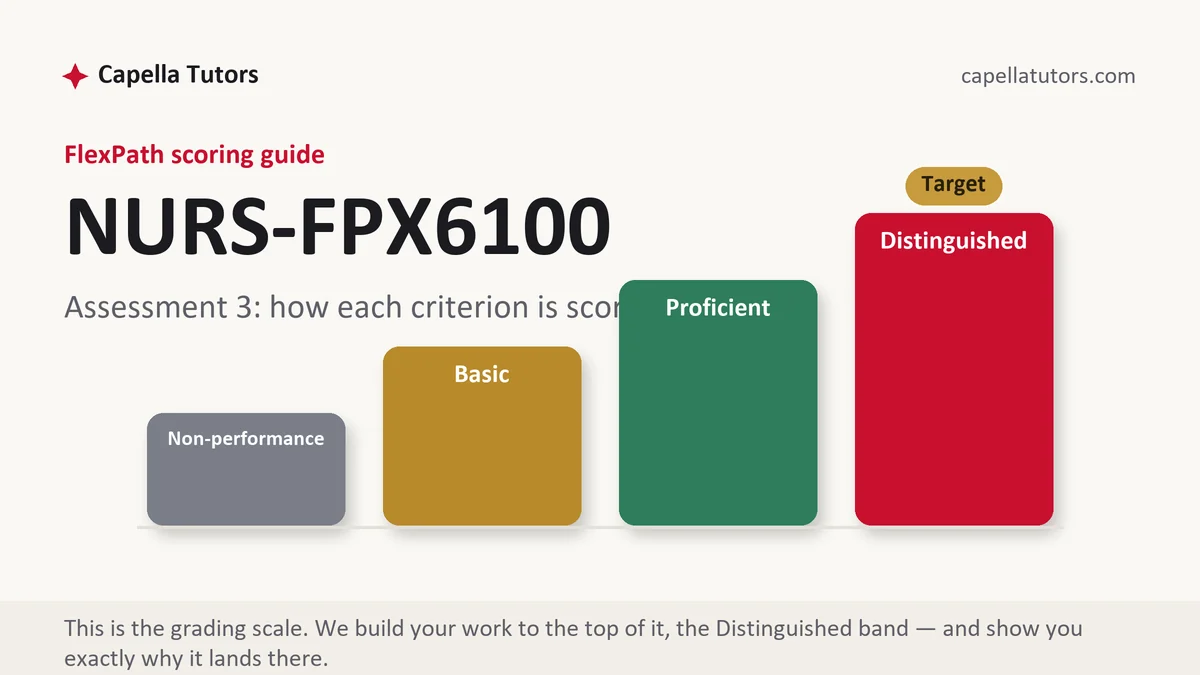
How NURS FPX 6100 Assessment 3 is scored
Each criterion in your scoring guide resolves to one of four levels, and the level text is the specification you are writing against:
| Level | What it means on a philosophy and management deliverable |
|---|---|
| Distinguished | The philosophy is traced to named learning theory attributed to its primary source, each management practice is derived from that philosophy rather than bolted on, and one situation where the philosophy would fail is worked through honestly. |
| Proficient | A coherent philosophy supported by current literature, with management strategies that are defensible and evidence-based. The link between belief and practice is asserted rather than demonstrated. |
| Basic | Beliefs about teaching stated as values, followed by a list of classroom rules from a source. Nothing connects the two halves, which is the structural flaw this assessment is designed to expose. |
| Non-performance | One half is missing, usually the management component, or the philosophy contains no theory and no citations at all. |
The mistake worth naming early is theory as decoration. Writing that I believe in adult learning principles is a value statement. Writing that Knowles's premise of learner self-direction requires me to negotiate the module sequence with residents, which is why my late work policy is a deadline they set rather than one I impose, is a philosophy doing work. The second version is what the top column describes.
The NURS FPX 6100 Assessment 3 method, step by step
-
Map the criteria, then decide which half leads
Both halves carry criteria, and the guide usually weights them separately. Build a heading per criterion, then decide the order: philosophy first if the guide asks you to derive practice from belief, management first if it asks you to justify existing practice. The order you choose has to be the order you actually argue in, or the consistency criterion catches you.
-
Pick two or three theories and commit to them
Breadth is the enemy here. Two theories argued properly outscore six named in passing. Andragogy from Knowles carries adult learners and self-direction. Bandura's work on self-efficacy carries confidence in skills teaching. Mezirow's transformative learning carries the moments where a learner's assumptions have to break. Vygotsky's zone of proximal development carries scaffolding and precepting. Cite each to its primary source, because citing a textbook summary of Knowles signals to a faculty evaluator that you have not read him.
-
Write the philosophy as claims, not values
Each paragraph should hold a claim, its theoretical warrant, and its practical consequence. Learners come to this course with prior clinical experience, therefore instruction opens with their cases rather than my slides, therefore the first session is built from three incidents they submit in advance. Claim, warrant, consequence. A philosophy that never reaches consequence is a mission statement.
-
Derive every management practice from a stated belief
Take each element of your management plan and write the sentence that connects it back. Attendance policy, participation expectations, phone use, late submissions, group work rules, incivility response. If you cannot derive a practice from your philosophy, you have either the wrong practice or the wrong philosophy, and saying which is the analysis the criterion wants.
-
Handle incivility with evidence, not tone
The literature on incivility in nursing education is developed enough to argue from. Clark's work supplies both a model of the faculty and student contribution and validated instruments with published reliability evidence, which lets you propose measurement rather than sentiment. Distinguish the classroom behaviors that need an immediate response from the patterns that need a documented, progressive process, and say who else in the institution is involved at each step.
-
Test the philosophy against a case where it breaks
Choose a real hard case: a learner whose self-direction produces three weeks of no submissions, or a group where one member does all the work. Walk through what your philosophy commits you to, what it costs, and where you would override it. Naming the limit of your own position is the move that separates a Distinguished philosophy from a Proficient one, and almost nobody makes it.
A structure that maps to the criteria
The word figures are our tutors' planning targets for a deliverable of this shape, not Capella rules; your scoring guide decides the real weighting.
| Section | What it must do | Guide |
|---|---|---|
| Introduction and context | The learners you teach or will teach, the setting, and the single sentence your philosophy comes down to. | ~150 words |
| Theoretical foundation | Two or three learning theories cited to primary sources, each with the reason it fits these learners. | ~300 words |
| Philosophy as claims | Beliefs about learning, teaching, and evaluation, each carried through to a practical consequence. | ~300 words |
| Managing the learning environment | Policies and practices for participation, deadlines, group work, and technology, each derived from a stated belief. | ~300 words |
| Incivility and difficult behavior | A graduated response built on current literature, with measurement and escalation named. | ~200 words |
| Limits and a hard case | One situation where the philosophy would not hold, worked through to a decision. | ~150 words |
| References | Current APA, learning theory attributed to primary sources rather than secondary summaries. | as needed |
Annotated sample excerpt
Our team wrote this model paragraph to show what a criterion's highest level sounds like in practice. Copy the structure and nothing else.
The learners in this asynchronous health assessment course are working nurses with a median of nine years of practice, which makes Knowles's premise of readiness to learn less an assumption than a constraint: they will engage content they can attach to a patient they remember, and they will skim everything else.1 My philosophy therefore treats prior experience as the curriculum's raw material, and the practical consequence is that each module opens with an assessment finding the learner has personally missed or misread, submitted in week one and returned to them in week six.2 The same premise sets my late work policy, since a course that claims self-direction and then penalizes a nurse for a mandated overtime shift is arguing against itself; deadlines here are negotiated once, in writing, and then held.3
- 1Grounds the philosophy in a named theorist and a number about the actual learners, so the theory is being applied rather than displayed.
- 2Carries the belief through to a specific, datable instructional decision. Claim to warrant to consequence in one sentence is the pattern that reads as Distinguished.
- 3Derives a management policy from the same premise and states the contradiction it avoids. Internal consistency between the two halves is what this assessment is built to test.
The full premium sample for your exact assessment, written fresh to your scoring guide and issue, is free to request. Study it, revise it into your own voice, and submit work you understand.
The five mistakes that cost Distinguished
- Theory as ornament. Four theorists named in one paragraph and never used again reads as a literature parade rather than a philosophy.
- Two documents in one file. A philosophy section and a rules section with no derivation between them is the structural failure this assessment exists to catch.
- Secondary sourcing of primary theory. Citing a textbook chapter for Knowles or Bandura is visible to any faculty evaluator and undercuts the whole foundation.
- Management as prohibition. A list of what learners may not do, with no learning rationale, cannot satisfy a criterion that asks for evidence-based practice.
- A philosophy with no limits. A position that works in every case has not been tested, and the criterion that pays for judgment stays unearned.
Pre-submission checklist
- One sentence early on that states the philosophy in full
- Two or three theories, each cited to its primary source and applied to these learners
- Every belief carried through to a practical consequence a colleague could observe
- Every management practice derived from a stated belief, in writing
- An incivility response with graduated steps, measurement, and escalation named
- One hard case worked through to a decision, including what the philosophy costs there
Philosophy and management, argued as one document?
Send the scoring guide and tell us who your learners are and what you already believe about teaching them. Our education writers build the theoretical foundation, derive the management plan from it, and hand back a premium original sample within 24 to 48 hours. Revisions run until the criteria clear and the first sample is on us.