This manual is for NURS FPX 6100 Assessment 2, start to submission. Hand us the assessment and you get a premium original sample written to your scoring guide in 24 to 48 hours, revised free until the criteria clear. Assessment 2 of NURS FPX 6100 usually asks for a reflective analysis of the nurse educator role, examined through the three obligations the academy attaches to it, teaching, scholarship, and service, and set inside a place you can actually name. The criteria reward judgment about the role rather than enthusiasm for it. Below is our method, a structure drawn from the criterion language, and an annotated sample excerpt you can study before you draft. Capella's catalog lists the course as NURS-FPX6100, and some courserooms print NURS6100; both point to this same Assessment 2. In current courserooms this assessment typically appears as "Reflection Paper".
One honesty note before the manual: Capella revises courses and scoring guides over time, so always write to the exact scoring guide attached to your assessment in the courseroom. The course identity above is verified on capella.edu; the method and structure below are our tutors' approach to it, not Capella's official rubric text.
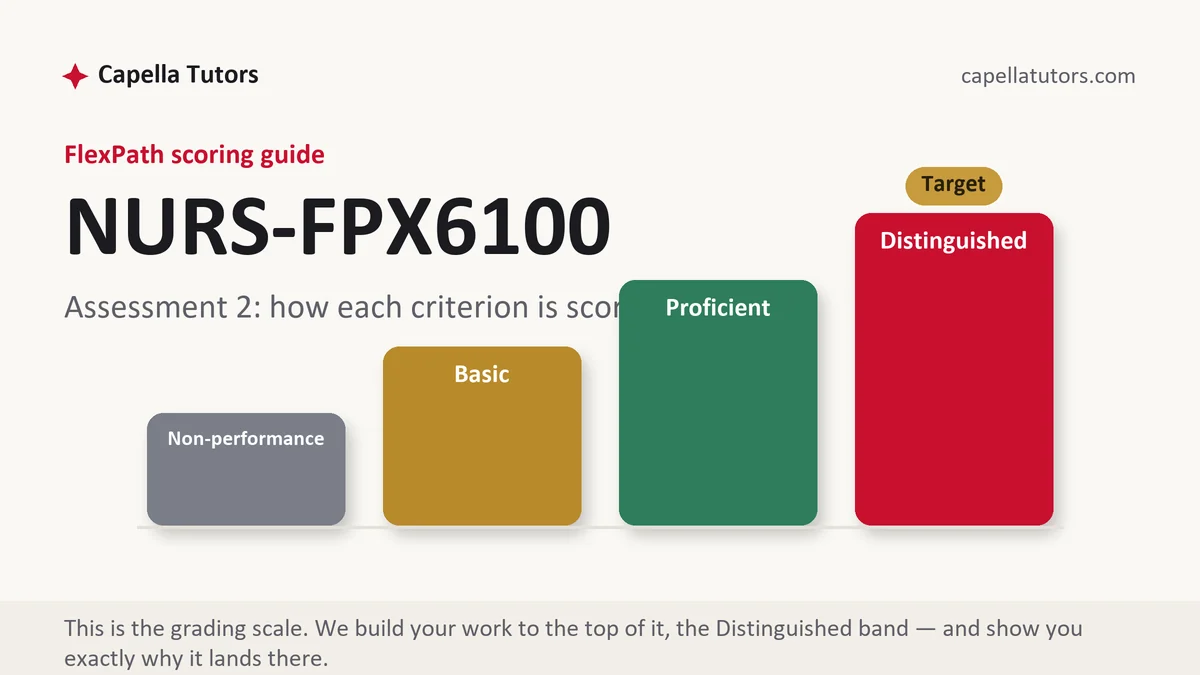
How NURS FPX 6100 Assessment 2 is scored
There are no grades to average in FlexPath. Each criterion lands on one of four levels, and the level descriptions tell you exactly what to write:
| Level | What it means on a reflective role analysis |
|---|---|
| Distinguished | All three obligations are analyzed in one named setting, the competing claims they make on the same working week are quantified, and the reflection admits a gap the writer has not closed yet, with the closing step specified. |
| Proficient | The three obligations are described accurately and applied to a setting. The analysis stops before the obligations are put in conflict with each other, which is where the top column lives. |
| Basic | An enthusiastic account of teaching, with scholarship and service mentioned in a sentence each and reflection that reports strengths only. This is where most first submissions land. |
| Non-performance | One obligation is absent from the paper, most often scholarship, and a missing element scores lower than a weak one. |
The trap in this assessment is register. Master's level reflection is an argument about a role, evidenced by literature and by your own documented experience. Undergraduate reflection is a story about how much you care, and it reads as Basic no matter how well the sentences are built.
The NURS FPX 6100 Assessment 2 method, step by step
-
Turn the criteria into headings, verbs first
Every criterion becomes a labeled section before you draft a word. Reflection assessments tempt learners into narrative flow, and narrative flow is exactly what buries a criterion an evaluator is hunting for. If the guide says evaluate the scholarship expectations of the role, the heading uses evaluate and the section reaches a judgment.
-
Fix the setting and refuse to leave it
One place, named, with numbers: a residency program that admits 24 new graduates twice a year, or a prelicensure program running two clinical sections of ten. Every claim about the role is then a claim about that place, which is what makes the analysis testable. Papers that drift between a classroom and a hospital lose the specificity the top two columns are built on.
-
Define scholarship correctly before you write about it
Most lost points in this assessment come from treating scholarship as original research. Boyer's four forms, discovery, integration, application, and teaching, give you the language to argue that a master's prepared educator practices the scholarship of teaching and of application, and that dissemination through a poster, a journal club, or a unit-based practice change counts. Cite Boyer where you use the distinction, not in a list of names at the end.
-
Inventory your own teaching, failures included
Write out four teaching encounters in plain terms: the learner, the content, what you did, what did not work. Precepting, competency validation, a family teaching session at discharge, a skills fair station. These episodes are the evidence you attach to each competency claim. Keep the encounter that went badly, because the criteria on role transition pay for recognizing that clinical expertise is not teaching expertise.
-
Put the three obligations in conflict on purpose
The reliable Distinguished move is arithmetic. A faculty appointment or an educator role holds a fixed week, and teaching load, committee service, and scholarly work all draw from it. Say what gets displaced when the residency cohort doubles, or which committee seat you would have to leave to finish a manuscript. Naming the tradeoff with numbers is analysis; listing the three obligations side by side is description.
-
Score yourself against the guide before you submit
Read the draft one criterion at a time and assign your own level honestly. Anything under Distinguished gets one more pass, and the usual repair is not more prose but a specific number, a citation placed inside the reasoning, or an admitted gap. Submit early in the week, since evaluation can take up to two business days and a Friday submission often waits for Monday.
A structure that maps to the criteria
These are planning targets our tutors use for a reflective role analysis of this type, not Capella requirements; follow your scoring guide wherever it asks for more.
| Section | What it must do | Guide |
|---|---|---|
| Introduction and setting | The place, its learners, and the educator role as it actually exists there, ending in the question the reflection will answer. | ~150 words |
| The teaching obligation | What teaching means in this role beyond lecturing, judged against a competency framework and one of your own encounters. | ~300 words |
| The scholarship obligation | Scholarship defined at master's level using a published typology, with a realistic dissemination plan for your setting. | ~300 words |
| The service obligation | Committee work, professional organization involvement, and institutional citizenship, with the time cost stated. | ~250 words |
| Where the three collide | The arithmetic of a fixed week, what gets displaced, and how the setting currently resolves it. | ~250 words |
| Reflection and next step | One competency you hold, one you lack, and the specific development action with a date on it. | ~200 words |
| References | Current APA, the competency framework and the scholarship typology cited to primary sources. | as needed |
Annotated sample excerpt
A short original model from our writers, pitched where the guide's highest level sits. Study the reasoning, not the phrasing.
In the residency office where I teach, scholarship is the obligation everyone agrees to and nobody schedules.1 Boyer's typology is useful here because it separates the scholarship of discovery, which this department has neither the staffing nor the review structure to attempt, from the scholarship of teaching and of application, which is already within reach: the didactic module I revised last spring produced pretest and posttest data on 24 residents that nobody has yet analyzed or reported.2 Treating that dataset as scholarship rather than as paperwork would cost roughly 20 hours of protected time, which is the same 20 hours currently absorbed by my seat on the falls committee, and the department has never been asked to choose between them.3
- 1Opens on the contradiction inside the role rather than a definition of scholarship, so the evaluator meets the analysis in the first line.
- 2Uses a published typology to make a discrimination, what this setting can and cannot do, and attributes it to its primary source. Applying a framework scores; naming one does not.
- 3Converts the obligation into hours and forces a tradeoff. Quantified conflict between the three role components is the single most reliable Distinguished move in this assessment.
The full premium sample for your exact assessment, written fresh to your scoring guide and issue, is free to request. Study it, revise it into your own voice, and submit work you understand.
The five mistakes that cost Distinguished
- Reflection as gratitude. A paper about how rewarding teaching is, with no judgment about the role, is the most common Basic submission in this course.
- Scholarship read as research. Claiming a master's prepared educator must generate original studies misstates the role and costs the scholarship criterion.
- Service left implicit. Committee work and professional involvement carry their own criterion, and mentioning them once in a closing paragraph does not answer it.
- A setting that moves. Analysis that starts in a school of nursing and finishes on a medical unit cannot be checked against anything.
- A self-assessment with no gap. Reflection that reports only strengths reads as unexamined and drops the transition criteria a full column.
Pre-submission checklist
- One named setting with learner numbers, held from the first sentence to the last
- Teaching, scholarship, and service each analyzed under their own heading
- Scholarship defined at master's level with a typology cited to its primary source
- At least one quantified conflict between the three obligations
- One competency named as held and one as missing, with a dated development step
- Current APA throughout, every in-text citation matched in the reference list
Want this reflection to read like an educator wrote it?
Send the scoring guide and the setting you are writing from, and tell us about one teaching encounter that did not go well. Our nursing writers build the analysis around it, keep the register at master's level, and return a premium original sample inside 24 to 48 hours with revisions until you hit your target. The first one is free.