This manual is for NURS FPX 6100 Assessment 1, start to submission. Send the scoring guide and we build the practicum planning document with you, the site, the mentor, the project, the objectives, and the call record, returned in 24 to 48 hours and revised free until your faculty signs it. Assessment 1 of NURS FPX 6100 is the gate that lets the rest of the course run. Your scoring guide usually asks you to name a practicum setting, secure a mentor whose preparation matches the role, define the project you will carry through the specialization, and document a scheduled conference call with faculty and that mentor. It looks like paperwork and it is graded like an assessment. What follows is the method our tutors use, a structure built from the criteria, and an annotated sample excerpt. Capella's catalog lists the course as NURS-FPX6100, and some courserooms print NURS6100; both point to this same Assessment 1. In current courserooms this assessment typically appears as "MSN Practicum Conference Call Template".
One honesty note before the manual: Capella revises courses and scoring guides over time, so always write to the exact scoring guide attached to your assessment in the courseroom. The course identity above is verified on capella.edu; the method and structure below are our tutors' approach to it, not Capella's official rubric text.
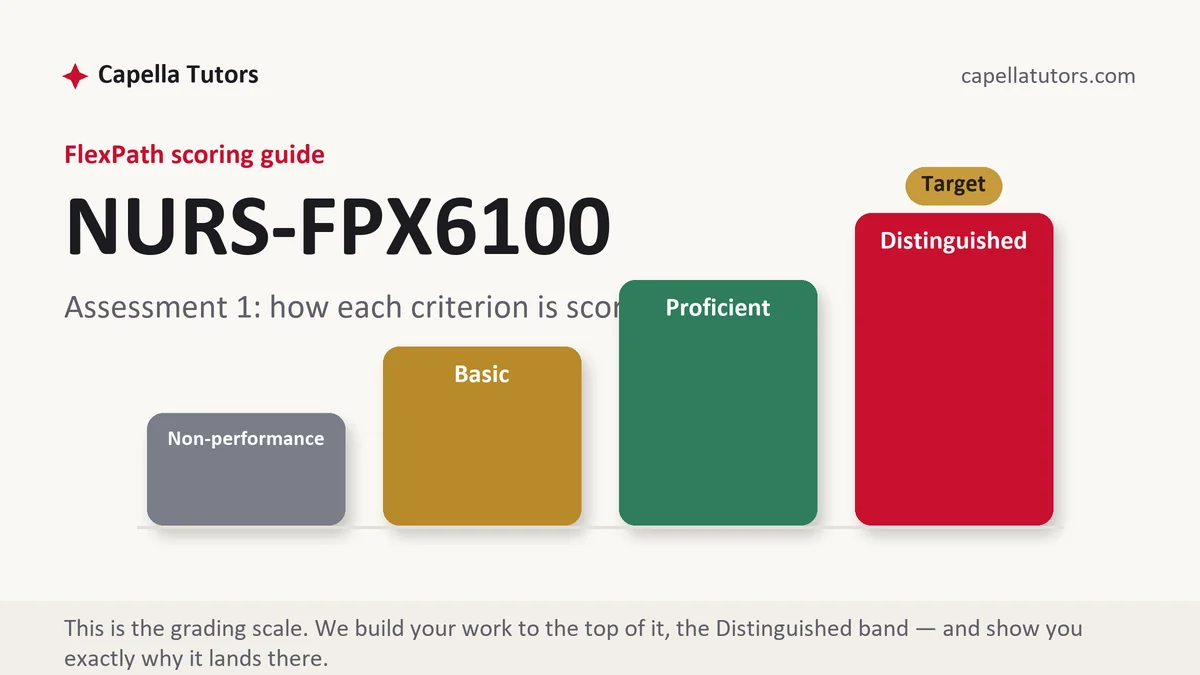
How NURS FPX 6100 Assessment 1 is scored
Nothing here averages into a letter grade. Every criterion on your scoring guide settles on one of four levels, and the wording of those levels is the writing brief:
| Level | What it means on a practicum planning document |
|---|---|
| Distinguished | Site, mentor, and project arrive with credentials, learner counts, and scheduling constraints attached, each practicum objective is measurable by a named source of evidence, and the hours plan still works when the mentor takes two weeks of leave. |
| Proficient | Every required element is present and accurate and the plan would function. Nothing in it anticipates what could go wrong, which is the move the top column pays for. |
| Basic | A setting and a mentor are named in general terms, the objectives read as intentions, and the hours appear as one total rather than a distribution anyone could hold you to. |
| Non-performance | A required element is missing outright, usually the mentor's qualifications or the documented call, and absence rather than weakness is what drops a criterion to the floor. |
Treat this deliverable as governance rather than admin. It is the document faculty reopen when your hours are reviewed later in the specialization, so an hour spent on precision now buys silence for the rest of the program.
The NURS FPX 6100 Assessment 1 method, step by step
-
Let the criteria, not the instructions, set your outline
The instructions describe a process; the criteria decide the grade. Copy each criterion into a blank document, keep its verb intact, and make it a heading. If a criterion asks you to identify a mentor whose qualifications support the practicum, that heading gets a paragraph about degrees, certification, and role scope, and nothing else lives under it.
-
Choose a setting that already owns learning
Pick a department or program with an existing teaching function, a nursing professional development team, a residency office, a clinical education unit, a school of nursing with sections you could observe. Describe it with counts: beds, annual hires, cohort size, sections per term. Numbers convert a setting into something your objectives can be measured against.
-
Vet the mentor against the role, not the relationship
Your guide usually expects graduate preparation and current practice in the educator role. State the mentor's degree, board certification if held, job title, and span of responsibility, then say in one sentence how that combination lets them supervise the project. Availability is a scheduling fact, not a qualification, and evaluators read the difference immediately.
-
Write objectives a third party could score
Each practicum objective needs an observable verb, a condition, and a source of evidence. Analyze the competency gaps documented in the last three preceptor evaluations is scorable. Learn more about precepting is not. Anchor the set in the NLN core competencies for nurse educators or the professional development scope and standards your mentor practices under, and name the framework in the sentence that uses it.
-
Distribute the hours and defend the distribution
Build a week by week table rather than a total. Split direct hours, meaning time in front of learners or in supervised project work, from indirect hours spent on design, literature, and documentation. Then add the contingency your evaluator is looking for: what shifts if the mentor is pulled to a survey visit or your unit goes to crisis staffing for a fortnight.
-
Run the call with an agenda and minute it
Bring a written agenda covering site access, project scope, objectives, hours verification, and the checkpoint schedule. Record date, attendees with roles, decisions reached, and the next review date. A conversation that happened but was never documented cannot satisfy a documentation criterion, and this is the criterion most often lost by learners who did everything right.
A structure that maps to the criteria
Word targets are planning figures our tutors use for a practicum planning document of this type, not Capella rules; expand any section your scoring guide weights more heavily.
| Section | What it must do | Guide |
|---|---|---|
| Practicum setting and learners | The department or program, who learns in it, how many, and who currently teaches them, described with counts rather than adjectives. | ~200 words |
| Mentor qualifications | Degree, certification, title, and scope of responsibility, tied explicitly to the qualification language in your guide. | ~150 words |
| Project scope and deliverable | What you will build or study, what the setting keeps afterward, and the boundary of what you are not attempting. | ~250 words |
| Practicum objectives | Three to five measurable objectives mapped to a published educator competency set, each with its source of evidence named. | ~250 words |
| Hours plan and verification | Direct and indirect hours by week, who signs them off, and the contingency if the schedule breaks. | ~200 words |
| Conference call record | Date, attendees, agenda items, agreements, and the next scheduled checkpoint. | ~150 words |
| References | Current APA for the competency framework, standards, and any literature supporting the project. | as needed |
Annotated sample excerpt
Below is an original model paragraph from our team, written at the level a top column description asks for. Take the moves; the words should be yours.
The practicum will be completed in the professional practice development department of a 210 bed community hospital that credentials 34 unit preceptors across five inpatient areas and onboards roughly 60 new graduates a year.1 My mentor is the department director, a master's prepared nurse holding board certification in nursing professional development, which satisfies both the graduate preparation and the current educator practice that my scoring guide requires of a qualified mentor.2 The project is a four session preceptor development workshop series, and by the close of my documented hours the department will hold a facilitator guide detailed enough to run the series without me, which is the deliverable my objectives are written to produce.3
- 1Converts the setting into a population with three counts attached, so every objective later in the document can be tested against a real place instead of a category of hospital.
- 2Answers the mentor criterion in the words the criterion uses, preparation and current practice, rather than asserting that the mentor is experienced and hoping the evaluator agrees.
- 3Names an artifact the department keeps. A project that ends in a deliverable can be verified; a project that ends when your hours run out cannot.
The full premium sample for your exact assessment, written fresh to your scoring guide and issue, is free to request. Study it, revise it into your own voice, and submit work you understand.
The five mistakes that cost Distinguished
- The unnamed setting. A department described by type rather than by size, learner volume, and existing teaching load leaves the objectives nothing to attach to.
- A mentor chosen for availability. Convenience is not a qualification, and the criterion asks for preparation and role scope in writing, not for a willing colleague.
- Objectives written as activities. Attend the education committee is a calendar entry. Analyze what the committee's last three agendas reveal about competency gaps is an objective.
- Hours as a lump sum. One total with no weekly distribution and no contingency reads as an estimate, and it is the first row faculty audit at the end of the specialization.
- An undocumented call. A meeting that took place but was never minuted with date, attendees, and agreements can score Non-performance on the documentation criterion by itself.
Pre-submission checklist
- Setting named with learner counts, teaching volume, and the team that owns education there
- Mentor's degree, certification, title, and scope written against the guide's qualification language
- Three to five objectives, each with a measurable verb, a competency anchor, and a source of evidence
- Hours split into direct and indirect, distributed by week, with a stated contingency
- Call minuted with date, attendees and roles, decisions, and the next checkpoint
- Current APA on the competency framework and standards, in-text citations matched to the list
Need the practicum plan cleared this week?
Send the scoring guide, the setting you can actually get into, and your mentor's credentials. A research analyst maps your criteria to sections, a subject matched writer builds the document, and it clears scoring-guide QA plus APA review before it reaches you inside 24 to 48 hours. Revisions run until your faculty signs off, and the opening premium sample carries no charge.