This manual is for NURS FPX 6085 Assessment 4, start to submission. Implementation Plan Design takes the intervention you designed in Assessment 3 and plans how it would be put into practice at your practicum site: the change model that guides it, the timeline and phases, who is responsible for each step, the resources and budget it needs, the barriers you expect and how you will address them, and how the plan will be communicated. Current versions follow it with an evaluation plan in Assessment 5, so this assessment is about delivery, not results. The grade turns on whether someone at your site could carry out the plan from what you wrote. Below is the method our tutors use, a structure that maps to the criteria, and an annotated sample excerpt. Prefer to hand it off? A premium original sample for this exact assessment comes back in 24 to 48 hours, revised free until it meets the guide. Capella's catalog lists the course as NURS-FPX6085, and some courserooms print NURS6085; both point to this same Assessment 4. In current courserooms this assessment typically appears as "Implementation Plan Design".
One honesty note before the manual: Capella revises courses and scoring guides over time, so always write to the exact scoring guide attached to your assessment in the courseroom. The course identity above is verified on capella.edu; the method and structure below are our tutors' approach to it, not Capella's official rubric text.
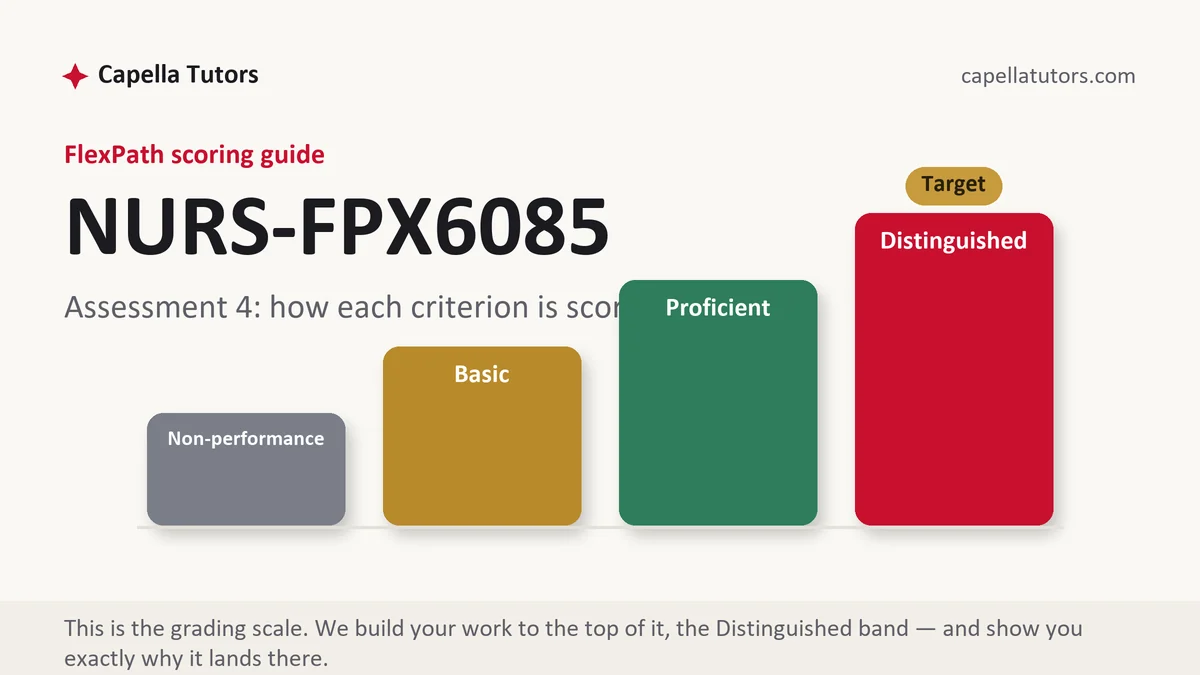
How NURS FPX 6085 Assessment 4 is scored
FlexPath does not use letter grades. Each criterion in the scoring guide lands on one of four levels, and the level descriptions are the real writing brief:
| Level | What it means on an implementation plan |
|---|---|
| Distinguished | A named change model structures the plan, phases and dates are realistic, every task has an owner, resources are costed, barriers are specific to the site with evidence-based responses, and communication reaches each stakeholder group. |
| Proficient | The plan is complete and sound, but some tasks lack owners or dates and barriers are general. |
| Basic | The plan restates the intervention with little detail on how it would be delivered. |
| Non-performance | The timeline, roles or barriers are missing. |
Keep the problem, PICOT question and intervention from Assessments 2 and 3. A plan for a different intervention breaks the capstone thread.
The NURS FPX 6085 Assessment 4 method, step by step
-
Restate the intervention
Two or three sentences carrying forward the intervention and the outcome it targets.
-
Choose a change model
Kotter, Lewin or the PDSA cycle, applied to your site: what each stage means for this intervention.
-
Build the timeline
Phases such as preparation, staff education, pilot and full rollout, with realistic dates.
-
Assign roles and resources
Who leads, who trains, who collects data; staff time, materials and any cost.
-
Anticipate barriers
Staffing, competing priorities, resistance or technology limits at your site, each with a response supported by evidence.
-
Plan communication
How leaders, staff and patients will hear about the change and its progress.
A structure that maps to the criteria
Word counts are planning targets our tutors use for this plan, not Capella rules; follow the length and format your scoring guide states.
| Section | What it must do | Guide |
|---|---|---|
| Introduction | The problem, the intervention and the purpose of the plan. | ~125 words |
| Change model | The model and how each stage applies. | ~225 words |
| Timeline and phases | Phases, dates and milestones, often as a table. | ~200 words |
| Roles and resources | Owners for each task and the resources needed. | ~225 words |
| Barriers and responses | Site-specific barriers with evidence-based responses. | ~225 words |
| Communication and references | The plan for each stakeholder group, then current APA. | ~150 words |
Annotated sample excerpt
An original model excerpt from our team, written to show the register that reaches the top of the guide. Learn the moves, then write your own version.
The barrier most likely to stall the rollout on this unit is time: night-shift nurses already report that they cannot finish documentation before handoff, and a new screening step will be read as one more task.1 The plan answers that by building the screening into the existing admission assessment in the record rather than adding a separate form, and by scheduling the ten-minute training at the start of each shift for two weeks instead of in a separate session staff would have to attend unpaid.2 Implementation studies consistently find that changes fitted to existing workflow are adopted faster than add-on tasks, which is why the pilot measures completion rate in week one before the change goes unit-wide.3
- 1Names a barrier specific to the site and the reason staff would resist.
- 2Responds with concrete design choices, not general encouragement.
- 3Supports the response with evidence and adds a check point, which shows the plan is realistic.
The full premium sample for your exact assessment, written fresh to your scoring guide and topic, is free to request. Study it, revise it into your own voice, and submit work you understand.
The five mistakes that cost Distinguished
- Reporting results. This assessment plans delivery; evaluation comes in Assessment 5.
- A change model named but not applied. Show each stage at your site.
- Tasks without owners. Every step needs a responsible person.
- Generic barriers. Write the barriers your site would actually face.
- No communication plan. Say how each group will hear about the change.
Pre-submission checklist
- Same problem and intervention as Assessments 2 and 3
- Named change model applied stage by stage
- Timeline with phases and dates
- Roles and resources for each task
- Site-specific barriers with evidence-based responses
- Communication plan and current APA references
Want the implementation plan written for your site?
Send the scoring guide and your Assessment 3 intervention. Our team returns a premium original implementation plan in 24 to 48 hours, revised free until it meets the guide.