This manual is for NURS FPX 6085 Assessment 3, start to submission. Send the scoring guide and your problem statement and a premium original sample returns within 24 to 48 hours, revised free until the criteria are satisfied. This deliverable in NURS FPX 6085 usually asks you to design the response to the problem you defined and to say exactly how it will be put into practice: the intervention justified from evidence, the framework behind it, the schedule, the people, the resources, and the resistance you expect. Your scoring guide decides which parts are graded together and which are separated. What follows is the design method our tutors work to, a structure built around the criteria, and an annotated excerpt. Capella's catalog lists the course as NURS-FPX6085, and some courserooms print NURS6085; both point to this same Assessment 3. In current courserooms this assessment typically appears as "Intervention Plan Design".
One honesty note before the manual: Capella revises courses and scoring guides over time, so always write to the exact scoring guide attached to your assessment in the courseroom. The course identity above is verified on capella.edu; the method and structure below are our tutors' approach to it, not Capella's official rubric text.
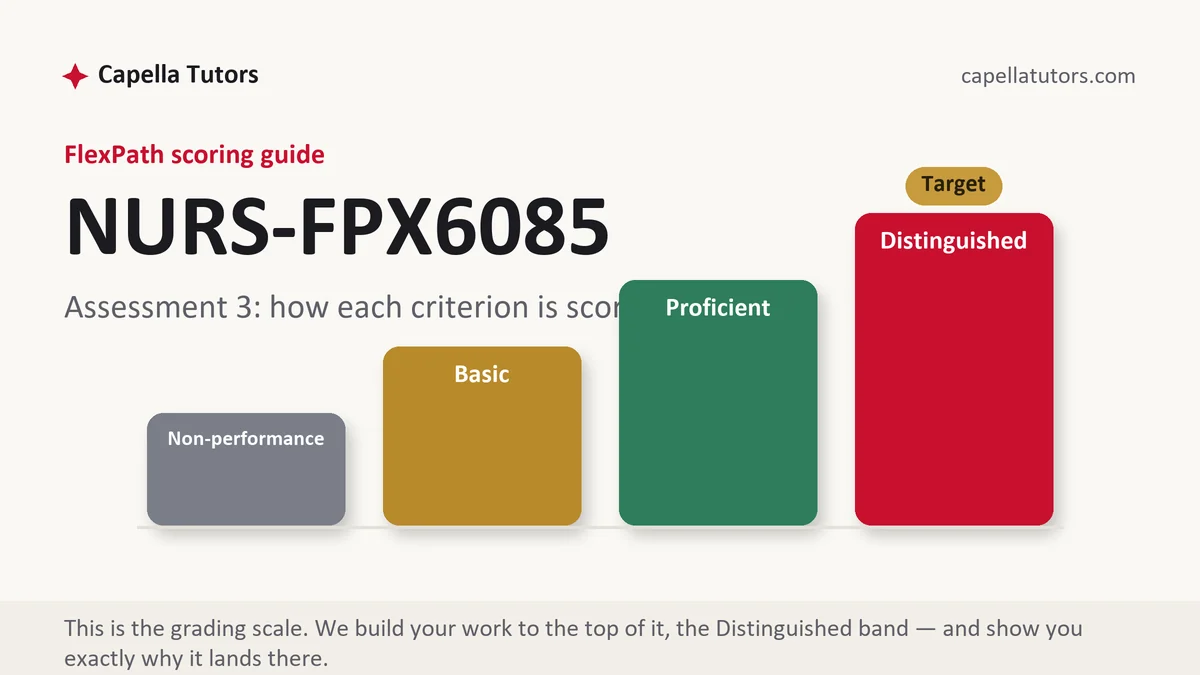
How NURS FPX 6085 Assessment 3 is scored
Criteria in FlexPath resolve to four levels rather than to a grade, and the wording of each level is the design brief:
| Level | What it means on an intervention and implementation design |
|---|---|
| Distinguished | Each design choice traces to a specific source, a named framework does real work in the plan rather than appearing once, the schedule carries dates and owners, and a rejected alternative is documented with the reason it was rejected. |
| Proficient | A sound intervention, evidence cited, steps listed. What is missing is the traceability, so a reader cannot tell which source produced which decision. |
| Basic | A reasonable idea with literature attached afterwards. The plan describes activity rather than a mechanism, and no framework is visibly guiding anything. |
| Non-performance | A required component never appears, most often the resource or stakeholder analysis, or the measurement plan the evaluation deliverable will depend on. |
The habit that separates graduate design work from competent planning is derivation. In the published implementation literature, every element of an intervention can be traced to a reason, and reasons are either evidence or a stated constraint of the setting. Write so that a reader could ask why about any sentence in your plan and find the answer already there.
The NURS FPX 6085 Assessment 3 method, step by step
-
Derive the intervention rather than defend the one you arrived with
Most students walk in with a solution already chosen. Set it aside long enough to read what the evidence actually recommends for your problem, then either adopt what the literature supports or state clearly why your setting requires a variant. Designs assembled from evidence look different from designs justified after the fact, and evaluators who read a lot of these can tell which they are holding.
-
Put a framework to work, visibly
Choose one change or implementation framework and let it structure the plan, so its phases become your phases and its constructs decide what you assess before you begin. A framework named in the introduction and abandoned by the second page is worse than none, because it advertises a rigor the plan does not have. If your specialization has its own model, use that one; the criteria reward work that reads as belonging to your degree.
-
Design for the unit you have, at the hour you have it
Write the intervention against real conditions: who is present at 0300, what the documentation system will and will not let you add, which competing initiative is already consuming the staff's attention. A design that would work on a fully staffed day shift and nowhere else is a design that will fail in week seven, and the failure will be attributed to the plan.
-
Write implementation as a schedule with names on it
Convert the design into dated phases, each with an owner, a deliverable, and the resources it consumes. Include the education or communication step, because interventions requiring staff behavior change fail at that step more often than at any other. Then count the hours the schedule costs you and check the total against what remains of your 200, since a plan that needs more hours than the session holds is not yet a plan.
-
Plan the resistance you can already name
Stakeholder analysis that praises the value of buy-in earns nothing. Name the roles likely to object, state the objection as they would state it, and write the specific response, whether that is a schedule change, a data point, or an ally who carries more weight than you do. Include the objection you consider legitimate. Acknowledging a real cost to the people doing the work is read as clinical maturity rather than as weakness.
-
Fix the measure before anything is implemented
Declare the measure, its definition, its collection method, and its collection dates inside this deliverable, and separate process measures from outcome measures while you do it. Deciding after implementation what you will report is the flaw that most reliably damages the final evaluation, and it is visible from the outside. Then mark yourself against each criterion and submit while the week still has evaluation capacity left in it.
A structure that maps to the criteria
Planning lengths our tutors work to for a typical design and implementation deliverable, not Capella rules. Shift the weight toward whatever your guide emphasizes.
| Section | What it must do | Guide |
|---|---|---|
| Problem restated and objective | The problem and baseline carried forward without drift, and the specific change the intervention is meant to produce. | ~200 words |
| Evidence and rationale | What the literature supports, source by source, with the mechanism explained and one rejected option and its reason. | ~400 words |
| The intervention | Exactly what will happen, who does it, when, and how it fits the documentation system and the staffing reality. | ~350 words |
| Framework and phases | The chosen framework and how its phases organize the work, with the constructs it tells you to assess up front. | ~250 words |
| Stakeholders and resistance | Named roles, their likely objections in their own terms, the response to each, and the resources required. | ~300 words |
| Measurement plan and references | Measure, definition, collection method and dates, process and outcome kept apart, then reconciled APA references. | ~250 words |
Annotated sample excerpt
An original model from our writers, showing how a design sentence carries its own justification. Use it as study material.
Shift report will move to a fixed five-field structure delivered at the bedside, because the studies supporting structured handoff attribute the effect to a constrained field set rather than to the location, while the bedside element is included on the separate evidence that patient presence reduces omitted care preferences.1 A checklist longer than five fields was rejected: the same literature reports abandonment when report length increases, and this unit already runs report inside a nine-minute overlap.2 Fidelity will be measured as the proportion of observed handoffs containing all five fields, collected by direct observation on twelve randomly selected shifts, which is a process measure and is reported separately from the omission rate.3
- 1Two design choices, two distinct evidence bases, each tied to the mechanism it explains. This is what traceability looks like at sentence level.
- 2The rejected alternative with its reason, half evidence and half local constraint. Documenting the road not taken is a Distinguished move on design criteria.
- 3Measure defined, method and sample stated, and process explicitly separated from outcome before implementation begins.
The full premium sample for your exact assessment, written fresh to your scoring guide and issue, is free to request. Study it, revise it into your own voice, and submit work you understand.
The five mistakes that cost Distinguished
- Evidence bolted on afterwards. Citations that support a decision already made read differently from citations that produced it, and the difference is legible.
- A decorative framework. Named once, never used, and the plan structured by nothing. This costs more credibility than omitting a framework entirely.
- A schedule with no owners. Phases without named responsibility are intentions, and the implementation criterion is looking for accountability.
- Buy-in as a paragraph. Anticipating resistance means naming who objects and what you will do, not affirming that engagement matters.
- Measurement deferred. A measure chosen after implementation cannot be defended, and it undermines the evaluation deliverable that follows.
Pre-submission checklist
- Every design choice traceable to a source or to a stated site constraint
- One framework organizing the phases, doing visible work throughout
- A rejected alternative documented with the reason it was rejected
- Dated phases with owners, resources, and an hour count that fits your remaining hours
- Named roles, their objections stated in their terms, and a concrete response to each
- Measure, definition, method and dates fixed now, process and outcome kept apart
Designing the intervention this week?
Send the scoring guide, your problem statement, and your baseline. Our research analyst builds the criterion map and the evidence table, a writer drafts the design against it, and scoring-guide and APA review close it out in 24 to 48 hours. We write the deliverables and the documentation; the clinical hours behind the project are yours, and no part of them is ours to complete.