This manual is for NURS FPX 6085 Assessment 2, start to submission. Send the scoring guide and a line about your setting and a premium original sample comes back inside 24 to 48 hours, revised at no charge until every criterion is met. This deliverable in NURS FPX 6085 usually asks you to define the practice problem your capstone will address, ground it in your practicum site rather than in national statistics, and frame it as a searchable question, most often in PICOT form. Your scoring guide decides the required elements and their order. Below is the method our tutors use, a structure that maps to the criteria, and an annotated excerpt. Capella's catalog lists the course as NURS-FPX6085, and some courserooms print NURS6085; both point to this same Assessment 2. In current courserooms this assessment typically appears as "Problem Statement (PICOT)".
One honesty note before the manual: Capella revises courses and scoring guides over time, so always write to the exact scoring guide attached to your assessment in the courseroom. The course identity above is verified on capella.edu; the method and structure below are our tutors' approach to it, not Capella's official rubric text.
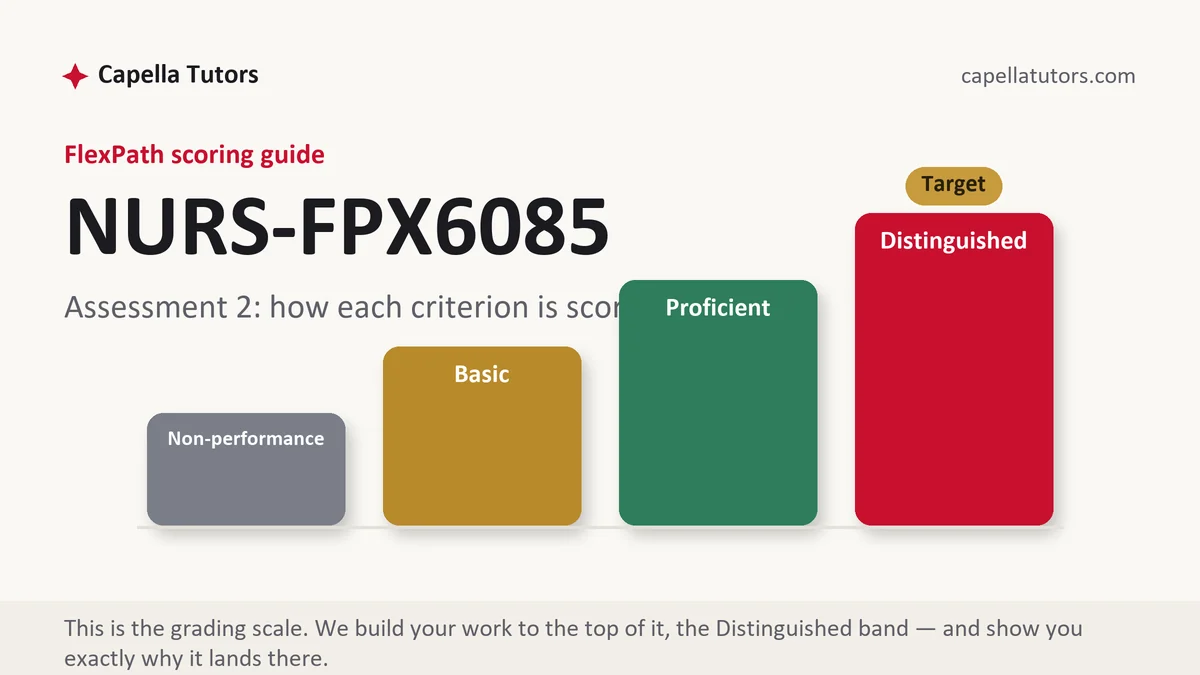
How NURS FPX 6085 Assessment 2 is scored
Every criterion in FlexPath lands on one of four levels instead of a grade, and the level wording is the writing specification:
| Level | What it means on a problem statement |
|---|---|
| Distinguished | The problem is quantified from the writer's own setting, the question is specific enough to be searched and answered, and the impact is argued in both clinical and operational terms with the boundary of the claim stated. |
| Proficient | A real problem, correctly framed and sourced, but sized from published literature rather than from the site, so the question could belong to any student anywhere. |
| Basic | A topic area rather than a problem. Important, widely discussed, and impossible to design a 200-hour intervention against. |
| Non-performance | A required element is missing, commonly the site description, the population boundary, or the timeframe in the question. |
The convention worth borrowing from the evidence-based practice literature is that a problem statement is a feasibility argument as much as a clinical one. Every choice you make here constrains what the later deliverables can design, implement, and measure, so a statement that reads impressively while being unmeasurable in your setting is the most expensive mistake available in this course.
The NURS FPX 6085 Assessment 2 method, step by step
-
Find the problem in your site's own numbers
Start from something already counted where you practice: a rate somebody reports monthly, a queue somebody complains about, a field left blank in the record. Problems that already generate data are the ones you can size in week two and measure again in week ten. Problems that would require new measurement infrastructure are the ones that consume a session without producing an evaluation.
-
Write the baseline down before you write the problem
Get the number first, then write the statement around it. Note the source of the figure, the period it covers, how it is defined, and who produced it, because you will be asked all four later and a baseline whose definition drifts between deliverables is what faculty notice and question. If you cannot obtain the figure yourself without a data request that may never clear, that is your answer about the project, and it is much cheaper to learn it now.
-
Build the question and keep every element honest
In PICOT form, the population needs a boundary you can enumerate, the intervention needs to be one thing you can actually deliver, the comparison is usually current practice and should be described rather than named, the outcome must be something already recorded or recordable by you, and the timeframe has to fit inside the hours. Weak questions almost always fail at the O and the T. A question ending in improved patient outcomes over time has no measurable content at all.
-
Search like a reviewer rather than a shopper
Work through the Capella library with deliberate terms, record what you searched and where, and read what disagrees with you. A problem statement whose sources all point one way tells an experienced reader that the search was conducted to confirm rather than to find. Favor primary studies over the reviews summarizing them, keep most sources inside five years, and add your specialization's standards documents because they establish the expectation your problem falls short of.
-
Argue the impact in two currencies
Say what the problem costs patients and what it costs the organization, in separate paragraphs, with evidence behind each. Master's level work is expected to hold both, and the operational half is where most drafts go thin. Time, rework, avoidable contacts, staff hours spent compensating for a broken process, all of it is legitimate and all of it makes the project defensible to the site whose permission you need.
-
Test the statement against the guides that come after
Open the remaining scoring guides in the course and read your draft problem statement against them. Can an intervention be designed for it from published evidence, delivered by you inside your hours, and evaluated against the baseline you just recorded? If any answer is no, shrink the statement now. Self-score each criterion afterwards and get the submission in early in the week.
A structure that maps to the criteria
Our tutors' planning targets for a typical capstone problem statement, not Capella requirements; adjust to the weighting in your own guide.
| Section | What it must do | Guide |
|---|---|---|
| Problem and question | The practice problem in one paragraph and the question in structured form, with every element specified. | ~250 words |
| Site and population | The de-identified setting, the population served, the unit, and the operating conditions that bear on the problem. | ~250 words |
| Baseline evidence | The number, its source, its definition, and its period, presented so a reader could reproduce how you obtained it. | ~250 words |
| Clinical impact | What the problem does to patients, supported by current literature and connected to your own population. | ~300 words |
| Operational impact | What it costs the organization in time, rework, or capacity, argued rather than asserted. | ~250 words |
| Feasibility, limits, references | Why this is deliverable in the hours available, what the statement does not claim, then reconciled APA references. | ~250 words |
Annotated sample excerpt
An original model from our writers, showing what a quantified problem statement sounds like. Learn the structure and write your own version.
At a rural primary care clinic serving roughly 4,100 established patients across two counties, discharge callbacks after hospital transitions are recorded as completed for 38 percent of eligible patients, taken from the clinic's transition-of-care worklist for January through March 2026, where eligible means a patient discharged from any inpatient facility in the preceding seven days.1 The gap matters clinically because the unreached patients are the ones whose medication changes go unverified, and operationally because each unresolved transition generates an average of two additional unscheduled contacts before the next appointment.2 The question asks whether a nurse-led structured callback protocol, compared with the clinic's current ad hoc practice, increases documented callback completion among discharged adult patients within a ten-week implementation window.3
- 1A number with its source, its period, and its definition. The definition is what keeps the baseline stable across the remaining deliverables.
- 2Impact argued in both currencies inside one sentence, clinical first, operational second. This is the move that makes a project defensible to the site.
- 3Every element of the question is specified and each one is something the writer can deliver or measure. Note the timeframe fits inside the session.
The full premium sample for your exact assessment, written fresh to your scoring guide and issue, is free to request. Study it, revise it into your own voice, and submit work you understand.
The five mistakes that cost Distinguished
- A national statistic doing the site's job. Published prevalence establishes that a problem exists somewhere, not that it exists on your unit at a size you can move.
- An outcome nobody records. If the measure does not already exist in your documentation, the evaluation deliverable has nothing to work with.
- A timeframe borrowed from the literature. Twelve-month follow-up periods belong to published trials, not to a 200-hour practicum.
- Sources that all agree. A one-directional reference list reads as a search designed to confirm, and reviewers notice it immediately.
- Impact stated only for patients. Leaving the operational argument out costs the criterion and weakens the case to the people whose permission you need.
Pre-submission checklist
- The baseline number appears with its source, definition, and period
- Every element of the question is specified and deliverable by you
- Site and population described concretely, individuals and employer de-identified
- Clinical and operational impact each argued with their own evidence
- At least one source that complicates your position, read and cited
- Draft tested against the later scoring guides, then self-scored criterion by criterion
Scoping the capstone problem now?
Send the guide, your setting, and the problem you are circling, ideally before you commit to it. A research analyst builds the criterion map and pressure-tests the scope against the hours you have, then an MSN-credentialed writer drafts it. We write the deliverables and the documentation, never the clinical hours, which remain yours to work and your site's to verify.