This manual is for NURS FPX 6026 Assessment 2, start to submission. Upload the criteria and the population you are working with and a premium original sample comes back within 24 to 48 hours, criterion walkthrough included, revised free until your guide is met. This deliverable usually asks for a policy proposal rather than a project plan: language a governing body could adopt, the biopsychosocial case that makes it necessary, the evidence and precedent behind it, and the measures that would show it working. The difference matters. A project asks for permission and a policy changes the default. Capella's catalog lists the course as NURS-FPX6026, and some courserooms print NURS6026; both point to this same Assessment 2. In current courserooms this assessment typically appears as "Biopsychosocial Population Health Policy Proposal".
One honesty note before the manual: Capella revises courses and scoring guides over time, so always write to the exact scoring guide attached to your assessment in the courseroom. The course identity above is verified on capella.edu; the method and structure below are our tutors' approach to it, not Capella's official rubric text.
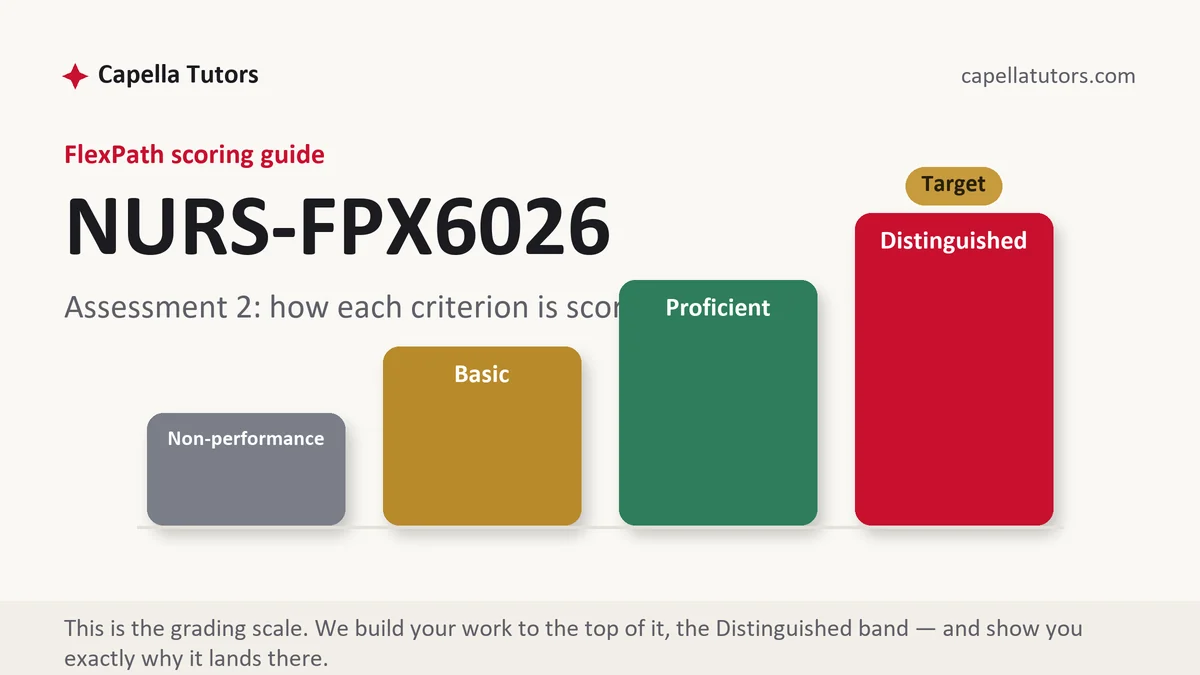
How NURS FPX 6026 Assessment 2 is scored
Four levels per criterion, and the top column here describes something closer to a governance document than an essay:
| Level | What it means on a policy proposal |
|---|---|
| Distinguished | The proposal contains adoptable language with a scope, a trigger, and an accountable role; the drivers behind it are argued as mechanisms; and the objections a committee will actually raise are answered before they are raised. |
| Proficient | The problem, the evidence, and the recommended direction are all sound. What is missing is text somebody could vote on. |
| Basic | A well-supported case for doing something, with the something left as a general commitment. No scope, no trigger, no owner, no cost. |
| Non-performance | A required element is absent, most often the stakeholder analysis, the resource implications, or the evaluation measures. |
Policy writing rewards a particular kind of precision about evidence. State the population the effect was measured in before you claim the effect for yours. Give the magnitude and its interval where a design decision depends on it, and say plainly when a body of evidence supports a direction but not a dose, which is often the honest position for a bundled intervention. A committee that catches you overclaiming once will discount everything else in the document.
The NURS FPX 6026 Assessment 2 method, step by step
-
Draft the policy sentence first and build the paper around it
Write the text you want adopted before you write the case for it: who is covered, what is triggered, by whom, within what interval, with what exception. Having that sentence early stops the document drifting into advocacy, because every section afterward has one specific object to justify.
-
Size the problem inside your own population
Prevalence, incidence, and the outcomes attached to it, each figure with its source in the same sentence, and each drawn from a population you can argue resembles yours. Add utilization and cost where the data exists, because a policy proposal is read by people who hold a budget and the burden section is where they decide whether to keep reading.
-
Argue three or four drivers as mechanisms
A driver is not a factor; it is a chain with an outcome at the end. Sensory deprivation from routine overnight vital signs shortens consolidated sleep, which raises the likelihood of an acute confusional episode, which lengthens the stay and raises the fall risk that the same policy is meant to reduce. Drivers written that way tell you what instrument to choose.
-
Match the policy instrument to the driver
Different mechanisms need different levers. A default in the electronic record changes a habit nobody defends. A required screening at a defined moment changes what gets noticed. A standing order changes who may act without waiting. A staffing or scheduling rule changes what is possible at three in the morning. Say which lever each driver receives and why the softer alternative would not hold.
-
Do the stakeholder analysis honestly
Name the roles the policy costs and the roles it relieves, and expect resistance from the ones it costs. Nursing time, medical autonomy, pharmacy workload, environmental services scheduling, and the finance office all have positions, and a proposal that names two objections and answers them in the text reads as governance rather than as advocacy.
-
Attach measures and an equity check, then self-score
Pair an outcome measure with a compliance measure and a balancing measure, each with its definition, its source system, its interval, and the committee that reviews it. Then state which subgroup the policy will serve least well and what the proposal does about them. Grade yourself against each criterion before the document leaves your desk, and submit early in the week rather than late.
A structure that maps to the criteria
These are our planning targets for a proposal of this scope, not Capella rules; adjust to whatever your own criteria weight most.
| Section | What it must do | Guide |
|---|---|---|
| Problem and population | The population bounded by condition, age, and setting, with burden and outcome figures cited in the sentence. | ~250 words |
| Biopsychosocial drivers | Three or four mechanisms, each ending in an outcome the policy is meant to change. | ~300 words |
| The proposed policy | Adoptable text: scope, trigger, accountable role, interval, exceptions, and effective date. | ~250 words |
| Evidence and precedent | Trials and reviews behind each component, with the population each effect was measured in, plus any facility that has already adopted something similar. | ~350 words |
| Stakeholders and resources | Who pays in time or money, who resists, and the ask stated in hours, roles, or system builds. | ~250 words |
| Measures and equity | Outcome, compliance, and balancing measures with sources and reviewers, plus the subgroup served least well. | ~200 words |
Annotated sample excerpt
An original model from our team showing the register a governance reader expects. Take the moves, then write yours.
All inpatients aged 65 and over admitted to a medical or surgical unit will be screened for confusion once per shift using a validated bedside instrument, with the result recorded in the flowsheet and a positive result routed to the attending team within one hour.1 Overnight vital signs and non-urgent phlebotomy between 11 p.m. and 5 a.m. require an order specifying the clinical reason, which makes uninterrupted sleep the default rather than the exception.2 Multicomponent programs of this shape reduced incident confusion by roughly a third in pooled hospital cohorts, an effect consistent in direction across settings while the individual contribution of each component remains unresolved, which is why the policy mandates the bundle and not a single element of it.3
- 1Scope, frequency, instrument type, documentation location, and an escalation interval in one adoptable sentence. This is what a committee can vote on.
- 2Changes a default rather than adding a reminder, and says so. Naming the lever is the analysis a policy criterion rewards.
- 3Claims the direction of the effect, declines to claim the dose, and turns that honesty into a design decision. Overclaiming here would cost more than the claim was worth.
The full premium sample for your exact assessment, written fresh to your scoring guide and issue, is free to request. Study it, revise it into your own voice, and submit work you understand.
The five mistakes that cost Distinguished
- A proposal with no adoptable text. If no sentence in the document could be pasted into a policy manual, the deliverable is an argument for a policy rather than a policy.
- Drivers listed as factors. A catalog of contributing influences gives the design nothing to aim at; mechanisms ending in outcomes do.
- Effects claimed for a population the studies never included. Naming the population an effect was measured in costs one clause and protects the whole argument.
- Stakeholders described as supportive. Somebody always pays in time, and a proposal that cannot say who has not been through governance in its author's mind.
- Compliance left unmeasured. Without a compliance measure, a policy that was never followed and a policy that did not work look identical in the data.
Pre-submission checklist
- One paragraph contains text a governing body could adopt verbatim
- Every burden figure carries its source and the population it came from
- Three or four drivers are written as mechanisms ending in outcomes
- Each component names the lever it uses and why a softer version would not hold
- Two objections from named roles are answered inside the document
- Outcome, compliance, and balancing measures each have a source, interval, and reviewer
Writing the policy proposal this week?
Upload the criteria and the population, and the draft comes back as a governance document: adoptable text, drivers argued as mechanisms, the resource ask in real units, and a measure set a committee would accept. Premium original sample in 24 to 48 hours, revised free until your guide is met.