This manual is for NURS FPX 6026 Assessment 1, start to submission. Send the criteria and name the group you are writing about, and a premium original sample arrives inside 24 to 48 hours, written to the Distinguished column with free revisions until your guide is satisfied. The opening deliverable of NURS FPX 6026 usually asks you to analyze the positions that professional bodies, agencies, and researchers have taken about a vulnerable population, and then to arrive at one of your own. It is an argument about arguments. Summarizing three position statements accurately is the work of the middle column; adjudicating between them is the work of the top. Capella's catalog lists the course as NURS-FPX6026, and some courserooms print NURS6026; both point to this same Assessment 1. In current courserooms this assessment typically appears as "Analysis of Position Papers for Vulnerable Populations".
One honesty note before the manual: Capella revises courses and scoring guides over time, so always write to the exact scoring guide attached to your assessment in the courseroom. The course identity above is verified on capella.edu; the method and structure below are our tutors' approach to it, not Capella's official rubric text.
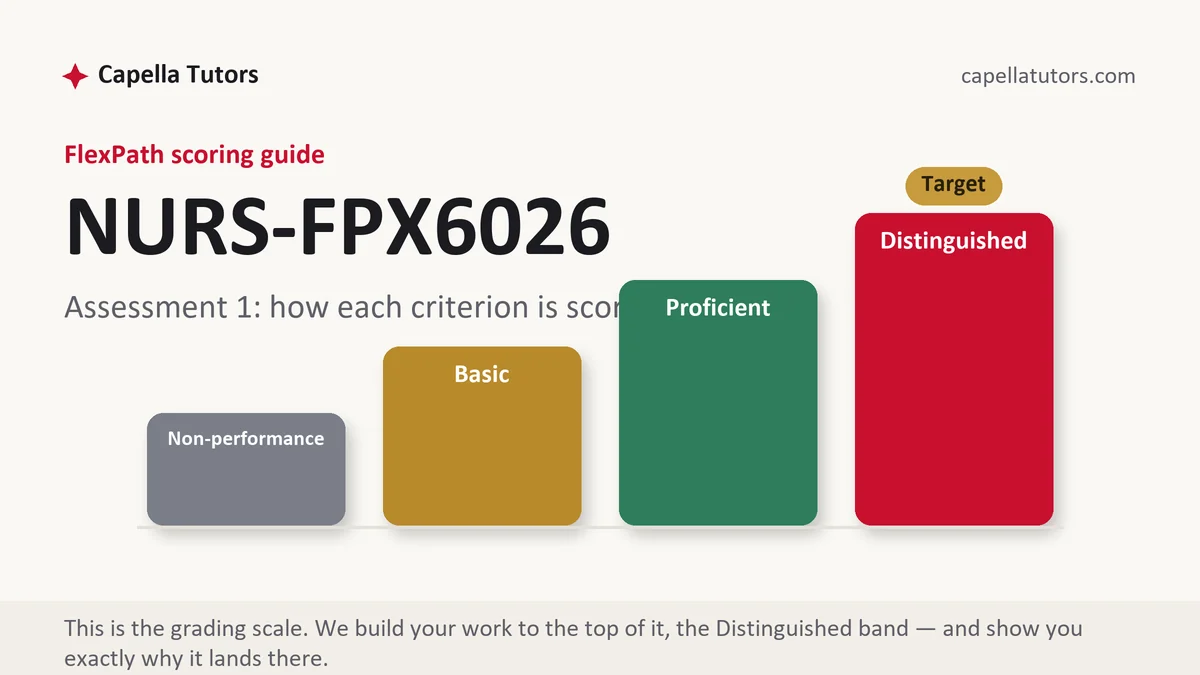
How NURS FPX 6026 Assessment 1 is scored
Each criterion is placed at one of four levels, and the gap between the middle two is the gap between reporting positions and weighing them:
| Level | What it means on an analysis of positions |
|---|---|
| Distinguished | The positions are set against each other at the exact point where they diverge, the evidence behind each is examined by design and not by prestige, and your own position arrives with the objection to it answered. |
| Proficient | The positions are represented fairly and completely, and the population's vulnerability is well established. Nothing yet has been decided between them. |
| Basic | Three summaries in sequence, each accurate, with a closing paragraph that agrees with all of them. No conflict located, so no analysis available. |
| Non-performance | A required element is missing, most often the interprofessional implications or the evidence appraisal behind one of the positions. |
Two conventions from scholarly argument carry weight here. Attribute a position to the body that holds it, with the year of the statement, because professional positions are revised and citing a superseded one is a visible error to a faculty reader. And judge the support behind a position rather than the standing of the body that issued it: a recommendation resting on consensus opinion is a different object from one resting on pooled trial data, and saying which is which is the appraisal the criterion wants.
The NURS FPX 6026 Assessment 1 method, step by step
-
Mark which criteria ask you to represent and which ask you to judge
Represent and analyze are different tasks and they earn different paragraphs. Build the outline with one heading per criterion, then write the word represent or judge beside each heading. Any judgment criterion answered with a fair summary has been answered in the wrong mode, and that single error accounts for most mid-column outcomes in this deliverable.
-
Define the population by the interests that make it vulnerable
Vulnerability is structural rather than adjectival, so name the structure: coverage that ends at a fixed number of weeks, a screening interval that falls outside every scheduled visit, a service that exists only during working hours. Postpartum people insured through a program with a fixed postpartum coverage window are a group whose vulnerability can be traced and measured. Vulnerable mothers cannot be.
-
Gather positions from bodies with standing, and date them
Specialty society statements, federal task force recommendations, accreditation requirements, and peer-reviewed argument pieces. Take the current version of each, note the year, and record the strength of the recommendation where the body publishes one. Three well-chosen positions beat six, because the analysis lives in the comparison and six comparisons do not fit.
-
Find the seam where the positions actually disagree
Bodies rarely disagree about whether a problem exists. They disagree about the interval, the threshold, the setting, who administers, or who pays. Locating that seam is the whole assignment: once you can write the sentence stating what one body requires and another leaves optional, the analysis criterion has something to reward.
-
Appraise the evidence under each position separately
Take the studies each body cites and rank them by design, then ask whether the population studied resembles the population you are writing about. A recommendation built on trials in academic obstetric practices may not transfer to a rural federally qualified health center, and naming that mismatch is analysis rather than criticism.
-
State your own position with its objection answered, then self-score
Close with a position, not a preference: which standard you would adopt, in which setting, at whose cost, and what you accept as its weakness. Add the strongest argument against you and answer it in the same section. Then grade the draft criterion by criterion and give anything below the top level another pass.
A structure that maps to the criteria
Planning targets our tutors work to for an analysis of this kind rather than Capella requirements; expand wherever your own guide concentrates weight.
| Section | What it must do | Guide |
|---|---|---|
| The population and its vulnerability | The group defined by a structural feature, with the disparity quantified and sourced. | ~250 words |
| Positions on the table | Each position attributed to its body with its year and its recommendation strength, stated fairly. | ~300 words |
| Where they diverge | The seam named precisely: interval, threshold, setting, administering role, or payer. | ~250 words |
| Evidence under each position | The studies behind each stance, ranked by design and tested for transfer to your population. | ~350 words |
| Your position | The standard you would adopt and why, with the counterargument stated and answered. | ~250 words |
| Interprofessional implications | Which roles the position changes work for, and what each would have to do differently. | ~200 words |
Annotated sample excerpt
An original model passage from our team, pitched where the top column sits. Study the moves and write your own version.
All three bodies agree that perinatal depression should be screened for, and none of them agrees on when. The obstetric society's 2023 statement places screening at the initial visit and again at the comprehensive postpartum visit; the pediatric statement puts it at well-child visits through the first six months, on the reasoning that the infant's schedule is the only reliable contact after week six; the task force recommendation names no interval at all and rests on evidence that treatment works when depression is detected.1 The seam is therefore not the value of screening but the ownership of the contact after the postpartum visit, and that question is where every implementation failure in this population lives.2 Only the pediatric position rests on evidence gathered in the setting it recommends, which is the strongest argument for adopting it even though it assigns the work to clinicians who do not treat the patient.3
- 1Three positions attributed, dated, and given with their reasoning in one sentence each. Fair representation done economically, so the space goes to the analysis.
- 2Names the seam explicitly. Everything the criterion asks for as analysis depends on a sentence like this existing somewhere on the page.
- 3Judges by the fit between evidence and setting rather than by the standing of the body, and concedes the cost of the choice in the same breath.
The full premium sample for your exact assessment, written fresh to your scoring guide and issue, is free to request. Study it, revise it into your own voice, and submit work you understand.
The five mistakes that cost Distinguished
- Three summaries and a handshake. Positions reported accurately and then endorsed collectively leaves the analysis criterion with nothing to grade.
- Positions cited without dates. Professional statements are revised, and quoting a superseded version is an error a nurse faculty member spots immediately.
- Authority mistaken for evidence. A prestigious body can hold a consensus position on thin data, and the criterion is asking you to notice.
- Vulnerability asserted as a quality of people. Structural features can be quantified and changed; adjectives about disadvantage cannot.
- A position with no cost admitted. Every adoptable standard burdens somebody, and naming who is what makes your stance credible rather than promotional.
Pre-submission checklist
- The population is defined by a structural feature, with the disparity quantified
- Each position is attributed to its body with its year and recommendation strength
- The exact seam of disagreement is stated in one sentence
- Evidence under each position is ranked by design and tested for transfer
- Your own position names its cost and answers the strongest objection
- Interprofessional implications state what each role would do differently
Want the position analysis done with backup?
Send the scoring guide and the population you have chosen. Our research analyst locates the current statements and the evidence underneath them, and a premium original sample comes back inside 24 to 48 hours written to the Distinguished column, with revisions until it gets there.