This manual is for NURS FPX 6011 Assessment 3, start to submission. Tell us which practice change you are carrying and a premium original sample comes back within 24 to 48 hours, written to the Distinguished column and revised free until your guide is satisfied. The closing deliverable of NURS FPX 6011 usually asks you to implement rather than to propose: take an evidence-based change, build the case for it in the form your audience will actually receive, and show how the interprofessional team adopts it, sustains it, and measures it. Many versions arrive as a presentation with speaker notes, which changes the writing more than students expect. Capella's catalog lists the course as NURS-FPX6011, and some courserooms print NURS6011; both point to this same Assessment 3. In current courserooms this assessment typically appears as "Implementing Evidence-Based Practice".
One honesty note before the manual: Capella revises courses and scoring guides over time, so always write to the exact scoring guide attached to your assessment in the courseroom. The course identity above is verified on capella.edu; the method and structure below are our tutors' approach to it, not Capella's official rubric text.
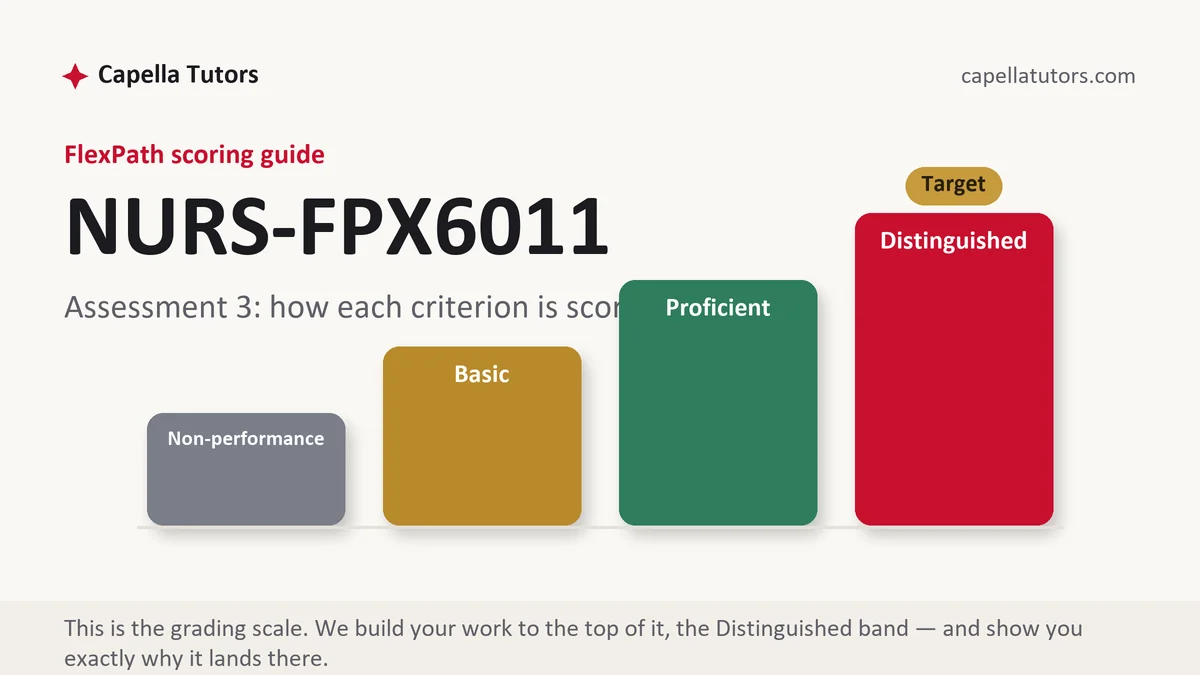
How NURS FPX 6011 Assessment 3 is scored
Four levels, one per criterion, and the top column is describing implementation reasoning rather than enthusiasm:
| Level | What it means on an implementation deliverable |
|---|---|
| Distinguished | The change is specified as a workflow with an owner and a trigger, adoption barriers are anticipated and answered, and the sustainment plan survives the moment the project attention stops. |
| Proficient | The change, the evidence, and the team roles are all present and correct, with barriers acknowledged in general terms rather than answered in specific ones. |
| Basic | A summary of the evidence plus a plan to educate staff. Nothing in the workflow visibly changes, so nothing could be audited. |
| Non-performance | A required element is absent, most often the evaluation measures or the speaker notes the format asked for. |
If the deliverable is a presentation, hold two standards at once. The slide carries the claim in the fewest words that stay accurate; the speaker notes carry the scholarly apparatus, including design, sample, effect size, and citation. Guides in this course commonly score the notes as the written work, so a deck of confident headings with thin notes underneath scores exactly as thin as the notes are.
The NURS FPX 6011 Assessment 3 method, step by step
-
Fix the format before you write a word
Presentation length, notes expectation, citation placement, and audience are all specified somewhere in the prompt, and each one changes the drafting. Write the audience at the top of your outline and keep it there. A slide set aimed at a unit council reads differently from one aimed at a quality committee holding a budget.
-
State the change as a workflow, not as a value
Say who does what, at which point in the day, in place of which current step. A group visit model becomes real when the sentence reads: the medical assistant batches eight patients into a 90 minute Thursday morning slot, the pharmacist reviews medications in the first 20 minutes, and the individual follow-up visit those patients would otherwise have received is retired. Now there is something to audit.
-
Build the evidence case in the order a reviewer reads
Design and setting, then sample, then the effect with its interval, then applicability to your population. Lead with the strongest design you found and say so. Where a smaller study resembles your setting better than a larger one, name the trade-off you accepted and the mechanism you are relying on, because that sentence is the analysis a criterion can reward.
-
Assign interprofessional roles with triggers attached
Collaboration is graded as accountability, so write it that way. Pharmacy owns the medication review at a defined point. Behavioral health is paged by a screening threshold rather than by intuition. The physician signs the shared plan before teaching begins. Add the escalation path for the case where the first contact does not answer, and the criterion is finished.
-
Anticipate two adoption barriers and answer them in the text
Room availability, scheduling templates, billing for group encounters, a clinician group that does not attend the huddle where the change is announced. Naming two predictable obstacles and stating how the design survives them is what makes a plan read as written by somebody who has worked a clinic rather than sketched one.
-
Measure, then plan for the day attention fades
Pair one outcome measure with at least one process measure and one balancing measure, each with a numerator, a denominator, a data source, an owner, and an interval. Then say what holds the change in place after the pilot: a standing agenda item, a template default, an order set, an annual audit. Sustainment is where most implementation deliverables stop short, and where the top column is looking.
A structure that maps to the criteria
Planning targets our tutors use for an implementation deliverable of this size, not Capella rules. If the format is a deck, treat these as speaker-notes word counts rather than slide text.
| Section | What it must do | Guide |
|---|---|---|
| Problem and change proposed | The gap in one paragraph with its baseline, then the change stated as a workflow substitution. | ~250 words |
| Evidence supporting the change | Studies in reader order, design and sample before effect, with applicability to your population argued. | ~350 words |
| Implementation steps | Sequence, timeline, resources, and the first test small enough to run on one clinic day. | ~300 words |
| Interprofessional roles | Who owns which step, the trigger that activates each role, and the escalation path. | ~250 words |
| Barriers and responses | Two predictable obstacles named, each with the design feature that answers it. | ~200 words |
| Evaluation and sustainment | Outcome, process, and balancing measures with owners and intervals, plus what keeps the change alive afterward. | ~250 words |
Annotated sample excerpt
An original passage from our team, pitched at the level the guide's top column describes. Learn the moves, then write yours.
The strongest evidence for the group visit model comes from a multisite randomized trial in 14 primary care practices, 1,306 adults with type 2 diabetes, reporting a mean glycated hemoglobin reduction of 0.6 percentage points at twelve months, 95 percent confidence interval 0.4 to 0.8, against usual individual visits.1 A smaller single-site cohort in a clinic closer in staffing to ours found a similar direction of effect but lost a third of participants by month six, which tells us the mechanism transfers and the retention does not.2 We are therefore adopting the visit structure from the trial and the reminder schedule from the cohort's stated remedy, and we will treat six-month attendance as a process measure rather than assuming it.3
- 1Design, sites, sample, then effect with its interval and its comparator. That order is how a journal reports and how a graduate evaluator reads.
- 2Puts two studies in contact and extracts something usable from the weaker one. Listing both would be Basic; separating what transfers from what does not is the graded move.
- 3Turns the appraisal into a design decision and a named measure. Evidence that changes nothing in the plan reads as decoration.
The full premium sample for your exact assessment, written fresh to your scoring guide and issue, is free to request. Study it, revise it into your own voice, and submit work you understand.
The five mistakes that cost Distinguished
- Slides that argue and notes that do not. When the notes carry the scholarly weight, thin notes are a thin paper however clean the deck looks.
- A change with no workflow substitution. If nothing current stops happening, the plan has added work rather than redesigned it, and staff will read that before your evaluator does.
- Effect claims without design or interval. A recommendation resting on the assertion that studies show improvement cannot be appraised, and appraisal is graded here too.
- Collaboration described as a culture. Teams collaborate when a trigger tells a named role to act; nothing else is auditable, and auditable is what the criterion means.
- No sustainment paragraph. Plans that end at the pilot leave the criterion about long-term adoption empty, and it is usually the easiest one on the guide to satisfy.
Pre-submission checklist
- Format, length, notes expectation, and audience confirmed against the prompt
- The change written as a workflow with an owner, a trigger, and a retired step
- Every effect claim preceded by design and sample and followed by its precision
- Interprofessional roles assigned with activation triggers and an escalation path
- Two adoption barriers named, each answered by a stated design feature
- Measures carry numerators, denominators, owners, and intervals, and sustainment is named
Closing out NURS FPX 6011?
Send the prompt, the scoring guide, and the practice change you have been building since the first deliverable. We return the slide text and the speaker notes as one document, cited and measured, inside 24 to 48 hours, then revise it free until your guide is satisfied. Finish the course the way the transcript should read.