This manual is for NURS FPX 6011 Assessment 2, start to submission. Upload the criteria and the population you are working with, and a premium original sample lands inside 24 to 48 hours with a criterion walkthrough attached and free revisions until it fits. This deliverable moves the course from diagnosis to design. It usually asks for a population health improvement plan: environmental and epidemiological data read as evidence, a health concern chosen from what that data shows, an intervention built to change a measurable outcome, and a communication strategy for the community and the professionals who will deliver it. The graded question is whether your plan could be staffed on Monday. Capella's catalog lists the course as NURS-FPX6011, and some courserooms print NURS6011; both point to this same Assessment 2. In current courserooms this assessment typically appears as "Evidence-Based Population Health Improvement Plan".
One honesty note before the manual: Capella revises courses and scoring guides over time, so always write to the exact scoring guide attached to your assessment in the courseroom. The course identity above is verified on capella.edu; the method and structure below are our tutors' approach to it, not Capella's official rubric text.
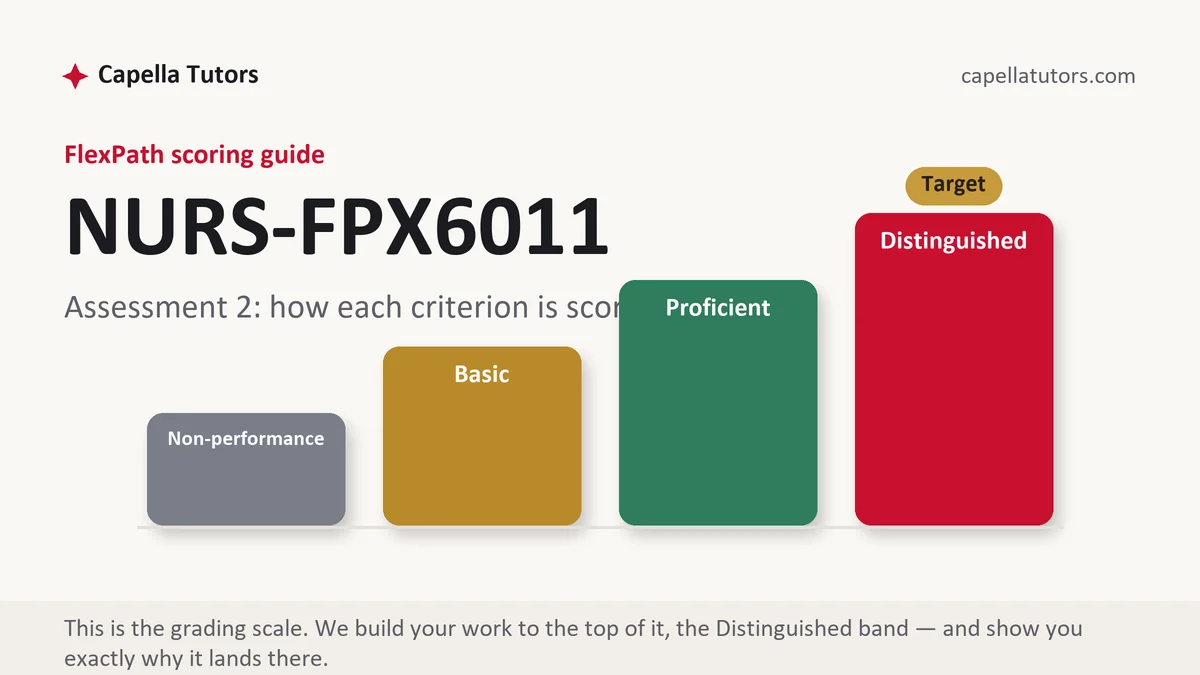
How NURS FPX 6011 Assessment 2 is scored
There are four levels per criterion and no grade curve. The words in the top column describe a specific act of reasoning, and your job is to perform it visibly:
| Level | What it means on a population health improvement plan |
|---|---|
| Distinguished | The data is interpreted rather than reported, the intervention is specified to the level of a staffing estimate, and the plan names the subgroup it will serve worst along with the adjustment for them. |
| Proficient | Data, concern, intervention, and communication approach are all sound and complete, with no judgment yet visible about trade-offs. |
| Basic | A data summary followed by a general commitment to education and outreach. No dose, no channel, no delivering role, so nobody could cost it. |
| Non-performance | A required element is missing outright, commonly the evaluation measures or the cultural and linguistic considerations the guide asked for. |
The scholarly convention that carries most weight in this deliverable is the disciplined separation of what the data shows from what you infer from it. Write the surveillance figure, its source, and its year, then start a new sentence for the inference. Evaluators who have written for peer review notice when the two are welded together, and a criterion asking you to analyze data cannot award analysis it cannot distinguish from description.
The NURS FPX 6011 Assessment 2 method, step by step
-
Split every compound criterion into its verbs
Analyze the data and explain the implications for the population is two graded tasks sharing one line. Mark each verb in the guide, give it its own paragraph in the outline, and tick it off in a final pass. Points lost here were never hidden; they were simply not looked for.
-
Read the environmental and epidemiological data as an argument
Coverage rates by age band, exemption patterns by school or district, disease incidence in the surrounding county, travel distance to a vaccinating provider. Pull each series from a named public health source with its collection year, then say what the pattern implies about where the shortfall is being produced. Data with no interpretation is a table; interpretation with no data is an opinion.
-
Name the health concern in a sentence that contains a measure
The concern should arrive with the outcome you intend to move and the baseline you intend to move it from. Adolescent immunization series completion at 58 percent in a school-based clinic serving 900 students is a workable statement of concern. Vaccine hesitancy among teenagers is a subject heading, and subject headings cannot be evaluated.
-
Assemble the evidence in three layers
Peer-reviewed trials and cohort studies for intervention effect, Cochrane reviews where the intervention has been reviewed, and a current professional guideline or federal recommendation for the standard your plan moves toward. Carry effect sizes and confidence intervals into the prose where they influence a design decision, since a bare significance claim tells a graduate reader nothing about whether the effect is worth staffing.
-
Design components against named mechanisms
Every component of the plan should answer a specific driver you have already argued. Reminder and recall messaging answers forgetting. Standing orders answer a missed opportunity at a visit already happening. Motivational interviewing training answers refusal driven by concern rather than by convenience. State who delivers each component, how often, through which channel, for how long, and what happens when a family disengages.
-
Write the communication strategy for two audiences at once
One version for the community, plain language, culturally located, delivered through channels the population actually uses, with reading level and translation named. One version for the professionals who will run the plan, which is a different document: roles, triggers, escalation, and the reporting rhythm. Guides in this course frequently grade both, and drafts that write only the first lose the criterion built on the second.
A structure that maps to the criteria
Targets our tutors plan against for an improvement plan of this scope, not rules from Capella; expand wherever your own criteria concentrate weight.
| Section | What it must do | Guide |
|---|---|---|
| Data analysis | The environmental and epidemiological series, each with source and year, then the inference drawn from the pattern in a separate sentence. | ~300 words |
| Health concern and population | The concern stated with an outcome measure and a baseline, the population written as inclusion criteria, and the reason this concern was prioritized over another. | ~200 words |
| Evidence base | Studies ranked by design and by resemblance to your population, with effect estimates and their precision carried into the text. | ~300 words |
| The improvement plan | Components, delivering roles, dose, channel, duration, and disengagement handling, each component aimed at a driver already argued. | ~300 words |
| Communication strategy | Community-facing approach with language and literacy handled, plus the interprofessional version with roles and triggers. | ~200 words |
| Evaluation and equity | Outcome and process measures with numerators, denominators, sources, intervals, and a stated adjustment for the subgroup served worst. | ~200 words |
Annotated sample excerpt
A model passage written by our team to show the level the top column is asking for. Study the moves and write your own version of them.
County surveillance for the 2024 school year records human papillomavirus series completion at 41 percent among students aged 13 to 17, against 62 percent statewide, with non-medical exemption filings concentrated in three of the district's eleven schools.1 Read together, those two series point away from access and toward decision-making: the schools with the lowest completion are the schools with the highest exemption rate, not the ones furthest from a provider.2 A cluster randomized trial in 22 school-based clinics found that a brief presumptive recommendation delivered by the clinic nurse raised series initiation by 9.4 percentage points, 95 percent confidence interval 4.1 to 14.7, an effect small per encounter and substantial across a panel of 900.3
- 1Three data series, each with its year and its comparison figure. The sentence describes and does not yet interpret, which keeps the next move clean.
- 2The inference gets its own sentence and rules out a rival explanation. This is the difference between a criterion reading description and a criterion reading analysis.
- 3Design and setting first, then effect with its interval, then a plain statement of practical scale. Precision reported and clinical weight judged, in that order.
The full premium sample for your exact assessment, written fresh to your scoring guide and issue, is free to request. Study it, revise it into your own voice, and submit work you understand.
The five mistakes that cost Distinguished
- Data reported and never read. Rates listed in a paragraph with no sentence saying what pattern they form leaves the analysis criterion with nothing to award.
- An intervention made of intentions. Increase education and improve outreach has no dose, no channel, and no owner, so no manager could staff it and no evaluator can credit it.
- Significance mistaken for importance. A p value is not a magnitude, and a graduate reader expects the effect size and its precision to appear before you decide the finding matters.
- A single communication plan for two audiences. The community message and the professional protocol are different documents, and guides here often grade them separately.
- No subgroup named. Every plan serves someone poorly, and saying who, plus your adjustment, is one of the cheapest routes to the top column in this course.
Pre-submission checklist
- Each data series arrives with its source, its year, and a separate interpretive sentence
- The health concern is stated with an outcome measure and a numeric baseline
- Effect sizes and confidence intervals appear wherever a design decision depends on them
- Every plan component names a delivering role, a dose, a channel, and a duration
- Community communication handles language, literacy, and channel explicitly
- One subgroup is named as served worst, with a stated adjustment for them
Want the improvement plan built with backup?
Upload the criteria and name the population and the data you already have. Our research analyst assembles the surveillance and trial evidence, and a premium original sample comes back in 24 to 48 hours, written to the top of the guide and revised free until it lands there. Plans that could be staffed are the ones that score.