This manual is for NURS FPX 6011 Assessment 1, start to submission. The Evidence-Based Patient-Centered Concept Map gives you a patient scenario, usually a patient managing a chronic condition such as diabetes amid family and social pressures, and asks you to analyze the patient's needs, build a concept map that links those needs to goals and evidence-based interventions, and write a narrative explaining the evidence, the communication strategies and the assumptions behind the map. The grade turns on patient-centeredness. A map that would fit any patient with the same diagnosis scores lower than one built around this patient's words, values and barriers. Below is the method our tutors use, a structure that maps to the criteria, and an annotated sample excerpt. Prefer to hand it off? A premium original sample for this exact assessment comes back in 24 to 48 hours, revised free until it meets the guide. Capella's catalog lists the course as NURS-FPX6011, and some courserooms print NURS6011; both point to this same Assessment 1. In current courserooms this assessment typically appears as "Evidence-Based Patient-Centered Concept Map".
One honesty note before the manual: Capella revises courses and scoring guides over time, so always write to the exact scoring guide attached to your assessment in the courseroom. The course identity above is verified on capella.edu; the method and structure below are our tutors' approach to it, not Capella's official rubric text.
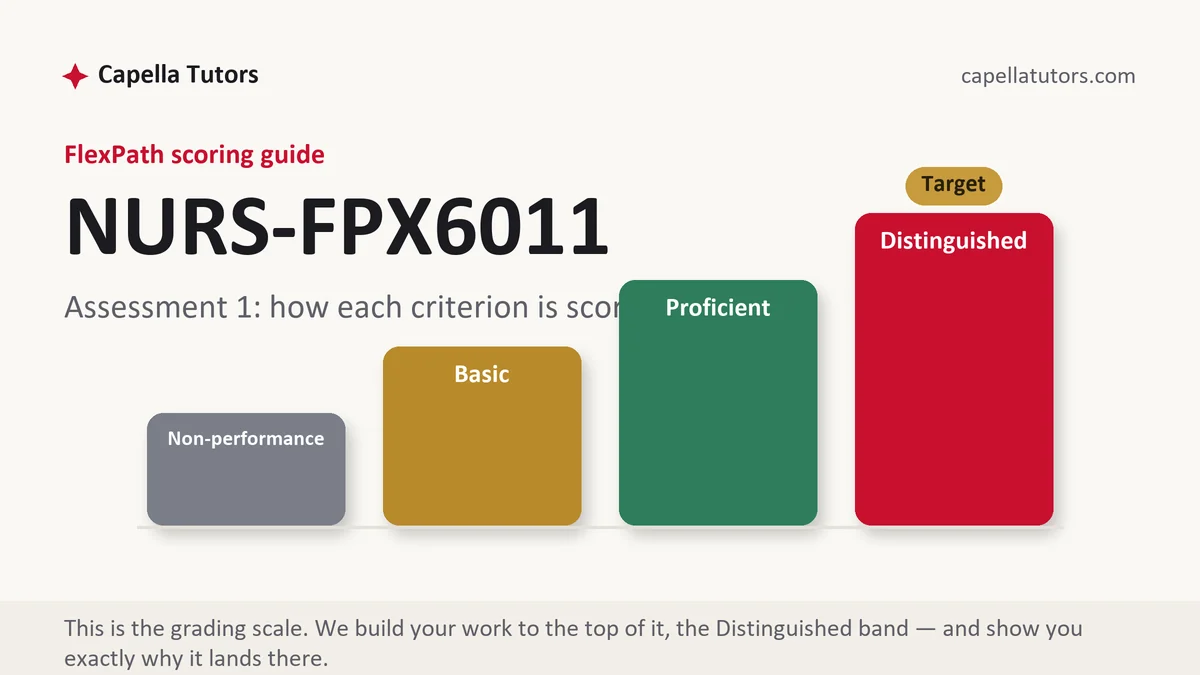
How NURS FPX 6011 Assessment 1 is scored
FlexPath does not use letter grades. Each criterion in the scoring guide lands on one of four levels, and the level descriptions are the real writing brief:
| Level | What it means on a patient-centered concept map |
|---|---|
| Distinguished | The map links each need from the scenario to a goal, an evidence-based intervention and an outcome measure, the narrative justifies each choice with current evidence, communication is tailored to the patient, and assumptions and unknowns are named. |
| Proficient | The map is complete and accurate, but some interventions are generic and the narrative explains less than the map shows. |
| Basic | The map lists diagnosis-level information and standard interventions, with little from the scenario. |
| Non-performance | The concept map or the narrative is missing, or required elements such as outcomes are absent. |
Use the template the course supplies if it supplies one, and quote the scenario. The patient's own words are the strongest evidence that the plan is centered on her.
The NURS FPX 6011 Assessment 1 method, step by step
-
Read the scenario for needs, not just problems
List clinical needs, such as glucose control and hypoglycemia risk, alongside psychosocial ones, such as caregiving load, fatigue with self-management and family concerns.
-
Set goals with the patient
For each need, a goal the patient could agree to, written in measurable terms with a time frame.
-
Choose evidence-based interventions
Match each goal to an intervention with current support, such as diabetes self-management education, simplified insulin regimens or community health worker follow-up, and cite it.
-
Define outcomes
Name how each intervention will be judged: fewer hypoglycemic episodes, attendance at appointments, logged glucose readings.
-
Plan communication
Explain how you will speak with this patient and her family, for example motivational interviewing and culturally aligned teaching, with evidence.
-
Write the narrative and name assumptions
Justify the evidence you chose, explain how it applies to her, and state what you assumed or could not know from the scenario.
A structure that maps to the criteria
Word counts are planning targets our tutors use for the narrative, not Capella rules; follow your scoring guide and the course template.
| Section | What it must do | Guide |
|---|---|---|
| Concept map | Needs, goals, interventions and outcomes linked for this patient. | one page |
| Patient needs analysis | Clinical and psychosocial needs drawn from the scenario. | ~250 words |
| Evidence for the interventions | Why each intervention is supported, with current sources. | ~300 words |
| Communication strategies | How the plan will be discussed with the patient and family. | ~200 words |
| Outcomes and evaluation | How success will be measured. | ~150 words |
| Assumptions and references | What was assumed or unknown, then current APA. | ~150 words |
Annotated sample excerpt
An original model excerpt from our team, written to show the register that reaches the top of the guide. Learn the moves, then write your own version.
The patient's two emergency visits for hypoglycemia in two months are the most urgent need on the map, but the scenario explains why they are happening: since her grandchildren began staying with her, she skips meals and stops checking her glucose because, in her words, she is too busy and overwhelmed.1 Her statement that diabetes runs in the family and cannot be stopped also points to a second need, low confidence in her own ability to manage the disease, which matters because self-efficacy is one of the strongest predictors of diabetes self-care.2 A plan that only adjusts her insulin would treat the episodes and leave both causes in place, so the map links the hypoglycemia need to meal timing that fits her caregiving day and to a confidence goal she sets herself.3
- 1Starts with the urgent clinical need and immediately connects it to the patient's circumstances.
- 2Identifies a psychosocial need from her words and supports its importance with evidence.
- 3Shows why a patient-centered plan differs from a diagnosis-centered one, which is the point of the assessment.
The full premium sample for your exact assessment, written fresh to your scoring guide and topic, is free to request. Study it, revise it into your own voice, and submit work you understand.
The five mistakes that cost Distinguished
- A generic diabetes map. Build every box from this patient's scenario.
- Goals the patient never agreed to. Write goals she could accept, in measurable terms.
- Interventions without evidence. Cite current support for each one.
- No communication plan. How you will talk with her and her family is graded.
- Skipping assumptions. Name what the scenario does not tell you.
Pre-submission checklist
- Clinical and psychosocial needs drawn from the scenario
- Measurable, patient-agreed goals
- Evidence-based intervention for each goal
- Outcome measure for each intervention
- Communication strategies for patient and family
- Assumptions named, current APA references
Want the concept map built for your scenario?
Send the scoring guide, the template and the scenario. Our team returns a premium original concept map with its narrative in 24 to 48 hours, revised free until it meets the guide.