This manual is for NURS FPX 4065 Assessment 4, start to submission. The Care Coordination Presentation to Colleagues puts your coordination work in front of peers: evidence-based strategies for the patient population, a change management approach, how coordinated care improves the patient experience, and the policy provisions that affect it. In most versions that means slides with speaker notes or a recorded talk, and the notes are where the evidence is scored. Below is the method our tutors use, a structure that maps to the criteria, and an annotated sample excerpt. Prefer to hand it off? A premium original sample for this exact assessment comes back in 24 to 48 hours, revised free until it meets the guide. Capella's catalog lists the course as NURS-FPX4065, and some courserooms print NURS4065; both point to this same Assessment 4. In current courserooms this assessment typically appears as "Care Coordination Presentation to Colleagues".
One honesty note before the manual: Capella revises courses and scoring guides over time, so always write to the exact scoring guide attached to your assessment in the courseroom. The course identity above is verified on capella.edu; the method and structure below are our tutors' approach to it, not Capella's official rubric text.
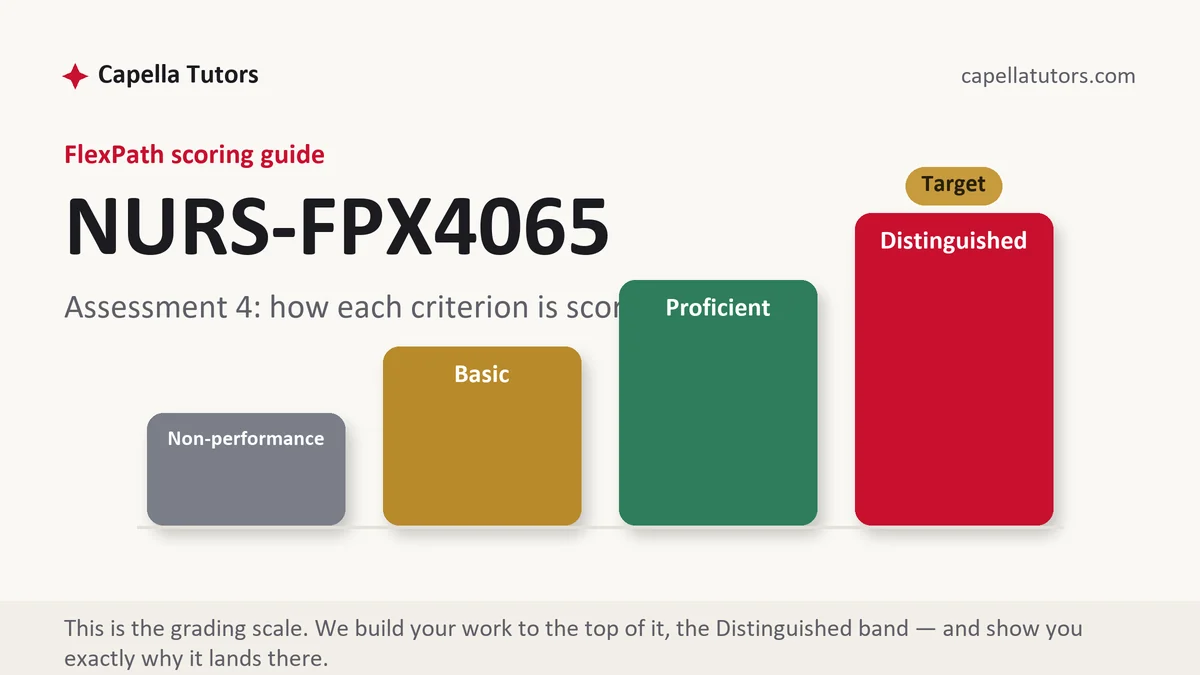
How NURS FPX 4065 Assessment 4 is scored
Four levels, no letters, one criterion at a time. On a presentation the levels track how much of the argument survives in the notes when the bullet points are stripped away:
| Level | What it means on a coordination presentation |
|---|---|
| Distinguished | The notes carry a complete argument with citations, the slides hold one claim each, the case is walked transition by transition with owners, and the delivery is pitched at working colleagues. The criterion names its extra move; write it into the notes. |
| Proficient | A well-organized deck with adequate notes that summarize the slides instead of extending them, and evidence that appears on screen but is never explained aloud. |
| Basic | Slides dense with text and notes that read 'discuss this'. The visual is doing work the notes were supposed to do, and criteria graded on the spoken argument find nothing to read. |
| Non-performance | A required element never appears, most often the speaker notes themselves, the references, or the community resource layer the coordination case depends on. |
If your guide asks for recorded audio or a specific slide count, follow it exactly. Format compliance is cheap to satisfy and expensive to miss, and no amount of good content rescues a submission missing the deliverable the guide named.
The NURS FPX 4065 Assessment 4 method, step by step
-
Write the speaker notes first and treat the slides as their captions
Draft the full spoken argument in prose before you touch a layout, then pull one line per screen from it. Decks built the other way around end up with notes that describe bullets. The order matters more than it sounds, and evaluators can tell which order you used within two slides.
-
Give every slide exactly one claim
One idea, a short heading that states it, and at most four supporting lines. If a slide needs a second heading it is two slides. Density is the visual signature of a presenter who has not decided what matters, and presentation criteria grade that judgment explicitly.
-
Open with the patient, not with an agenda
The first substantive slide should put your colleagues at the bedside: the condition, the circumstances, the reason coordination is hard in this case. Agenda slides and definitions of care coordination spend the attention you need later. Start where the difficulty is and the audience follows without being asked.
-
Walk the transitions in the order the patient lives them
Admission, unit moves, discharge, home, follow-up, pharmacy, and for each one name the receiver, the information that must travel, and who owns the risk. Chronology is the structure the audience can hold without notes, and it happens to be the structure the coordination criteria examine.
-
Put the evidence and the citations in the notes, not on the screen
Say the source aloud in the note text and list it on a references slide at the end in current APA. A slide crowded with author names looks rigorous and reads as clutter; a note that explains why a study supports this discharge decision is what the evidence criterion actually credits.
-
Time it aloud, check accessibility, then submit early
Read the notes at speaking pace against whatever limit the guide sets, and cut rather than compress. Check contrast, font size, and any required captions or transcript. Then self-score every criterion at one of the four levels and submit at the start of the week, since evaluations can take two business days.
A structure that maps to the criteria
The note-word targets below are our tutors' planning figures for a typical 4065 presentation, not Capella requirements. Slide counts and timing come from your scoring guide, which overrules everything here.
| Section | What it must do | Guide |
|---|---|---|
| Title and purpose | Who you are addressing, what case they are about to hear, and why it is worth their time. | ~120 words of notes |
| The patient and the problem | The de-identified composite, the condition, and the specific reason coordination is difficult here. | ~250 words of notes |
| The transition walk | Three or four slides, one per handoff, each naming receiver, transferred information, risk, and owner. | ~400 words of notes |
| Community resources and coverage | Named services with eligibility, plus the payer reality that decides which of them the patient can use. | ~250 words of notes |
| Evidence behind the choices | The sources supporting the coordination decisions, explained aloud rather than displayed. | ~200 words of notes |
| What you want colleagues to do | The specific practice changes you are asking the room for, stated as actions with owners. | ~150 words of notes |
| References slide | Current APA, every source spoken in the notes appearing here and nowhere else. | as needed |
Annotated sample excerpt
Below is an excerpt from an original model our team built for this deliverable type, presenting an uninsured patient's COPD discharge transition. The slide line is short on purpose; the notes carry the grade.
Slide: Discharge day, three things that must travel with him. Notes: This patient has no insurance and no primary care provider, so the inhaler he used upstairs costs him about 340 dollars at a retail pharmacy, and he will not fill it.1 Before he leaves we do three things and I want to name who does each: the pharmacy technician submits the manufacturer assistance application, I call the federally qualified health center and book the appointment while he is still in the room, and the respiratory therapist watches him use the device twice with teach-back rather than handing him a leaflet.2 If you take one thing from this slide, take the booking, because a referral a patient is told to make himself is a referral that mostly does not happen, and our own return data for uninsured COPD patients says so.3
- 1The slide states one claim in seven words while the note supplies the number that makes the claim bite. That division of labor is the whole skill this assessment tests.
- 2Three actions with three named owners, spoken in the first person to a room of peers. Coordination criteria read notes like this and find everything they were sent to look for.
- 3A direct ask, justified by local evidence, delivered in colleague register. The presenter is not teaching nursing, she is asking practitioners to change one habit.
The full premium sample for your exact assessment, written fresh to your scoring guide and issue, is free to request. Study it, revise it into your own voice, and submit work you understand.
The five mistakes that cost Distinguished
- Notes that narrate the slide. If the note repeats the bullet, the criteria graded on the spoken argument have nothing to read, and the deck scores as if it were empty.
- The wall of text slide. Paragraphs on screen mean the presenter has not chosen. Presentation criteria treat that as a delivery failure, not a formatting quibble.
- Citations displayed but never explained. An author name on a slide is not evidence use. The note has to say what the source establishes and why it applies here.
- Skipping the resource and coverage reality. A coordination case that ignores who pays reads as theoretical, and this course grades practical feasibility.
- Ignoring the format instruction. Missing audio, missing notes, or half the required slides costs criteria that had nothing to do with your argument.
Pre-submission checklist
- Speaker notes contain a complete spoken argument, not slide summaries
- Every slide carries one claim and a heading that states it
- Each transition slide names receiver, information transferred, risk, and owner
- Community resources appear with eligibility and the payer reality behind them
- Sources are explained in the notes and listed in current APA on a references slide
- Format instructions met exactly, timed aloud, self-scored, submitted early in the week
Want the deck and the notes handled?
Send the scoring guide, your earlier 4065 work, and any format requirements your courseroom lists. The desk returns a premium original deck with complete speaker notes, references, and any required audio script inside 24 to 48 hours, revised free until it sits in the Distinguished column. Presentations are where students lose points for formatting rather than thinking; that part we simply handle.