This manual is for NURS FPX 4065 Assessment 3, start to submission. Ethical and Policy Factors in Care Coordination takes the plan from Assessment 2 and examines the ethical questions and the governmental policies that shape it, usually addressed to colleagues: national, state and local policy provisions, the ethical dilemmas they create, the Code of Ethics for Nurses, and the effect on equity and outcomes. The material is familiar, but the grade turns on whether you apply it to concrete coordination decisions or recite it in general. Below is the method our tutors use, a structure that maps to the criteria, and an annotated sample excerpt. Prefer to hand it off? A premium original sample for this exact assessment comes back in 24 to 48 hours, revised free until it meets the guide. Capella's catalog lists the course as NURS-FPX4065, and some courserooms print NURS4065; both point to this same Assessment 3. In current courserooms this assessment typically appears as "Ethical and Policy Factors in Care Coordination".
One honesty note before the manual: Capella revises courses and scoring guides over time, so always write to the exact scoring guide attached to your assessment in the courseroom. The course identity above is verified on capella.edu; the method and structure below are our tutors' approach to it, not Capella's official rubric text.
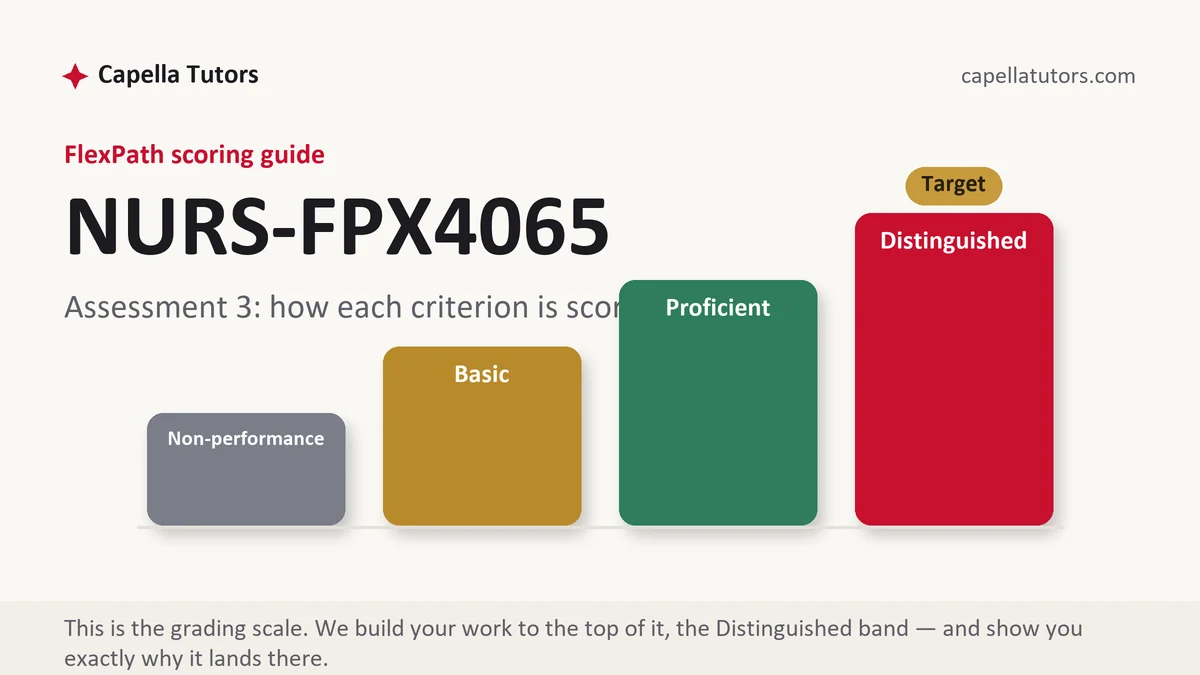
How NURS FPX 4065 Assessment 3 is scored
Every criterion in FlexPath lands on one of four levels, letters never enter it. On an ethics and policy piece the levels sort by how specific the argument is willing to get:
| Level | What it means on an ethical and policy analysis |
|---|---|
| Distinguished | One real coordination decision is examined, named code provisions and specific statutory or regulatory rules are applied to it, competing obligations are weighed openly, and the consequence for the patient is stated. The criterion names the extra move; write it. |
| Proficient | Correct ethical reasoning and accurate policy citations, applied to the case at a comfortable distance, with the conflict acknowledged but never actually adjudicated. |
| Basic | A tour of ethical principles and health policy with the case appearing as illustration. Everything true, nothing decided, which is exactly how the criteria will score it. |
| Non-performance | A required element is absent, commonly the policy layer, the code provisions, or the connection back to the coordination plan the analysis is supposed to serve. |
Watch the audience instruction. If your guide says the piece is addressed to colleagues, and many in this course do, the register changes: you are briefing peers who share your vocabulary, not explaining nursing to an outsider, and some guides attach a presentation format with speaker notes to the same requirement.
The NURS FPX 4065 Assessment 3 method, step by step
-
Split the ethics criterion from the policy criterion on paper
They are graded separately and they fail differently. Ethics asks what the right action is when obligations collide; policy asks which rules constrain the options. Write the two headings first and refuse to let their paragraphs blend, because a merged discussion usually satisfies neither criterion fully.
-
Pick a decision, not a topic
'Ethics in care coordination' cannot be argued. 'Who gets the last available home health slot this week' can. Choose a single choice with a defensible answer on more than one side, and every principle you cite afterward has somewhere concrete to land.
-
Cite provisions and rules by name, not by reputation
Point to specific provisions of the nursing code of ethics, the particular part of the privacy rule that governs the disclosure in question, the coverage or readmission policy shaping the decision, and the section of your state's nurse practice act that sets the boundary. Then quote the obligation in your own words. Naming the document without naming the obligation is the most common way this section stalls at Proficient.
-
Run the competing obligations against each other
Autonomy against beneficence, one patient's claim against the next patient's, the employer's incentive against the patient's interest. Say which obligation you weigh heavier here and why, and name what that choice costs. Criteria asking for analysis are asking for a decision defended, not a balanced summary of everyone's feelings.
-
Say what the policy changes for the coordination plan
Bring it back to the plan: which referral becomes possible, which conversation must be documented differently, which timeline moves because a rule says so. The link between the policy analysis and the coordination work is a criterion of its own in most versions of this assessment, and it is easy to forget under a heading about law.
-
Check the tone against the audience, then self-score and submit
Read the draft aloud imagining a room of nurses. Anything that explains the obvious to peers or moralizes at them comes out. Then grade every criterion at one of the four levels yourself, revise what falls short, and submit early in the week while a two-day evaluation window still helps you.
A structure that maps to the criteria
These word targets are our tutors' planning numbers for a typical 4065 ethics and policy piece, not Capella requirements. If your guide sets a slide count or a length, that instruction wins.
| Section | What it must do | Guide |
|---|---|---|
| Purpose and audience | Who is being addressed, what decision is under examination, and why it matters to the coordination work. | ~150 words |
| The case, de-identified | The situation in enough operational detail that the dilemma is visible, with all identifiers removed. | ~250 words |
| The ethical question | The obligations in collision, named and attributed, with the stakes for each party stated plainly. | ~300 words |
| Code provisions applied | Specific provisions of the nursing code, applied to this decision rather than described in general. | ~250 words |
| Policy and regulatory layer | Privacy rules, coverage law, and practice-act boundaries as they constrain these particular options. | ~300 words |
| Implications for coordination | What changes in the plan, the documentation, or the referral route once the analysis is accepted. | ~200 words |
| Conclusion and references | The position restated and closed in current APA, sources current and matched. | as needed |
Annotated sample excerpt
Here is an excerpt from an original model our team wrote for this deliverable type, taking up the allocation of scarce home health slots. Notice that it commits to something.
The agency accepts eleven new home health admissions a week and averages nineteen referrals, so someone is already deciding who waits, and at present that someone is whoever answers the intake line.1 Provision 1 of the nursing code obliges us to practice with equal respect for the worth of every person, which does not tell us who receives Tuesday's slot, but it does rule out the informal triage we currently run on which referring physician calls twice.2 Federal readmission penalties push the same decision the other way, toward patients whose return would cost the hospital money, and naming that pressure aloud in front of colleagues is the first honest move this analysis can make.3
- 1The dilemma is stated as an operational fact with numbers, not as a philosophical question. An evaluator can see immediately that a real decision is under examination.
- 2A named provision is applied to the specific choice, and the application is used to eliminate a current practice. That is what applying a code looks like as opposed to citing one.
- 3The policy pressure is named and its direction stated, so the analysis has two forces to weigh rather than one position to defend.
The full premium sample for your exact assessment, written fresh to your scoring guide and issue, is free to request. Study it, revise it into your own voice, and submit work you understand.
The five mistakes that cost Distinguished
- Principles without a decision. Listing autonomy, beneficence, nonmaleficence, and justice proves definitions were learned; applying them to one contested choice proves reasoning.
- The code cited as a whole. Referring to the code of ethics generally, with no provision named, leaves the criterion nothing specific to credit.
- Policy as background. A paragraph summarizing coverage law that never touches the case is filler under a serious heading.
- Fence-sitting. Presenting both sides evenly and stopping is not analysis. Take a position, defend it, and name what it costs.
- Wrong audience register. If the guide says colleagues, explaining basic nursing concepts reads as misjudged, and some criteria grade that judgment directly.
Pre-submission checklist
- Ethics and policy are argued under separate labeled headings
- One concrete coordination decision anchors the entire analysis
- Specific code provisions are named and applied to that decision
- Privacy, coverage, and practice-act rules are cited by their actual constraint
- A position is taken, defended, and its cost named
- Audience register checked, self-scored on all four levels, submitted early in the week
Want the argument built with you?
Send the scoring guide and the situation you plan to analyze, along with your earlier 4065 work if you have it. The desk builds the ethical argument on named provisions and the policy layer on the rules that actually bind, then returns a premium original piece in 24 to 48 hours, revised free until the guide reads Distinguished. If your version asks for slides and speaker notes, we deliver both.