This manual is for NURS FPX 4065 Assessment 2, start to submission. The Preliminary Care Coordination Plan is the first written plan in Capella's care coordination course: for one patient population and health concern, you lay out the physical, psychosocial and cultural considerations, the settings and handoffs the patient crosses, SMART goals, evidence-based interventions and the community resources that keep the patient supported after discharge. Coordination writing is graded on seams. Evaluators look for the points where responsibility changes hands and check whether you named an owner, a resource and a measure for each. Below is the method our tutors use, a structure that maps to the criteria, and an annotated sample excerpt. Prefer to hand it off? A premium original sample for this exact assessment comes back in 24 to 48 hours, revised free until it meets the guide. Capella's catalog lists the course as NURS-FPX4065, and some courserooms print NURS4065; both point to this same Assessment 2. In current courserooms this assessment typically appears as "Preliminary Care Coordination Plan".
One honesty note before the manual: Capella revises courses and scoring guides over time, so always write to the exact scoring guide attached to your assessment in the courseroom. The course identity above is verified on capella.edu; the method and structure below are our tutors' approach to it, not Capella's official rubric text.
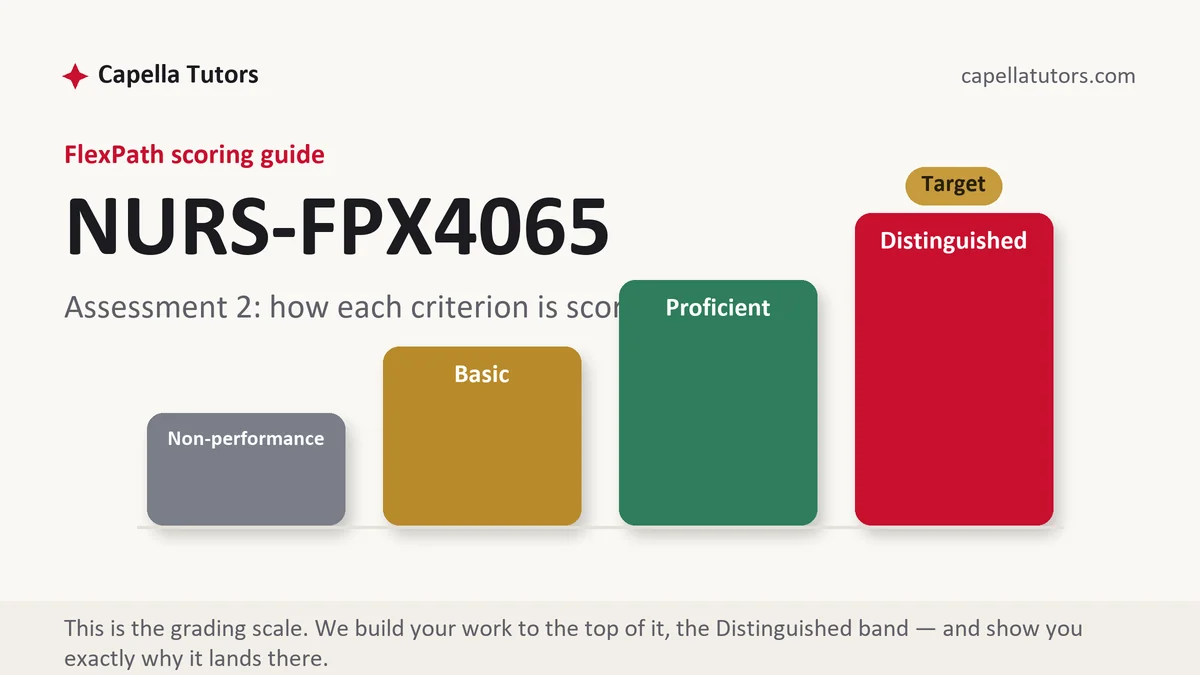
How NURS FPX 4065 Assessment 2 is scored
FlexPath scoring uses four levels and no letters. Each criterion is placed on one of them, and on a coordination plan the levels separate along a single axis, whether the plan could actually be run by somebody else:
| Level | What it means on a preliminary coordination plan |
|---|---|
| Distinguished | Every transition carries a named owner, a named risk, and a stated handoff, community resources are real and reachable, and the patient's stated preferences visibly change decisions in the plan. Each criterion names one further move; make it on purpose. |
| Proficient | A complete journey mapped with credible evidence behind it, but risks arrive unassigned and the patient's preferences are reported rather than allowed to alter anything. |
| Basic | A summary of good coordination practice with a patient attached to it. Sincere, general, and unable to satisfy criteria that ask what happens at each specific transition. |
| Non-performance | A required element never appears, most often the community resources, the evidence base, or the patient's own priorities as a stated input rather than background color. |
Treat this plan as reusable infrastructure. In most 4065 sequences the patient and condition you choose here carry through the later assessments, so a scenario with enough transitions to analyze now spares you an invented one in week six.
The NURS FPX 4065 Assessment 2 method, step by step
-
Take the criteria apart before you choose the patient
Paste each criterion into a blank document as a heading with its Distinguished text beneath, then read the whole list once as a set of demands about the patient you have not picked yet. Some scenarios cannot satisfy those demands. Better to discover that before you have written a thousand words about one.
-
Build a composite patient, then strip what is left
Assemble the case from patterns you have actually seen: the condition, the age, the housing, the caregiver, the coverage. Composite is safer than real and richer than invented, because the details come from practice while the person does not exist. Remove names, dates, unit identifiers, and anything that could point at a chart.
-
Map the journey as transitions rather than as a story
List every point where responsibility changes hands: admission, the move between units, discharge, the first home visit, the follow-up appointment, the pharmacy. For each one write who hands off, who receives, what information travels, and what fails if it does not. Narrative prose hides seams; a transition list forces them into the open.
-
Give every risk an owner and a deadline
A risk with no name attached to it is an observation. 'Medication reconciliation is important' earns nothing; 'the discharging pharmacist calls within 24 hours to confirm the old bottle is discarded' is a plan. Ownership and timing are the two specifics coordination criteria check most literally.
-
Name community resources the way someone who called them would
Home health, transport programs, meal delivery, disease-specific foundation support, sliding-scale clinics: name the type, the eligibility, and what the patient does to reach it. A plan that says the patient will be referred to community resources without saying which ones is the single most common Basic paragraph in this course.
-
Make a preference change a decision, then self-score and submit
Find at least one place where what the patient wants alters the plan: the visit timed to a caregiver's shift, teach-back in the patient's first language, a goal the patient set that the protocol did not. Then grade your own draft on all four levels, close the gaps, and submit at the start of the week so the evaluation window fits your session.
A structure that maps to the criteria
The word targets below are our tutors' planning numbers for a typical 4065 preliminary plan, not Capella requirements. Your scoring guide decides the balance and overrules this table.
| Section | What it must do | Guide |
|---|---|---|
| Introduction | The patient, the condition, and the purpose of the plan, with the coordination problem stated in one sentence. | ~150 words |
| Patient scenario and priorities | The composite case, de-identified, with care priorities ordered and justified by evidence rather than habit. | ~250 words |
| The transition map | Each handoff with its sender, receiver, transferred information, named risk, and owner. | ~350 words |
| Community resources | Specific services with eligibility, contact route, and the barrier each one answers for this patient. | ~250 words |
| Evidence and best practice | Current sources supporting the coordination choices, each cited inside the sentence doing the work. | ~200 words |
| Anticipated failures and contingencies | What is most likely to break, how it would be detected, and who responds when it does. | ~200 words |
| Conclusion and references | The plan closed in current APA with citations matched both directions. | as needed |
Annotated sample excerpt
Below is an excerpt from an original model our team wrote for this deliverable type, built around a heart failure readmission case. Read it for how ownership is assigned.
Mr. R is a composite: 71 years old, two heart failure admissions in five months, living alone in a second-floor walk-up with a daughter who works night shifts.1 The discharge transition carries three risks and each one has an owner, so the diuretic dose change belongs to the pharmacist making the reconciliation call within 24 hours, the seven-day cardiology follow-up belongs to the transition coordinator who books it before the patient leaves the unit, and the daily weight log belongs to the home health nurse on the first visit.2 Teach-back is scheduled for four in the afternoon because that is when the daughter is awake and present, rather than at the morning rounds slot the discharge template assumes.3
- 1A composite drawn tightly enough to have circumstances. The walk-up and the night shift are not color, they are the constraints the rest of the plan has to work around.
- 2Three risks, three owners, three deadlines, in one sentence. This is the density coordination criteria are written to reward, and it is almost impossible to fake.
- 3A patient circumstance visibly overrides an institutional default. One sentence like this does more for a patient-centered criterion than a page of principle.
The full premium sample for your exact assessment, written fresh to your scoring guide and issue, is free to request. Study it, revise it into your own voice, and submit work you understand.
The five mistakes that cost Distinguished
- Coordination described instead of planned. Paragraphs about the value of communication contain nothing gradable. Transitions with owners do.
- Resources named as a category. 'Community services' is not a referral. Name the service type, its eligibility, and how the patient reaches it.
- A patient with no preferences. If nothing the patient wants changes anything in the plan, the patient-centered criterion has no evidence to score.
- Real chart details left in. Dates, room numbers, and initials can identify someone. Build a composite and keep it de-identified throughout.
- Evidence attached to nothing. Sources listed in a paragraph of background do no work. Cite inside the sentence that makes the coordination decision.
Pre-submission checklist
- Each scoring-guide criterion owns a labeled section
- The patient is a de-identified composite with stated circumstances and priorities
- Every transition names sender, receiver, information transferred, risk, and owner
- At least three community resources appear with eligibility and contact route
- One documented patient preference visibly changes a decision in the plan
- Self-scored on all four levels, current APA throughout, submitted early in the week
Starting 4065 with backup?
Send the scoring guide and any scenario your courseroom supplies, or just the condition you know best from practice. An eight-person pod builds the composite, maps the transitions with owners, and returns a premium original coordination plan in 24 to 48 hours, revised free until it sits in the Distinguished column. The patient you choose here usually carries the rest of the course, so choose it with a second opinion.