This manual is for NURS FPX 4065 Assessment 1, start to submission. In the current version of Patient-Centered Care Coordination, Assessment 1 is the practicum planning step: you take part in a conference call with your faculty about the BSN practicum in this course and complete the worksheet that records it, covering your practicum goals, schedule, documentation and expectations, with the action items you agree. It is short, but the plans you record here organize the practicum hours and the care coordination assessments that follow. Below is how to prepare, what to record, and an annotated sample excerpt. Prefer to hand it off? A premium original sample for this exact assessment comes back in 24 to 48 hours, revised free until it meets the guide. Capella's catalog lists the course as NURS-FPX4065, and some courserooms print NURS4065; both point to this same Assessment 1.
One honesty note before the manual: Capella revises courses and scoring guides over time, so always write to the exact scoring guide attached to your assessment in the courseroom. The course identity above is verified on capella.edu; the method and structure below are our tutors' approach to it, not Capella's official rubric text.
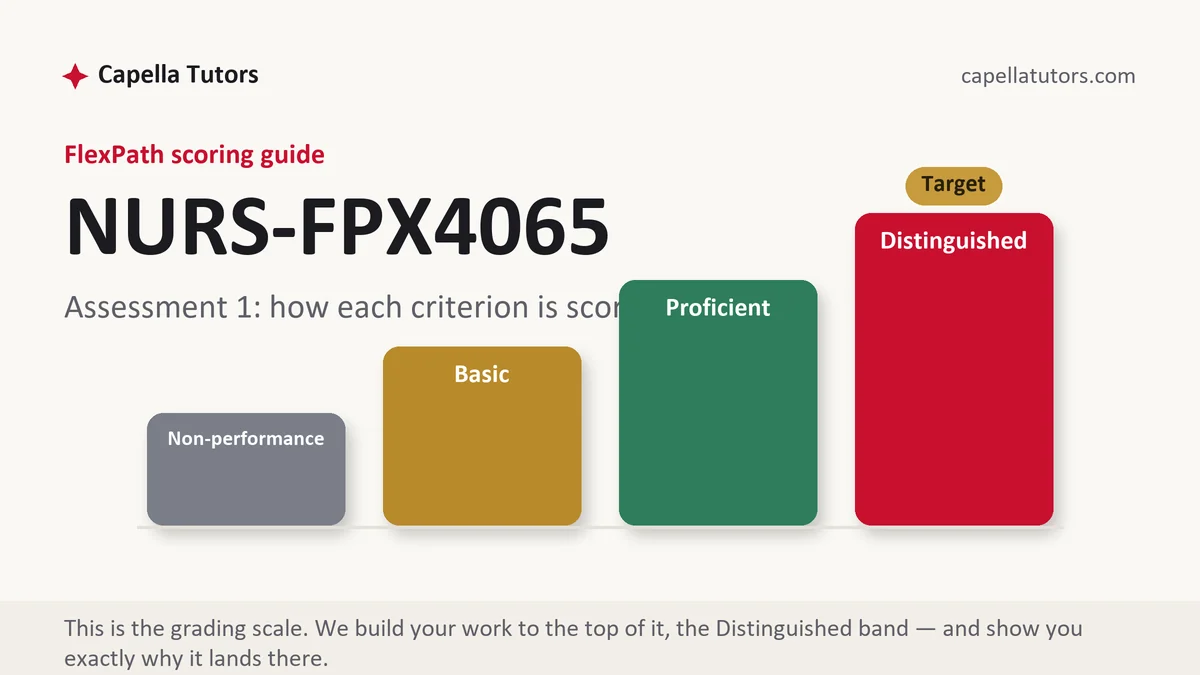
How NURS FPX 4065 Assessment 1 is scored
FlexPath does not use letter grades. Each criterion in the scoring guide lands on one of four levels, and the level descriptions are the real writing brief:
| Level | What it means on the practicum call worksheet |
|---|---|
| Distinguished | Every section of the worksheet is complete, goals are specific and linked to the course, the schedule is realistic, documentation tools and deadlines are named, and action items have owners and dates. |
| Proficient | The worksheet is complete, but goals and action items are general. |
| Basic | Sections are thin or copied from the instructions, with no evidence the call shaped the plan. |
| Non-performance | The worksheet is incomplete or the call did not take place. |
Check your scoring guide and the call instructions in the courseroom. Some versions ask for a short written summary as well as the worksheet.
The NURS FPX 4065 Assessment 1 method, step by step
-
Read the practicum requirements first
Know how many hours the course expects, what counts toward them, and which tool records them before the call.
-
Draft goals before you talk
Two or three practicum goals linked to care coordination: a patient population you will focus on, a resource you will investigate, a skill you will practice.
-
Prepare questions
About documentation, deadlines, approval of activities and how practicum work connects to the written assessments.
-
Record the call in the worksheet
Meeting topic, goals, schedule, documentation and expectations, each with notes in your own words.
-
Turn notes into action items
Each with what, who and by when, for example logging hours weekly or confirming a community resource contact.
-
Submit and keep the plan in view
Submit the completed worksheet, and use it to schedule the hours and the next assessments.
A structure that maps to the criteria
This is a worksheet rather than an essay; the parts below are what the evaluator checks. Follow the template in your courseroom.
| Section | What it must do | Guide |
|---|---|---|
| Meeting topic | Date, participants by role and purpose of the call. | short entry |
| Practicum goals | Specific goals linked to the course. | 2 to 3 goals |
| Practicum schedule | When hours will be completed and how. | short notes |
| Documentation | Tools, logs and deadlines agreed. | short notes |
| Expectations | What faculty expect and what you need. | short notes |
| Action items | What, who and by when. | a short list |
Annotated sample excerpt
An original model excerpt from our team, written to show the register that reaches the top of the guide. Learn the moves, then write your own version.
Goal 1: identify three community resources that support adults with serious mental illness after discharge from an acute unit, and confirm what each one provides and how patients are referred.1 Goal 2: observe or discuss two discharge transitions with a care coordinator or case manager, noting where information is lost between settings.2 Action items: log practicum hours in the course tool every Friday; contact the county behavioral health office by the end of week two; review the care coordination plan requirements before drafting Assessment 2.3
- 1Writes a goal that is specific and connected to care coordination.
- 2Adds a second goal that feeds the later written assessments.
- 3Turns the call into dated actions, which is what the action-item criterion looks for.
The full premium sample for your exact assessment, written fresh to your scoring guide and topic, is free to request. Study it, revise it into your own voice, and submit work you understand.
The five mistakes that cost Distinguished
- Goals copied from the instructions. Write goals specific to your population and setting.
- No schedule. The practicum hours need a plan.
- Vague action items. Each needs an owner and a date.
- Skipping documentation. Know which tool records your hours before you start.
- Not using the worksheet later. It is the plan for the rest of the course.
Pre-submission checklist
- Practicum requirements read before the call
- Specific goals linked to care coordination
- Realistic schedule recorded
- Documentation tools and deadlines named
- Action items with owners and dates
- Worksheet complete and submitted
Want the written work in this course covered?
The call is yours, but the care coordination plan, the ethics and policy analysis and the presentation are written assessments we support. Send the scoring guides for premium original samples in 24 to 48 hours, revised free.