This manual is for NURS FPX 4055 Assessment 4, start to submission. The Health Promotion Plan Presentation asks you to present the health promotion plan you designed in Assessment 1 to the community group it was written for: the health concern and the key facts the audience needs, the SMART goals and their link to Healthy People 2030, the activities of the session, and how you will evaluate whether the session met its goals. It is delivered as a recorded presentation or slides with speaker notes; check what your courseroom asks for. The grade turns on speaking to the community audience, not to an instructor, and on goals you can actually measure. Below is the method our tutors use, a structure that maps to the criteria, and an annotated sample excerpt. Prefer to hand it off? A premium original sample for this exact assessment comes back in 24 to 48 hours, revised free until it meets the guide. Capella's catalog lists the course as NURS-FPX4055, and some courserooms print NURS4055; both point to this same Assessment 4. In current courserooms this assessment typically appears as "Health Promotion Plan Presentation".
One honesty note before the manual: Capella revises courses and scoring guides over time, so always write to the exact scoring guide attached to your assessment in the courseroom. The course identity above is verified on capella.edu; the method and structure below are our tutors' approach to it, not Capella's official rubric text.
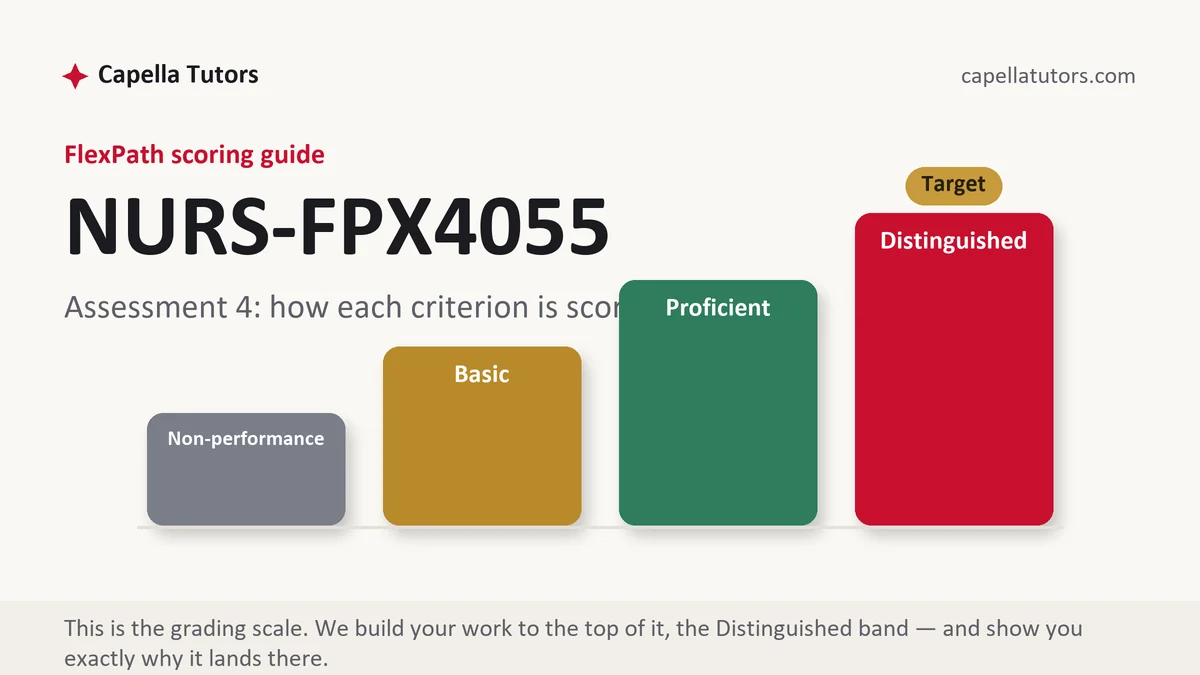
How NURS FPX 4055 Assessment 4 is scored
FlexPath does not use letter grades. Each criterion in the scoring guide lands on one of four levels, and the level descriptions are the real writing brief:
| Level | What it means on a health promotion presentation |
|---|---|
| Distinguished | The content is pitched to the community audience, key facts are accurate and sourced, SMART goals are specific and linked to a named Healthy People 2030 objective, activities fit the audience, and evaluation methods match each goal. |
| Proficient | All parts are present and accurate, but the language suits an instructor more than the audience, or evaluation is general. |
| Basic | The presentation repeats the Assessment 1 plan with little adaptation and vague goals. |
| Non-performance | The goals, the Healthy People 2030 link or the evaluation is missing. |
Keep the population and health concern from Assessment 1. This presentation is that plan delivered, so its goals should match the ones you set there.
The NURS FPX 4055 Assessment 4 method, step by step
-
Open for the audience
Welcome the group, state the health concern in plain language and give a short roadmap of the session.
-
Give the key facts
Three or four facts the audience needs: how the condition spreads or develops, who is at risk, and what prevention does. Use current CDC or similar sources.
-
Present the SMART goals
Each goal specific, measurable, achievable, relevant and time-bound, and each linked to a named Healthy People 2030 objective.
-
Describe the session activities
Discussion, demonstration, role-play or a short quiz, chosen for the audience's age and literacy.
-
Explain evaluation
How you will measure each goal: a pre and post quiz, a confidence survey, a follow-up count of appointments booked.
-
Close with a call to action
Summarize, give one action for the audience to take, and include a references slide.
A structure that maps to the criteria
Timing and slide counts vary by version; follow your scoring guide. The note lengths below are planning targets our tutors use.
| Section | What the slide and notes must do | Guide |
|---|---|---|
| Introduction and roadmap | Welcome, purpose and session outline. | 1 to 2 slides, ~125 words of notes |
| Key facts | The health concern and the facts the audience needs. | 2 slides, ~200 words |
| SMART goals and Healthy People 2030 | Goals linked to named objectives. | 1 to 2 slides, ~200 words |
| Session activities | What the audience will do and why. | 1 slide, ~150 words |
| Evaluation | A method for each goal. | 1 slide, ~150 words |
| Summary and references | Call to action and current APA references. | 2 slides, ~100 words |
Annotated sample excerpt
An original model excerpt from our team, written to show the register that reaches the top of the guide. Learn the moves, then write your own version.
Our first goal for today is simple to measure: by the end of this session, at least eight in ten of you will be able to name two cancers the HPV vaccine helps prevent.1 We will check that with a five-question quiz at the end, the same one you took when you arrived, so we can see what changed.2 This goal supports the Healthy People 2030 objective to increase the proportion of adolescents who receive the recommended doses of the HPV vaccine, because people who understand why the vaccine matters are more likely to schedule it.3
- 1States a goal in words the audience understands, with a measurable target.
- 2Pairs the goal with its evaluation method, which is the match the criteria ask for.
- 3Links the goal to a named national objective and explains the connection.
The full premium sample for your exact assessment, written fresh to your scoring guide and topic, is free to request. Study it, revise it into your own voice, and submit work you understand.
The five mistakes that cost Distinguished
- Speaking to the instructor. Write and present for the community audience.
- Goals that cannot be measured. "Increase awareness" needs a number and a method.
- A missing Healthy People 2030 link. Name the objective each goal supports.
- New goals. Keep the goals from your Assessment 1 plan.
- No evaluation plan. Say how you will know the session worked.
Pre-submission checklist
- Same population and health concern as Assessment 1
- Key facts accurate and sourced
- SMART goals with a named Healthy People 2030 objective each
- Activities suited to the audience
- An evaluation method for each goal
- Notes or script with current APA references
Want the presentation built from your plan?
Send the scoring guide and your Assessment 1 plan. Our team returns a premium original slide deck with full speaker notes in 24 to 48 hours, revised free until it meets the guide.