This manual is for NURS FPX 4055 Assessment 3, start to submission. The Disaster Recovery Plan asks you to plan the recovery of a community after a disaster, usually the community and scenario provided in the courseroom: who in the community is most at risk, which determinants of health and barriers will slow recovery, the culturally responsive strategies that would reduce disparities, how policy and interprofessional partners shape the response, and how you would know recovery is working. The grade turns on equity and specificity. A general emergency plan scores lower than one that names the groups at risk, the barriers each faces, and the action that answers each barrier. Below is the method our tutors use, a structure that maps to the criteria, and an annotated sample excerpt. Prefer to hand it off? A premium original sample for this exact assessment comes back in 24 to 48 hours, revised free until it meets the guide. Capella's catalog lists the course as NURS-FPX4055, and some courserooms print NURS4055; both point to this same Assessment 3. In current courserooms this assessment typically appears as "Disaster Recovery Plan".
One honesty note before the manual: Capella revises courses and scoring guides over time, so always write to the exact scoring guide attached to your assessment in the courseroom. The course identity above is verified on capella.edu; the method and structure below are our tutors' approach to it, not Capella's official rubric text.
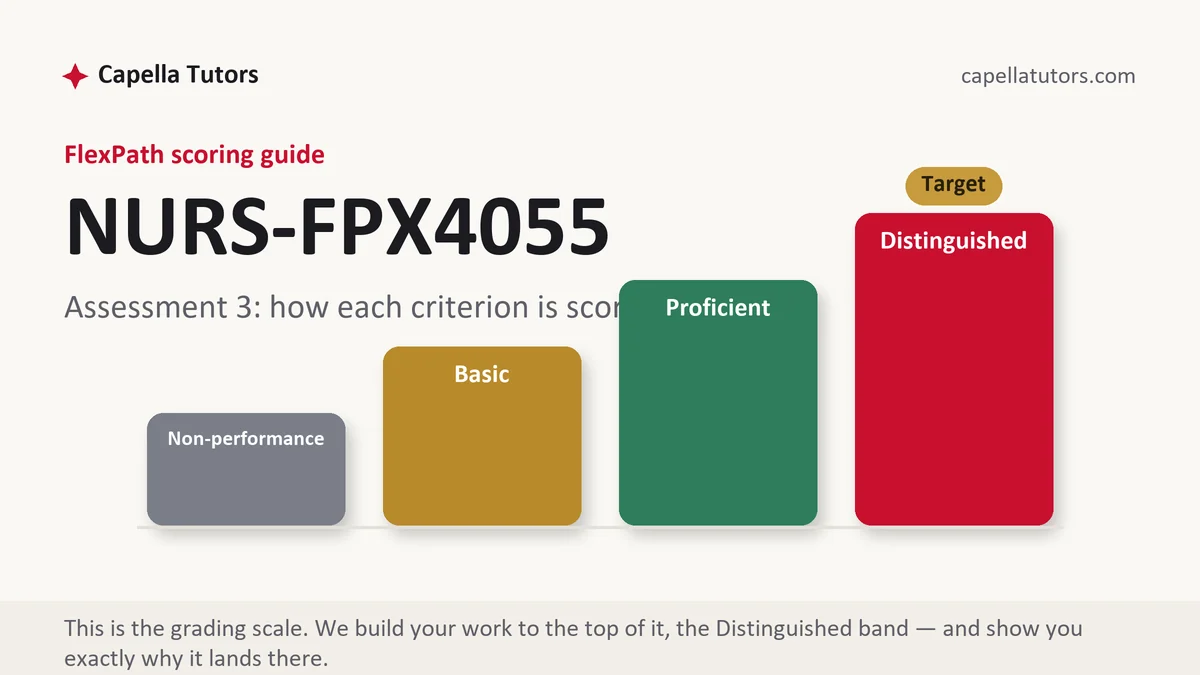
How NURS FPX 4055 Assessment 3 is scored
FlexPath does not use letter grades. Each criterion in the scoring guide lands on one of four levels, and the level descriptions are the real writing brief:
| Level | What it means on a disaster recovery plan |
|---|---|
| Distinguished | The community and disaster are described with data, at-risk groups are identified, determinants and barriers are linked to specific culturally responsive strategies, a recognized framework guides communication, policy and partner roles are explained, and evaluation measures are named. |
| Proficient | All parts are present and accurate, but strategies are not matched to specific barriers and evaluation is general. |
| Basic | The plan describes disaster response in general with little about this community or equity. |
| Non-performance | A required element, such as the determinants and barriers, the policy discussion or the evaluation, is missing. |
Use the community data in the course scenario first, then public sources such as census and CDC data. Evaluators look for numbers from the scenario in the plan.
The NURS FPX 4055 Assessment 3 method, step by step
-
Describe the community and the disaster
Population, demographics, income, language, health status and infrastructure, drawn from the scenario, plus what the disaster damaged.
-
Identify the groups most at risk
Older adults, people with disabilities, uninsured residents, people with limited English, residents without transportation. Use figures from the scenario.
-
Link determinants to barriers
For each group, the determinant of health that drives risk, such as income, housing or language, and the barrier it creates during recovery. A table works well for this criterion.
-
Match each barrier to a strategy
Multilingual alerts, mobile clinics, accessible shelters, partnerships with trusted community organizations. Tie each strategy to evidence and to the CDC's Crisis and Emergency Risk Communication (CERC) principles or another framework your guide names.
-
Explain policy and partners
Relevant laws or programs, such as the Stafford Act and FEMA assistance, and the roles of public health, hospitals, emergency management and community groups.
-
Set evaluation measures
How you would measure recovery: shelter capacity used, clinic visits restored, vaccination or medication access, and equity measures by group.
A structure that maps to the criteria
Word counts are planning targets our tutors use for this plan, not Capella rules; follow the length and format your scoring guide states.
| Section | What it must do | Guide |
|---|---|---|
| Introduction and overview | The community, the disaster and the plan's purpose. | ~150 words |
| At-risk groups | Who is most affected, with scenario data. | ~175 words |
| Determinants and barriers | Determinants linked to recovery barriers, often as a table. | ~250 words |
| Culturally responsive strategies | One strategy per barrier with evidence and a framework. | ~250 words |
| Policy and interprofessional roles | Relevant policy and who does what. | ~175 words |
| Evaluation and references | Recovery and equity measures, then current APA. | ~125 words |
Annotated sample excerpt
An original model excerpt from our team, written to show the register that reaches the top of the guide. Learn the moves, then write your own version.
In the scenario, a large share of residents speak Spanish at home, and the city's first flood warnings went out in English only through a text alert system that required registration.1 That combination of a language barrier and a registration barrier explains why residents in the east side neighborhoods arrived at shelters late or not at all.2 The plan therefore sends every recovery message in English and Spanish through radio, churches and the community health center, following the CERC principle of being first, right and credible, and it tracks shelter and clinic use by neighborhood so the gap can be seen if it persists.3
- 1Starts from data in the scenario, which grounds the barrier in this community.
- 2Explains how the barrier produced a measurable harm.
- 3Matches a specific strategy to the barrier, ties it to a framework and adds a measure, the full chain the criteria reward.
The full premium sample for your exact assessment, written fresh to your scoring guide and topic, is free to request. Study it, revise it into your own voice, and submit work you understand.
The five mistakes that cost Distinguished
- A generic emergency plan. Use this community's data and groups.
- Barriers without strategies. Each barrier needs an answer.
- No framework. Name the communication or planning framework that guides the plan.
- Policy mentioned in one line. Explain how policy shapes resources and roles.
- No evaluation. Recovery needs measures, including equity measures.
Pre-submission checklist
- Community and disaster described with scenario data
- At-risk groups identified
- Determinants linked to barriers
- A culturally responsive strategy for each barrier, with evidence
- Policy and interprofessional roles explained
- Evaluation measures and current APA references
Want the recovery plan written for your scenario?
Send the scoring guide and the community scenario. Our team returns a premium original disaster recovery plan in 24 to 48 hours, revised free until it meets the guide.