This manual is for NURS FPX 4055 Assessment 2, start to submission. Assessment 2 of NURS FPX 4055 moves off the plan and onto the machinery: the agencies, programs, and funding streams a community actually runs, examined for what they deliver and to whom. The grade turns on verification. Evaluators can tell within a paragraph whether you read an organization's website or spoke to the organization, and the criteria are written to pay for the second one. What follows is the method our tutors use on a resource analysis, a section map keyed to the criteria, and an annotated excerpt from an original model. Rather hand it over? A premium original sample for this exact assessment comes back in 24 to 48 hours, revised free until your guide reads Distinguished. Capella's catalog lists the course as NURS-FPX4055, and some courserooms print NURS4055; both point to this same Assessment 2. In current courserooms this assessment typically appears as "Community Resources".
One honesty note before the manual: Capella revises courses and scoring guides over time, so always write to the exact scoring guide attached to your assessment in the courseroom. The course identity above is verified on capella.edu; the method and structure below are our tutors' approach to it, not Capella's official rubric text.
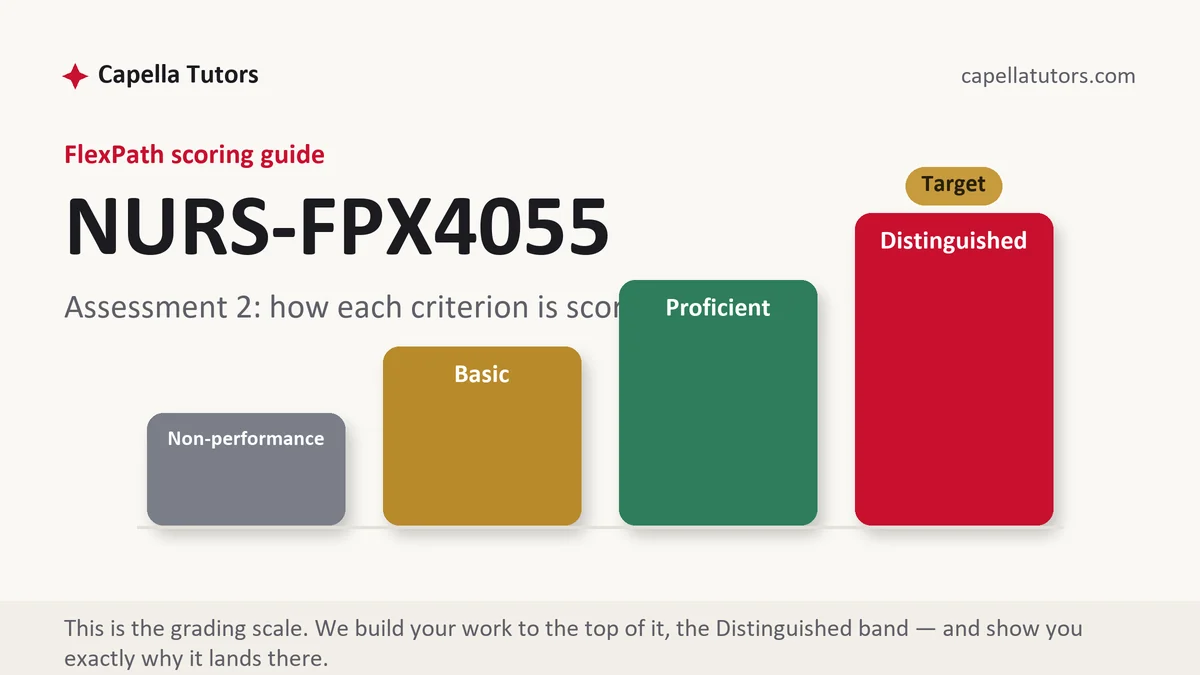
How NURS FPX 4055 Assessment 2 is scored
FlexPath issues no letters. Your evaluator places every criterion on one of four levels, and those level descriptions are best read as writing instructions rather than as feedback:
| Level | What it means on a community resource analysis |
|---|---|
| Distinguished | The resource is described from primary contact, its eligibility rules and reach are stated in numbers, and the analysis names plainly whom the system leaves waiting. Each criterion asks for one extra move; write that move as its own sentence. |
| Proficient | An accurate, well-supported account of the resource that stops before the hard part. The gaps go unnamed and the fit with the population is asserted rather than demonstrated. |
| Basic | A tidy paraphrase of what an organization publishes about itself. Nothing in it is wrong, nothing in it is examined, and the criteria are built to notice the difference. |
| Non-performance | A required element is simply absent, most often the equity layer or the link back to the population's own data. Missing, not thin, is what drops a criterion to the floor. |
Budget your time accordingly. This is the assessment where the writing is fast and the legwork is slow, and students who invert that ratio submit summaries and get graded as such.
The NURS FPX 4055 Assessment 2 method, step by step
-
Convert the criteria into a list of claims you must prove
Copy each criterion into an empty document, then rewrite it as a sentence starting with the words 'I must show that'. The exercise is unglamorous and it exposes exactly which facts you do not yet have. Anything on that list without a source beside it is the reason your draft is not finished, whatever the word count says.
-
Choose a resource close enough to verify
Pick a program you can reach by phone in an afternoon: a county nutrition program, a mobile clinic, a school-based service, a hospital community benefit initiative. Reputation matters less than reachability. The best-known organization in your state is a worse choice than the small one whose intake coordinator will answer your questions and confirm what the website leaves out.
-
Call the organization instead of reading its brochure
Ask five things and write down the answers: who qualifies, what documents intake requires, how long the wait runs, what the service costs a patient with no coverage, and where the money comes from. Half of those answers are missing from published material, and each one you bring back is a specific your evaluator has no way to mistake for filler.
-
Set the resource against the population's numbers
A program serving 400 households a year in a county where 9,000 households qualify is a finding, not a footnote. Put the capacity next to the need, both cited, and let the arithmetic argue. Criteria asking how well a resource meets the community's needs are asking you to divide, then say what the quotient means for the people on the wrong side of it.
-
Name who is eligible and who quietly is not
Eligibility is where systems reveal their politics. Income cutoffs, documentation requirements, service-area lines, hours that assume no second shift, a portal that assumes broadband: each one excludes someone, and saying so with evidence is the equity work the top column keeps asking for. Write it as observation, not indictment, and cite the rule you are describing.
-
Score the draft criterion by criterion, then submit early in the week
Read your own analysis with the guide open and assign each criterion a level in writing. Where you land under the top column, the fix is almost always one missing specific rather than a rewrite. Then submit on a Monday or Tuesday; evaluations can run two business days, and a flat-rate FlexPath session is measured in weeks you do not get back.
A structure that maps to the criteria
These word targets are our tutors' planning numbers for a typical 4055 resource analysis, not Capella requirements. Your scoring guide sets the scope, and it wins any argument with this table.
| Section | What it must do | Guide |
|---|---|---|
| Introduction | Name the community, the health concern, and the resource under examination, and state what the analysis intends to establish. | ~150 words |
| The concern in local data | Two or three cited statistics that prove the need is real and local, benchmarked against state or national figures. | ~200 words |
| The resource described | Services, capacity, staffing, and referral routes, sourced from direct contact wherever the published material stops. | ~250 words |
| Access, eligibility, and equity | Who qualifies, what intake demands, how long the wait runs, and which parts of the population those rules exclude. | ~300 words |
| Funding, governance, and policy | Where the money originates, which rules govern the service, and how stable that arrangement is over the next two years. | ~250 words |
| Fit, gaps, and recommendations | Capacity set against need, the gaps named, and improvements a real administrator could actually authorize. | ~250 words |
| Conclusion and references | The judgment stated plainly, current APA, every data source dated to its release year. | as needed |
Annotated sample excerpt
Here is an excerpt from an original model our team built for this deliverable type, using a food-insecurity screening program inside a primary care clinic. Read it for what it verifies, then verify your own.
The clinic screens every adult at intake with the two-item Hunger Vital Sign, and 22 percent of the 4,100 adults screened last year answered yes to at least one item.1 Positive screens route to one referral coordinator who works Tuesdays and Thursdays, so a Friday positive waits four days for its first call, and the partner pantry closes new registrations on Wednesday afternoon.2 The produce voucher attached to the referral is carried by a two-year foundation grant now in its final eight months, which is why sustainability appears in this analysis as a question rather than a closing courtesy.3
- 1Instrument, denominator, and yield in a single sentence. A criterion asking you to describe the resource is asking for operational fact at exactly this resolution.
- 2The gap is written as a schedule rather than a grievance. Mechanics like this are what separate an analysis from a summary, and no evaluator mistakes them for padding.
- 3Funding fragility raised early and given work to do, so the recommendations arriving later have something concrete to answer.
The full premium sample for your exact assessment, written fresh to your scoring guide and issue, is free to request. Study it, revise it into your own voice, and submit work you understand.
The five mistakes that cost Distinguished
- The brochure paraphrase. If every fact in your description appears on the organization's landing page, you have written a summary, and summaries live in the Basic column no matter how cleanly they read.
- Eligibility left soft. 'Services are available to community members in need' describes no rule. Income thresholds, documents, and service-area lines are the actual answer.
- A resource that answers nobody's documented barrier. The program has to connect back to the numbers you used to establish the need, or the fit criterion has nothing to grade.
- Equity as a closing sentence. One line about disparities at the end reads as a box being ticked. The exclusions belong inside the analysis, attached to the rules that create them.
- Recommendations nobody could fund. Suggesting the clinic hire three coordinators is not a recommendation, it is a wish. Propose what the budget and the policy would actually allow.
Pre-submission checklist
- Every scoring-guide criterion owns a labeled section of the analysis
- At least three facts in the description came from direct contact, not the website
- Capacity and need are both cited, and the comparison is stated in a sentence
- Eligibility rules are quoted specifically, with the excluded groups named
- Funding source, term, and stability are on the page
- Self-scored against all four levels, references in current APA, submitted early in the week
Want the legwork done alongside you?
Send the scoring guide and the community or program you are looking at. Our eight-person desk, research analyst included, verifies the resource picture and returns a premium original analysis inside 24 to 48 hours, revised free until it sits in the Distinguished column. The calls and the eligibility digging are the slow half of this assessment; let someone else run them.