This manual is for NURS FPX 4055 Assessment 1, start to submission. Assessment 1 of NURS FPX 4055 asks for a health promotion plan built for a named population, the deliverable that sets the tone for Capella's community-practice course. The grade lives in specificity: a real place, real numbers, goals a spreadsheet could verify, and plan elements matched to barriers the data actually documents. It is scored the FlexPath way, criterion by criterion on a four-level guide. This manual walks the method our tutors use for it, a section map with word targets, and an annotated excerpt from an original model. If you would rather hand it off, a premium original sample for this exact assessment comes back in 24 to 48 hours, revised free until it clears your guide. Capella's catalog lists the course as NURS-FPX4055, and some courserooms print NURS4055; both point to this same Assessment 1.
One honesty note before the manual: Capella revises courses and scoring guides over time, so always write to the exact scoring guide attached to your assessment in the courseroom. The course identity above is verified on capella.edu; the method and structure below are our tutors' approach to it, not Capella's official rubric text.
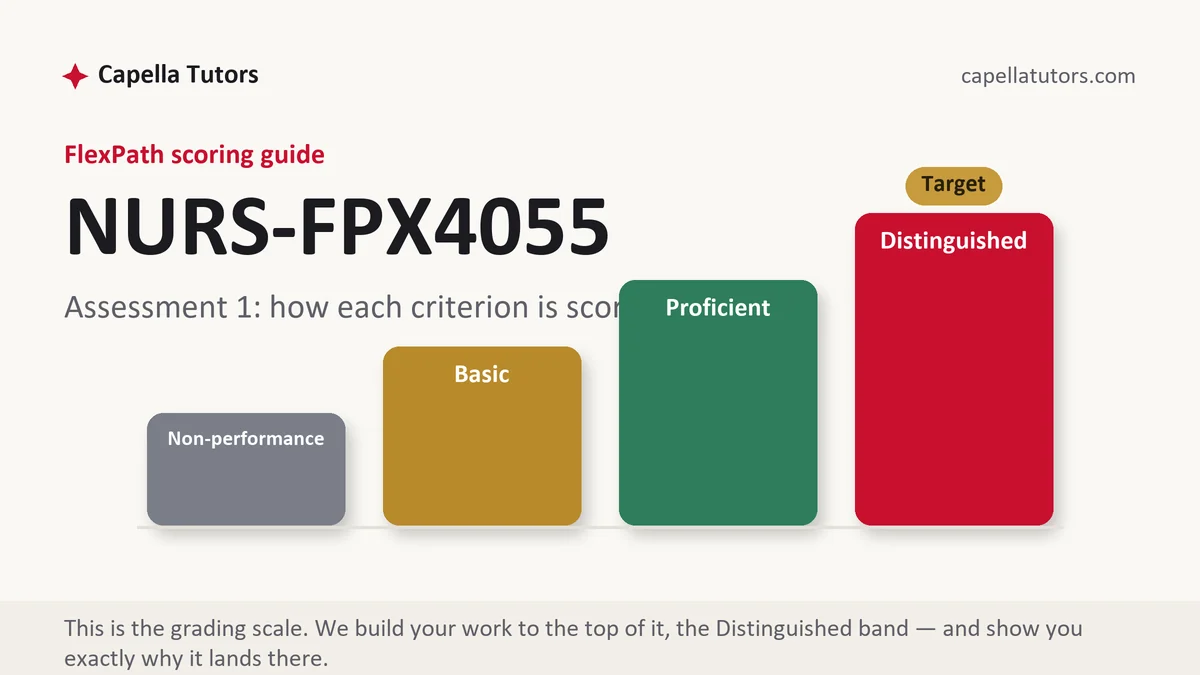
How NURS FPX 4055 Assessment 1 is scored
FlexPath never issues letter grades. Your evaluator reads the plan against the scoring guide and places each criterion on one of four levels, so the level language is the target you write to:
| Level | What it means on a health promotion plan |
|---|---|
| Distinguished | The population is named and counted, every goal carries a baseline and a target, and each plan element answers a barrier the data proved. The guide spells out one extra move per criterion; make it in writing. |
| Proficient | A complete plan for a clearly described population, supported throughout. Competent work that stops one deliberate move short of the top column. |
| Basic | A plan for a community described in adjectives rather than numbers, with goals that cannot be measured. Where most first drafts in this course land. |
| Non-performance | A required element never appears, often the evaluation piece or the alignment to recognized objectives. Absent, not thin, is what sends a criterion to the bottom. |
Because this is the opening assessment of 4055, the population you choose here tends to follow you through the course. Pick a county you can reach data for now, and the later community work inherits a foundation instead of starting over.
The NURS FPX 4055 Assessment 1 method, step by step
-
Outline from the criteria, not the instructions
The instructions tell you what to produce; the criteria decide what it earns. Copy each criterion into a blank document as a heading, paste its Distinguished description underneath, and treat that skeleton as the entire assignment. A paragraph that serves no criterion is decoration, and decoration is the first thing evaluators skip.
-
Pick a population you can count
Your own county or city almost always wins, because the choice is really about data supply. Ten minutes on County Health Rankings and your state health department site tells you whether the numbers exist. A population you know from practice, with published statistics behind it, beats any community you picked for being interesting.
-
Pull the numbers before you write a word
Collect the data layer first: County Health Rankings for the county picture, CDC surveillance for prevalence and trend, the state health department for local reports, and Healthy People 2030 for the objective your goals will hang on. When a criterion asks you to describe the population's health status, it is asking for cited statistics set against a benchmark, nothing softer.
-
Choose goals a spreadsheet could verify
Write each goal with a baseline, a target number, and a date, then tie it to a named Healthy People 2030 objective. "Increase awareness of diabetes risk" cannot be scored; "raise screening completion from 46 to 60 percent within twelve months" can. Measurable goals also make the evaluation section nearly write itself.
-
Match every plan element to a documented barrier
For each activity in the plan, name the barrier it answers and the data that proved the barrier exists. Cost, transportation, literacy, culture, distance: whichever your numbers show, the plan should visibly answer it. An activity with no barrier behind it reads as filler, and evaluators grade it that way.
-
Score your own draft against the guide first
Before submitting, read the plan one criterion at a time and assign it a level yourself, honestly. Anything short of the top column gets another pass. Then submit early in the week; evaluations can take two business days, and a plan submitted Friday buys you a weekend of waiting for nothing.
A structure that maps to the criteria
The word targets below are planning numbers from our tutors, not Capella requirements. Your scoring guide decides scope, and it wins every disagreement.
| Section | What it must do | Guide |
|---|---|---|
| Introduction | Name the population, the health concern, and what the plan intends, in plain declaratives. | ~150 words |
| Population profile | Demographics, geography, and health status carried by cited statistics compared to state or national benchmarks. | ~250 words |
| The health concern | The problem the data shows, argued with prevalence and trend from at least two sources that agree. | ~200 words |
| Goals and alignment | SMART goals with baselines and targets, each anchored to a named Healthy People 2030 objective. | ~200 words |
| The plan itself | Activities, channels, and partners, with each element answering a barrier the data documented. | ~350 words |
| Evaluation | Measures, data sources, and timing that could genuinely run after you leave the page. | ~150 words |
| References | Current APA, every data source cited with its update year. | as needed |
Annotated sample excerpt
Below is an excerpt from an original model our team wrote for this deliverable type, using a rural diabetes scenario. Study the moves it makes, then make them with your own population.
Harlan County's adult diabetes prevalence runs 14.9 percent against a state figure of 11.2, and the gap has widened in each of the last three County Health Rankings releases.1 The county's two primary care clinics sit forty minutes apart on a single highway, which is one reason 38 percent of adults report no routine checkup in the past year.2 This plan targets adults aged 45 to 70 in the county's three largest unincorporated communities, and it delivers prediabetes screening and a proven lifestyle program through the churches and the agricultural extension office those adults already visit.3
- 1Two cited numbers and a trend inside the first sentence. The population's problem is quantified before it is described, which is the order the criteria reward.
- 2Geography turned into a measurable access barrier. The 38 percent figure is doing argument work, not decoration.
- 3The population named by age and place, and the delivery channels chosen because the documented barriers point to them. Every later section is now set up.
The full premium sample for your exact assessment, written fresh to your scoring guide and issue, is free to request. Study it, revise it into your own voice, and submit work you understand.
The five mistakes that cost Distinguished
- The adjective community. "A rural area with limited access" names nothing and cites nothing; on a population criterion it scores Basic on contact.
- Numbers without argument. A block of statistics no sentence interprets is data decoration, and it earns the same score as no data.
- Borrowed interventions with no fit case. A textbook program is fine, but only once you argue why it fits this population's documented barriers.
- Goals without baselines. A target you cannot compare against a starting number is a wish, and wishes are unmeasurable by definition.
- An evaluation written as an afterthought. If the measures could not genuinely run, evaluators notice, because the criterion asks them to check.
Pre-submission checklist
- Each scoring-guide criterion owns a clearly labeled section of the plan
- The population is named by place and defined with cited statistics against a benchmark
- Every goal carries a baseline, a target, a date, and a Healthy People 2030 anchor
- Each plan activity names the documented barrier it answers
- Evaluation measures name a data source, an interval, and a success number
- Self-scored at the top level on every criterion, submitted early in the week
Want the plan drafted with backup?
Send the scoring guide and the county or population you have in mind. Our eight-person team, research analyst included, assembles the data picture and returns a premium original sample written to the Distinguished column in 24 to 48 hours, revisions free until it lands there. Data assembly is the slow part of this assessment; skip it.