This manual is for NURS FPX 4045 Assessment 4, start to submission. Informatics and Nursing-Sensitive Quality Indicators asks you to prepare a training presentation, usually for newly hired nurses, about one nursing-sensitive quality indicator such as falls with injury or pressure injuries: what the indicator measures and why it matters, how nurses collect and document its data, how the organization reports and uses those data, and why accurate documentation affects care. It is delivered as a recorded presentation or slides with speaker notes; check what your courseroom asks for. The grade turns on showing the path from a nurse's documentation to the organization's quality decisions. Below is the method our tutors use, a structure that maps to the criteria, and an annotated sample excerpt. Prefer to hand it off? A premium original sample for this exact assessment comes back in 24 to 48 hours, revised free until it meets the guide. Capella's catalog lists the course as NURS-FPX4045, and some courserooms print NURS4045; both point to this same Assessment 4. In current courserooms this assessment typically appears as "Informatics and Nursing-Sensitive Quality Indicators".
One honesty note before the manual: Capella revises courses and scoring guides over time, so always write to the exact scoring guide attached to your assessment in the courseroom. The course identity above is verified on capella.edu; the method and structure below are our tutors' approach to it, not Capella's official rubric text.
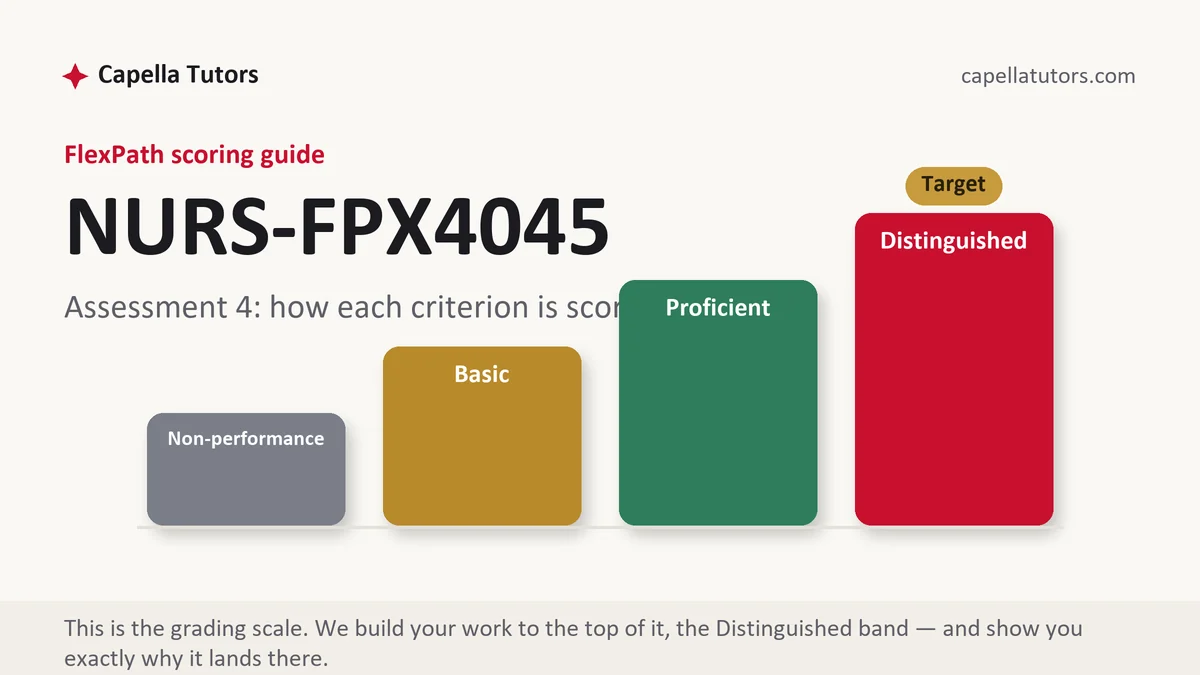
How NURS FPX 4045 Assessment 4 is scored
FlexPath does not use letter grades. Each criterion in the scoring guide lands on one of four levels, and the level descriptions are the real writing brief:
| Level | What it means on a quality indicator training presentation |
|---|---|
| Distinguished | One indicator is defined from a credible source, data collection and documentation are explained step by step, the route from data to reporting and improvement is shown, the nurse's role is concrete, and the content suits new staff. |
| Proficient | All parts are present and accurate, but the data path and the nurse's role are described generally. |
| Basic | The presentation discusses quality broadly, with the chosen indicator and its data only briefly explained. |
| Non-performance | The indicator, the data collection or the reporting discussion is missing. |
Choose an indicator you can trace from the bedside to a dashboard. Falls with injury and hospital-acquired pressure injuries work well because their documentation is concrete.
The NURS FPX 4045 Assessment 4 method, step by step
-
Define nursing-sensitive quality indicators
Explain the term and the National Database of Nursing Quality Indicators (NDNQI), and the structure, process and outcome categories. Cite the source.
-
Choose one indicator and say why it matters
Give its definition, why it reflects nursing care, and a figure that shows its cost or harm.
-
Show how the data are collected
What the nurse documents, where in the record, and when. Use your organization's process in general terms.
-
Show how the data are used
How the organization aggregates, reports and benchmarks the indicator, and how results lead to changes in practice.
-
Make the nurse's role concrete
What a new nurse must do on every shift to keep the data accurate, and what happens to care when documentation is incomplete.
-
Write for new staff
Clear, practical notes or a script, with citations, that a new hire could follow.
A structure that maps to the criteria
Timing and slide counts vary by version; follow your scoring guide. The note lengths below are planning targets our tutors use.
| Section | What the slide and notes must do | Guide |
|---|---|---|
| Introduction | Purpose of the training and the audience. | 1 slide, ~100 words of notes |
| Nursing-sensitive quality indicators | Definition, NDNQI and the three categories. | 1 to 2 slides, ~150 words |
| The chosen indicator | Definition, importance and a figure. | 1 to 2 slides, ~175 words |
| Collecting and documenting the data | What, where and when nurses document. | 2 slides, ~200 words |
| Reporting and using the data | Aggregation, benchmarking and practice change. | 2 slides, ~200 words |
| The nurse's role and close | Shift-level responsibilities, summary, references. | 2 slides, ~150 words |
Annotated sample excerpt
An original model excerpt from our team, written to show the register that reaches the top of the guide. Learn the moves, then write your own version.
Every fall on this unit generates two pieces of documentation, and both feed the indicator we are discussing today.1 The first is the post-fall assessment in the patient's record, completed within the shift, which captures the injury level from none to major; the second is the incident report, which the quality team uses to confirm the injury level and count the event.2 If the injury level is left blank or recorded differently in the two places, the fall may be counted incorrectly, and the unit's rate, which is compared with similar units nationally, stops telling us whether our prevention work is succeeding.3
- 1Opens with a fact a new nurse can act on, which suits the training audience.
- 2Explains exactly what is documented and where, the data path the criteria ask about.
- 3Shows the consequence of inaccurate documentation for benchmarking and care.
The full premium sample for your exact assessment, written fresh to your scoring guide and topic, is free to request. Study it, revise it into your own voice, and submit work you understand.
The five mistakes that cost Distinguished
- Quality in general. Keep to one indicator and trace its data.
- Skipping documentation details. New nurses need to know what to record and where.
- No reporting path. Show how the data reach the people who act on them.
- An audience mismatch. Write for new hires, not for executives.
- Slides with no notes or script. The notes carry the content the evaluator scores.
Pre-submission checklist
- Nursing-sensitive indicators and NDNQI explained
- One indicator chosen with a figure showing its importance
- Data collection and documentation explained step by step
- Reporting and use of the data shown
- The nurse's role made concrete
- Notes or script with current APA citations
Want the training presentation built?
Send the scoring guide and the indicator you chose. Our team returns a premium original slide deck with full speaker notes in 24 to 48 hours, revised free until it meets the guide.