This manual is for NURS FPX 4045 Assessment 3, start to submission. Technology in Nursing asks you to choose one technology used in nursing practice, such as telehealth, smart pumps or remote patient monitoring, find current peer-reviewed sources about it, and write an annotated bibliography that explains how each source informs the technology's effect on quality, safety and care, ending with a summary recommendation. The grade turns on the annotations. Each one needs to do more than summarize: it should say what the source adds to the case for or against the technology. Below is the method our tutors use, a structure that maps to the criteria, and an annotated sample excerpt. Prefer to hand it off? A premium original sample for this exact assessment comes back in 24 to 48 hours, revised free until it meets the guide. Capella's catalog lists the course as NURS-FPX4045, and some courserooms print NURS4045; both point to this same Assessment 3. In current courserooms this assessment typically appears as "Technology in Nursing".
One honesty note before the manual: Capella revises courses and scoring guides over time, so always write to the exact scoring guide attached to your assessment in the courseroom. The course identity above is verified on capella.edu; the method and structure below are our tutors' approach to it, not Capella's official rubric text.
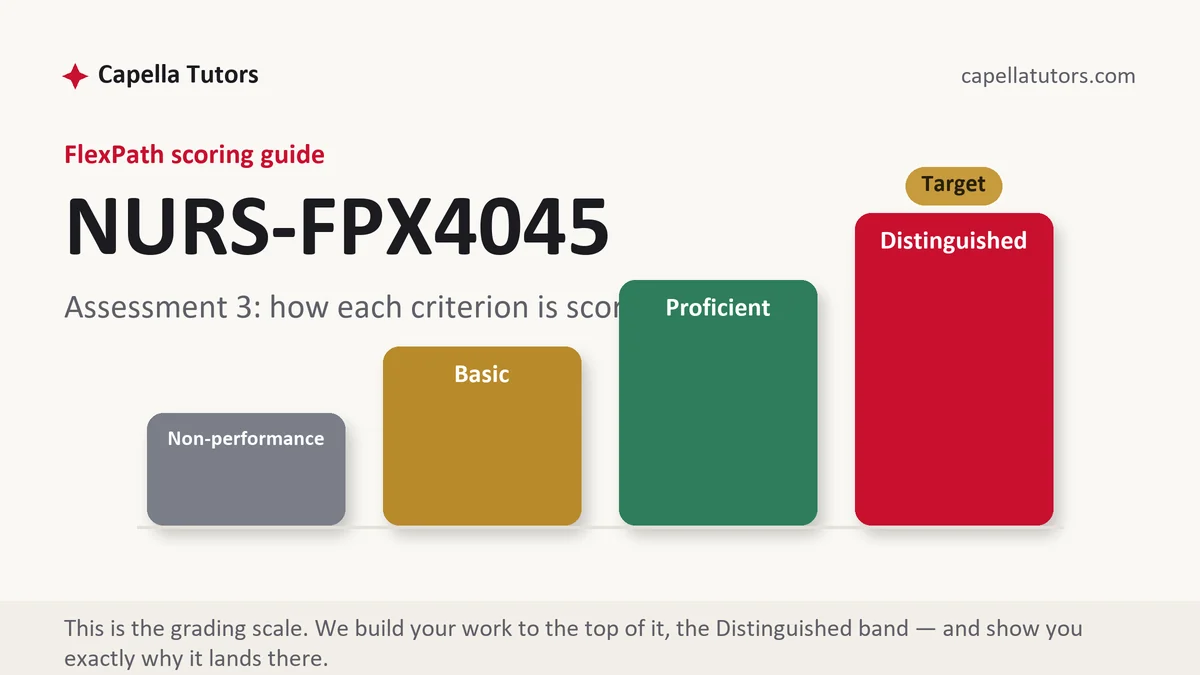
How NURS FPX 4045 Assessment 3 is scored
FlexPath does not use letter grades. Each criterion in the scoring guide lands on one of four levels, and the level descriptions are the real writing brief:
| Level | What it means on a technology annotated bibliography |
|---|---|
| Distinguished | The technology is clearly defined and its relevance argued, the search is described, each annotation summarizes the source and explains its contribution to quality, safety or implementation, and the summary recommendation draws the sources together. |
| Proficient | The annotations are accurate and relevant, but they summarize more than they evaluate, and the recommendation is brief. |
| Basic | Sources are loosely related to the technology and annotations repeat the abstracts. |
| Non-performance | Too few sources, no search description or no summary recommendation. |
Choose a technology narrow enough to annotate well. "Telehealth videoconferencing for post-discharge follow-up" gives sharper sources than "telehealth".
The NURS FPX 4045 Assessment 3 method, step by step
-
Choose and define the technology
Name the technology, the setting where nurses use it, and why it interests you professionally.
-
Describe your search
Databases such as PubMed and CINAHL, the key terms you used, filters such as peer-reviewed and the last five years, and why you chose these sources.
-
Write annotations with a pattern
For each source: what the study did and found, its strengths and limits, and how it informs the technology's effect on quality, safety or care.
-
Cover implementation as well as outcomes
Include at least one source on adoption: training, workflow, cost or patient acceptance. Recommendations without implementation evidence read as Proficient.
-
Summarize the evidence
Draw the sources together: what they agree on, where they conflict, and what that means for nursing practice.
-
Recommend
State whether and how an organization should adopt or expand the technology.
A structure that maps to the criteria
Word counts are planning targets our tutors use, not Capella rules; follow the source count and length your scoring guide states.
| Section | What it must do | Guide |
|---|---|---|
| Introduction | The technology, the setting and why it matters. | ~125 words |
| Search method | Databases, terms, filters and selection. | ~100 words |
| Annotations | One per source: summary, strengths, limits, contribution. | ~150 words each |
| Summary of the literature | Agreements, conflicts and implications. | ~175 words |
| Recommendation and references | Adoption advice, then current APA. | ~100 words |
Annotated sample excerpt
An original model excerpt from our team, written to show the register that reaches the top of the guide. Learn the moves, then write your own version.
The first source is a recent scoping review of videoconferencing in specialist outpatient services, which found consistent patient satisfaction alongside mixed evidence on clinical outcomes.1 Its strength is breadth across settings; its limit is that a scoping review maps the evidence rather than weighing it, so it cannot show whether videoconferencing is as safe as in-person follow-up.2 For this bibliography it establishes that patients accept the technology, which supports the case for adoption, while pointing to the outcome studies that follow as the evidence on safety.3
- 1Summarizes the source in one sentence with its main finding.
- 2Judges the source's design and its limit, the evaluation the top column rewards.
- 3States the source's role in the overall argument, which turns a list into a bibliography.
The full premium sample for your exact assessment, written fresh to your scoring guide and topic, is free to request. Study it, revise it into your own voice, and submit work you understand.
The five mistakes that cost Distinguished
- A technology that is too broad. Narrow it so the sources speak to the same question.
- Annotations that repeat abstracts. Evaluate and connect each source.
- No implementation evidence. Include adoption, training or workflow sources.
- Missing search description. Say where and how you looked.
- No summary recommendation. Close by drawing the sources together.
Pre-submission checklist
- One clearly defined technology and setting
- Search method described
- Each annotation summarizes, evaluates and connects
- At least one source on implementation
- Summary and recommendation draw the sources together
- Current APA references
Want the annotated bibliography done?
Send the scoring guide and the technology you chose. Our team returns a premium original annotated bibliography in 24 to 48 hours, revised free until it meets the guide.