This manual is for NURS FPX 4045 Assessment 2, start to submission. Assessment 2 of NURS FPX 4045 is the protected health information deliverable, and students lose points on it for a reason unrelated to effort: they write privacy as a value instead of as a rule with parts. The criteria want the rule named, applied to specific staff behavior on a specific unit, with the boundary of interdisciplinary sharing drawn precisely and the guidance written so a colleague could actually follow it. Below is the method our tutors use here, a section plan matched to the criteria, and an annotated passage out of one of our models. Prefer it handled? A premium original sample for this exact assessment is delivered inside 24 to 48 hours, with free revisions until each criterion sits where you want it. Capella's catalog lists the course as NURS-FPX4045, and some courserooms print NURS4045; both point to this same Assessment 2. In current courserooms this assessment typically appears as "Protected Health Information (PHI): Privacy, Security, and Confidentiality Best Practices".
One honesty note before the manual: Capella revises courses and scoring guides over time, so always write to the exact scoring guide attached to your assessment in the courseroom. The course identity above is verified on capella.edu; the method and structure below are our tutors' approach to it, not Capella's official rubric text.
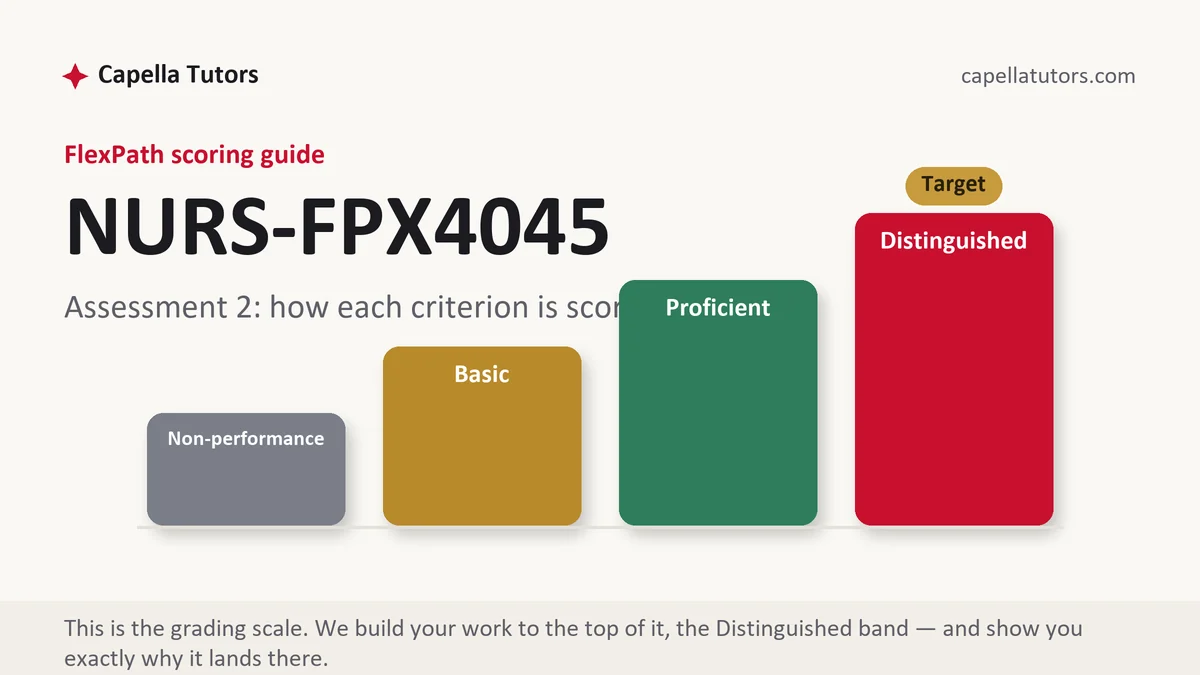
How NURS FPX 4045 Assessment 2 is scored
Every criterion resolves to one of four columns, and on a privacy deliverable the columns are unusually easy to read, because the difference between them is specificity:
| Level | What it means on a protected health information deliverable |
|---|---|
| Distinguished | Identifiers are named as a category with examples from the unit, the governing rule is cited and then applied to a behavior somebody actually performs, the sharing boundary is drawn with the reason behind it, and the guidance is short enough that a busy nurse would obey it. |
| Proficient | The rule is cited correctly and the risks are real, but the application stays at policy level, so the paper describes what staff should do without ever describing what staff do. |
| Basic | Sincere writing about respecting patient confidentiality, with the regulation mentioned once by name and never used. Nothing here can be scored as application. |
| Non-performance | A required piece is absent, most often the staff-facing guidance or the interdisciplinary sharing analysis, both of which are separate criteria more often than students expect. |
Your scoring guide decides the artifact this becomes, and the range is wide: a staff briefing, a training handout, a paper with a guidance section attached. The criteria survive the format change, so read the guide for its audience before you settle on a tone.
The NURS FPX 4045 Assessment 2 method, step by step
-
Rebuild the guide and count the privacy criteria
Paste each criterion into an empty document as a heading, then count how many of them concern privacy, security, or the sharing boundary separately. They usually split into two or three, and answering all of them in one paragraph hands away the criteria you never noticed were separate.
-
Choose one behavior, not one abstraction
Privacy writing gets specific or it gets Basic. Pick a single practice your unit performs, the way handoff information moves between shifts, what happens to a printed worklist at the end of a shift, who has a shared login and why. One behavior examined in detail outscores five risks listed in a row.
-
Name the rule, then use it
Treat HIPAA as a regulation with distinct parts rather than a mood: the Privacy Rule governs uses and disclosures, the Security Rule governs administrative, physical, and technical safeguards for electronic information, and the breach notification requirements sit alongside both. Cite the rule accurately, then apply it to the behavior you chose. HHS and ONC material on healthit.gov carry the regulatory layer.
-
Separate privacy, security, and confidentiality on the page
These three get used interchangeably in conversation and are graded separately in this course. Privacy is the patient's control over their information, security is the set of safeguards protecting it, confidentiality is the professional obligation once you hold it. Define each in one sentence, then show the same behavior touching all three differently. That paragraph alone tends to lift a criterion a full column.
-
Draw the interdisciplinary sharing boundary with its reason
Interdisciplinary care requires disclosure, so the question is never whether to share but what, with whom, and how much. Write the boundary as a test a colleague could apply at the moment of sharing: does this person need this element to do their part of the care. Include the awkward cases, the consulting service, the case manager, the student, because the awkward cases are where the criterion lives.
-
Write guidance that survives a real shift, then self-score
Close with rules a nurse could follow at 0300 without rereading them: three or four lines, imperative, each one tied to a risk you documented earlier. Then score every criterion against all four columns, revise anything under target once, and submit early in the week so a returned evaluation still leaves you room to answer it.
A structure that maps to the criteria
The word targets below are planning weights our tutors use for a typical 4045 privacy deliverable. Capella sets none of them, and your scoring guide decides the emphasis.
| Section | What it must do | Guide |
|---|---|---|
| Introduction and setting | Name the unit, the audience for the guidance, and the practice whose privacy risk the paper examines. | ~150 words |
| What counts as PHI here | The identifier categories, illustrated with the ones this practice actually moves, room and unit numbers included. | ~250 words |
| The rules that govern it | Privacy Rule, Security Rule, and breach obligations cited accurately, then applied to the chosen behavior line by line. | ~300 words |
| Where the risk actually lives | The moment in the workflow when information leaves protected channels, with the pressure that makes staff do it. | ~250 words |
| Sharing, safeguards, and guidance | The interdisciplinary boundary and its test, the safeguards by function, and the short staff-facing rules that follow. | ~250 words |
| Conclusion and references | The obligation restated without new claims, current APA, citations matched both directions, regulatory sources cited as reports. | as needed |
Annotated sample excerpt
The passage below comes out of a model file our writers built for this deliverable, annotated so you can see which sentence does which job. Borrow the structure, write your own words.
On a step-down unit at shift change, the fastest way to tell the oncoming nurse that a drain output has changed is a text message from one personal phone to another, and that convenience is exactly where protected health information leaves the record.1 A message pairing a clinical fact with an identifier is PHI whatever application carries it, and a room number is an identifier, so the governing question is not what was said but what the platform did with it: whether the content was encrypted in transit and at rest, whether a lost device can be wiped, and whether the exchange is retrievable by the organization that is accountable for it.2 The unit standard that follows is short enough to be obeyed: clinical handoff content travels only through the organization's secure messaging application, personal devices carry no patient images at any time, and anything that changes the plan of care goes into the record rather than staying in a thread.3
- 1Fixes the risk to a named moment on a named unit, which gives the privacy criterion a behavior to grade instead of a principle to admire.
- 2Applies the rule to a specific artifact and names the technical safeguards by what they do, which is the cite-then-use move the top column pays for.
- 3Lands on guidance a nurse could follow mid-shift, three lines, each one answering a risk the paragraph already documented.
The full premium sample for your exact assessment, written fresh to your scoring guide and issue, is free to request. Study it, revise it into your own voice, and submit work you understand.
The five mistakes that cost Distinguished
- Privacy as a value. Paragraphs on how much patients deserve confidentiality contain no application, and application is what the criterion is measuring.
- The regulation named once. Citing HIPAA in the introduction and never returning to it is the single most common way this assessment stalls at Basic.
- Three terms treated as one. Privacy, security, and confidentiality get graded separately here; collapsing them costs the criterion that asked you to distinguish them.
- The boundary left undrawn. "Share only what is necessary" gives a colleague no test to apply; the awkward cases are where the column expects you to work.
- Guidance nobody could follow. A twelve-point policy handed to a nurse mid-shift will not be read, and evaluators judge feasibility.
Pre-submission checklist
- Each privacy-related criterion counted and given its own section
- One real practice examined in detail rather than a list of risks
- The rule cited accurately by part and applied to named behavior
- Privacy, security, and confidentiality defined and kept distinct
- The interdisciplinary sharing boundary written as an applicable test
- Guidance short, imperative, risk-linked, self-scored, submitted early
Want the privacy deliverable written for you?
Send the scoring guide and one line about how information actually moves on your unit. Eight people work the order, a research analyst and two QA reviewers among them, and the premium original PHI deliverable comes back inside 24 to 48 hours, regulatory citations checked against current federal sources and revisions free until every criterion reads Distinguished. This is the assessment where vague writing is punished hardest; do not improvise it.