This manual is for NURS FPX 4045 Assessment 1, start to submission. Nursing Informatics in Health Care asks you to explain the role of the nurse informaticist to colleagues or leaders in a health care organization: what the role is, how nurse informaticists work with other disciplines, how they improve patient care, safety and efficiency, and the opportunities and challenges an organization faces in adding the role, ending with a recommendation. The grade turns on concrete examples. A description of informatics in general scores lower than a paper showing what a nurse informaticist actually does with a system your organization uses. Below is the method our tutors use, a structure that maps to the criteria, and an annotated sample excerpt. Prefer to hand it off? A premium original sample for this exact assessment comes back in 24 to 48 hours, revised free until it meets the guide. Capella's catalog lists the course as NURS-FPX4045, and some courserooms print NURS4045; both point to this same Assessment 1. In current courserooms this assessment typically appears as "Nursing Informatics in Health Care".
One honesty note before the manual: Capella revises courses and scoring guides over time, so always write to the exact scoring guide attached to your assessment in the courseroom. The course identity above is verified on capella.edu; the method and structure below are our tutors' approach to it, not Capella's official rubric text.
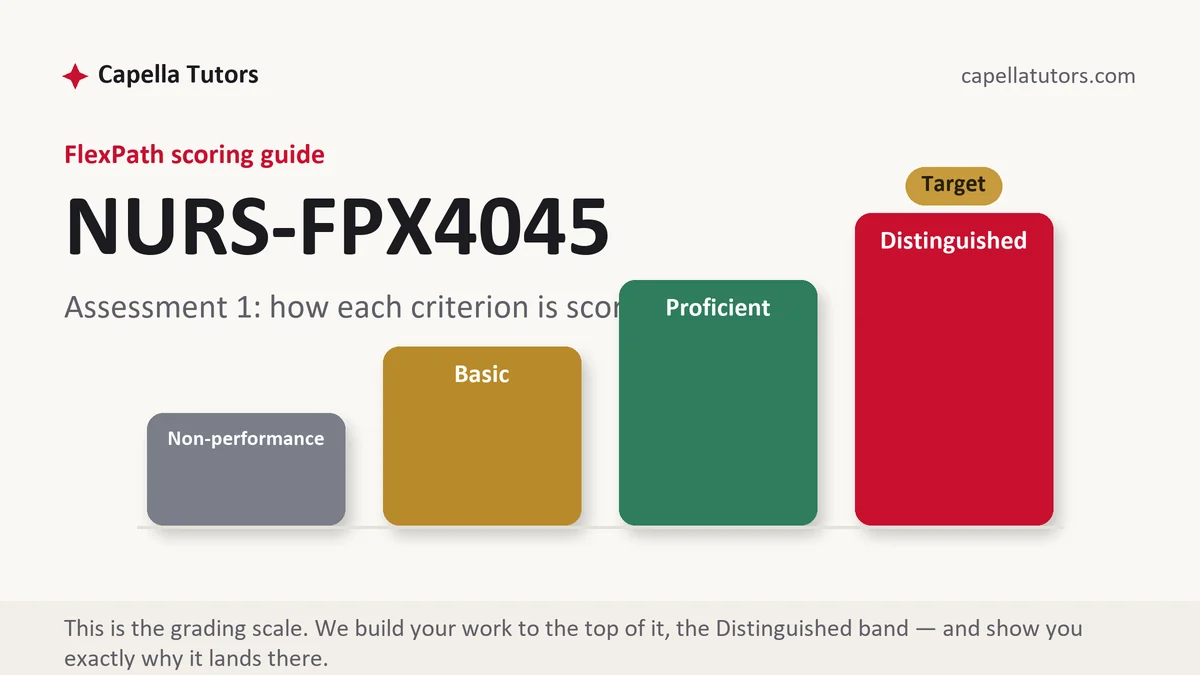
How NURS FPX 4045 Assessment 1 is scored
FlexPath does not use letter grades. Each criterion in the scoring guide lands on one of four levels, and the level descriptions are the real writing brief:
| Level | What it means on a nursing informatics role paper |
|---|---|
| Distinguished | The role is defined from a credible source, its work is shown through a specific example such as a clinical decision support or EHR project, interdisciplinary collaboration is described, outcomes are supported with evidence, and the recommendation weighs opportunities against challenges. |
| Proficient | All parts are present and accurate, but the examples stay general and the challenges are briefly listed. |
| Basic | The paper describes informatics broadly with little about the nurse informaticist's actual work. |
| Non-performance | A required part, such as the challenges or the recommendation, is missing. |
Write for the audience your guide names, often an interdisciplinary team or a leader deciding whether to fund the role. That audience wants practical value, not history.
The NURS FPX 4045 Assessment 1 method, step by step
-
Define the role precisely
Use the American Nurses Association or HIMSS description: a nurse who integrates nursing science with information science to manage and communicate data and knowledge. Cite it.
-
Show the role through one example
Choose a technology the role supports, such as clinical decision support alerts, barcode medication administration or an EHR documentation redesign, and describe what the nurse informaticist does from planning to training.
-
Describe interdisciplinary work
Who the role works with: physicians, pharmacists, IT staff, quality teams. Explain how it translates clinical needs into system requirements and back.
-
Support the outcomes with evidence
Cite studies linking informatics nurses to safety, efficiency or satisfaction, for example fewer medication errors or less documentation time.
-
Weigh opportunities and challenges
Opportunities such as better data use and staff engagement; challenges such as cost, alert fatigue, staff resistance and privacy obligations.
-
Recommend
Close with a clear recommendation for the organization, sized to its situation.
A structure that maps to the criteria
Word counts are planning targets our tutors use for this paper, not Capella rules; follow the length your scoring guide states.
| Section | What it must do | Guide |
|---|---|---|
| Introduction | The organization's situation and why the role matters now. | ~125 words |
| The nurse informaticist role | Definition and core responsibilities. | ~200 words |
| The role in practice | One technology example from planning to training. | ~250 words |
| Interdisciplinary collaboration | Who the role works with and how. | ~175 words |
| Opportunities and challenges | Evidence-based benefits and obstacles. | ~225 words |
| Recommendation and references | A clear recommendation, then current APA. | ~125 words |
Annotated sample excerpt
An original model excerpt from our team, written to show the register that reaches the top of the guide. Learn the moves, then write your own version.
When the hospital added sepsis alerts to its electronic health record, the nurse informaticist was the person who sat between the nurses who would receive the alerts and the analysts who would build them.1 She reviewed which vital sign and lab combinations nurses already used to recognize early sepsis, worked with the build team so the alert fired at those thresholds rather than at every abnormal value, and tested it on one unit before rollout.2 Because alert fatigue is a known reason clinicians ignore warnings, that early tuning mattered as much as the alert itself, and it is the kind of work no other role on the team is positioned to do.3
- 1Places the role in a real project, which shows what the nurse informaticist actually does.
- 2Describes concrete actions across disciplines, which answers the collaboration criterion.
- 3Connects the work to a known risk and explains why the role is distinct, the extra move of the top column.
The full premium sample for your exact assessment, written fresh to your scoring guide and topic, is free to request. Study it, revise it into your own voice, and submit work you understand.
The five mistakes that cost Distinguished
- Informatics in general. Keep the focus on the nurse informaticist's work.
- No example. One concrete project makes every other section stronger.
- Benefits without evidence. Support outcome claims with sources.
- Challenges skipped. Cost, resistance and alert fatigue belong in a credible recommendation.
- Ignoring the audience. Write for the team or leader your guide names.
Pre-submission checklist
- Role defined from a credible source
- One technology example described in practice
- Interdisciplinary collaboration explained
- Outcomes supported with evidence
- Opportunities and challenges weighed
- Clear recommendation and current APA references
Want the informatics paper written to your guide?
Send the scoring guide and the technology your organization uses. Our team returns a premium original paper in 24 to 48 hours, revised free until it meets the guide.