This manual is for NURS FPX 4035 Assessment 4, start to submission. The Improvement Plan Tool Kit closes the course by building the resource set that would let other nurses carry out the safety improvement plan you developed earlier: an annotated bibliography of evidence-based sources, organized into categories, with each source summarized and its practical use explained. The grade turns on usefulness. A list of good articles scores lower than a tool kit where every entry tells a nurse what the resource is, why it matters for this plan and when to use it. Below is the method our tutors use, a structure that maps to the criteria, and an annotated sample excerpt. Prefer to hand it off? A premium original sample for this exact assessment comes back in 24 to 48 hours, revised free until it meets the guide. Capella's catalog lists the course as NURS-FPX4035, and some courserooms print NURS4035; both point to this same Assessment 4. In current courserooms this assessment typically appears as "Improvement Plan Tool Kit".
One honesty note before the manual: Capella revises courses and scoring guides over time, so always write to the exact scoring guide attached to your assessment in the courseroom. The course identity above is verified on capella.edu; the method and structure below are our tutors' approach to it, not Capella's official rubric text.
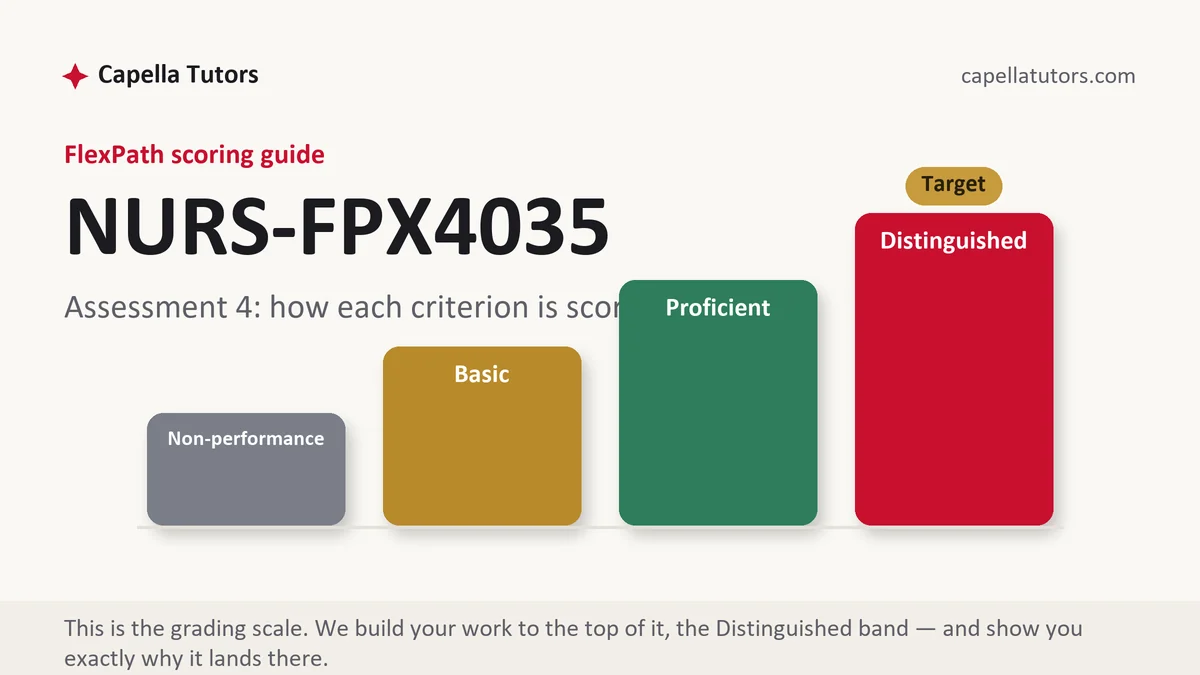
How NURS FPX 4035 Assessment 4 is scored
FlexPath does not use letter grades. Each criterion in the scoring guide lands on one of four levels, and the level descriptions are the real writing brief:
| Level | What it means on an improvement plan tool kit |
|---|---|
| Distinguished | Resources are organized into clear categories that match the plan, each annotation summarizes the source and explains how and when a nurse would use it, sources are current and credible, and the introduction explains how the kit was built. |
| Proficient | The categories and annotations are accurate, but the explanation of use is general and repeats across entries. |
| Basic | Annotations summarize articles without connecting them to the improvement plan. |
| Non-performance | The kit has too few resources for the guide, or categories or annotations are missing. |
Keep the same safety issue and plan you used in Assessments 1 to 3. The tool kit is the practical companion to that plan, so every category should map to a part of it.
The NURS FPX 4035 Assessment 4 method, step by step
-
Name the plan the kit supports
Open with the safety issue and the improvement plan in two or three sentences, and say who the kit is for, for example nurses on a medical-surgical unit adopting a fall prevention bundle.
-
Choose categories that match the plan
Typical categories are organizational best practices, risk assessment tools, patient and family education, and technology or monitoring. Use the categories your guide names if it names them.
-
Select credible, current resources
Peer-reviewed studies, professional guidelines, and tools from bodies such as AHRQ or The Joint Commission. Aim for the number of sources your scoring guide sets, spread across the categories.
-
Write each annotation in two parts
First what the source is and what it found; then how a nurse would use it in this plan, and when.
-
Explain your search
State the databases and key terms you used and how you chose the sources, so the evaluator can see the kit was built deliberately.
-
Format for use
A table or clear headings by category makes the kit usable. Keep every reference in current APA.
A structure that maps to the criteria
Word counts are planning targets our tutors use for the tool kit, not Capella rules; follow the source count and length your scoring guide states.
| Section | What it must do | Guide |
|---|---|---|
| Introduction | The safety issue, the plan, the audience and how the kit was built. | ~150 words |
| Category 1: organizational best practices | Annotated sources on systems and policies. | ~250 words |
| Category 2: assessment tools | Annotated sources on risk screening and measurement. | ~250 words |
| Category 3: patient and family education | Annotated sources on teaching and engagement. | ~250 words |
| Category 4: technology or monitoring | Annotated sources on alarms, alerts or data tools. | ~250 words |
| References | Every source in current APA. | as needed |
Annotated sample excerpt
An original model excerpt from our team, written to show the register that reaches the top of the guide. Learn the moves, then write your own version.
Agency for Healthcare Research and Quality. (2013). Preventing falls in hospitals: A toolkit for improving quality of care. This toolkit sets out a step-by-step approach to implementing a fall prevention program, including a universal precautions checklist, a scheduled rounding protocol and measures for tracking falls with injury.1 For nurses on our unit, its universal precautions checklist is the starting point for every admission, and its rounding protocol supports the hourly rounding step in our improvement plan.2 Use it at the start of implementation to train staff and again at the three-month review, when its measurement section helps compare our fall rates with the baseline.3
- 1Identifies the resource and its content briefly, the first half of a strong annotation.
- 2Connects the resource to a specific step of the improvement plan.
- 3Says when to use it, which is the practical guidance that separates a tool kit from a reference list.
The full premium sample for your exact assessment, written fresh to your scoring guide and topic, is free to request. Study it, revise it into your own voice, and submit work you understand.
The five mistakes that cost Distinguished
- A reference list with summaries only. Every entry needs a use in this plan.
- Categories that do not match the plan. The kit should map to the parts of your improvement plan.
- Old or weak sources. Use current peer-reviewed research and recognized guidelines.
- Too few sources. Meet the count your scoring guide sets across the categories.
- No search explanation. Say how the sources were found and chosen.
Pre-submission checklist
- Same safety issue and plan as Assessments 1 to 3
- Categories that match the plan
- Source count meets the guide, sources current and credible
- Each annotation summarizes and explains use
- Search method explained
- Current APA references
Want the tool kit assembled for your plan?
Send the scoring guide and your improvement plan. Our team returns a premium original tool kit with categorized, annotated sources in 24 to 48 hours, revised free until it meets the guide.