This manual is for NURS FPX 4035 Assessment 3, start to submission. Assessment 3 of NURS FPX 4035 turns your improvement work outward: you present the plan to the people who must run it, frontline nurses, charge staff, the interdisciplinary neighbors your change touches. The grading shifts with the audience. Where the earlier deliverables rewarded analysis, this one rewards persuasion built on that analysis, roles assigned, resistance anticipated, the change made survivable for a real unit. What follows is the method our tutors use, the structure they build to, and an annotated excerpt from an original model. Prefer it done? A premium original sample for this exact assessment lands in 24 to 48 hours, revised free until the target column. Capella's catalog lists the course as NURS-FPX4035, and some courserooms print NURS4035; both point to this same Assessment 3. In current courserooms this assessment typically appears as "Improvement Plan In-Service Presentation".
One honesty note before the manual: Capella revises courses and scoring guides over time, so always write to the exact scoring guide attached to your assessment in the courseroom. The course identity above is verified on capella.edu; the method and structure below are our tutors' approach to it, not Capella's official rubric text.
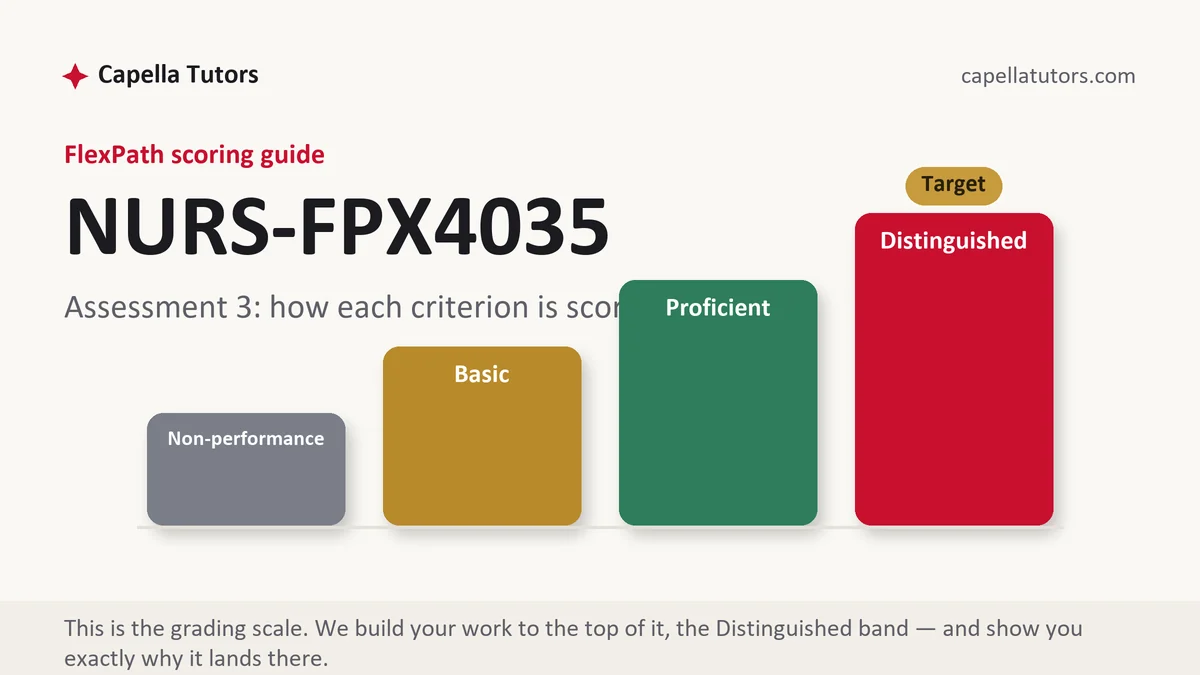
How NURS FPX 4035 Assessment 3 is scored
Four columns per criterion, as everywhere in FlexPath, but on a presentation deliverable the columns grade communication choices as hard as content:
| Level | What it means on an improvement presentation |
|---|---|
| Distinguished | The audience is named and addressed in its own terms, every role in the plan has an owner, the likely objection is raised before the room can raise it, and sustainment is planned past the launch week. |
| Proficient | The plan is communicated accurately and completely, but it speaks about the audience rather than to it, and the objection handling stays generic. |
| Basic | The earlier paper pasted onto slides: dense text, no roles, no delivery layer, evidence recited instead of translated for the floor. |
| Non-performance | A required channel is missing, commonly the speaker notes or delivery script that many guides treat as the actual graded artifact. |
Check your scoring guide for the required format before building anything; guides for this deliverable vary between slide decks with notes, recorded delivery, and written toolkits. The criteria travel across formats, the file type does not.
The NURS FPX 4035 Assessment 3 method, step by step
-
Read the guide for the audience, not just the content
Somewhere in your criteria sits the answer to who is in the room, staff nurses, an interdisciplinary team, unit leadership. Outline from the criteria as always, one heading each with the Distinguished text pasted under it, but underline every word describing the audience, because those words grade your tone, vocabulary, and evidence translation.
-
Carry the same problem forward, compressed
This deliverable usually presents the improvement work you built earlier in the course. Do not re-argue the analysis; compress it. The room gets the problem in one slide's worth of numbers and the cause ranking in one more, because the presentation's real estate belongs to what happens next, not to how you got here.
-
Give every part of the plan a named owner
A unit adopts a change when each person can find their own job in it. Assign the plan's moving parts to roles, who opens the new process each shift, who collects the measure, who escalates when it slips, and say what each owner needs from leadership to do it. Plans without owners are the presentations units politely forget.
-
Build slides as argument, notes as delivery
Each slide is one claim in seven lines or fewer; the speaker notes carry the full spoken paragraph, evidence woven in conversationally with citations still present. Evaluators read the notes as closely as the slides, often more closely, because the notes prove you can actually deliver this to a room rather than read at one.
-
Answer the objection before the room asks it
Every practice change costs somebody workflow, and your audience knows it before you finish the title slide. Name the cost honestly, this adds ninety seconds to shift start, then answer it with the trade: what the ninety seconds buys, in the audience's own currency of fewer callbacks, cleaner handoffs, less rework. Preempted objections read as respect; ignored ones read as inexperience.
-
Close the loop, then check every channel
End with sustainment: how the change survives month three, when will data be shared back with staff, what triggers an adjustment. Then run the final audit across every required channel, slides, notes, references slide, any recording, scoring each criterion at one of the four levels before you submit, early in the week as always.
A structure that maps to the criteria
The counts below assume a slide deck with speaker notes, our team's usual planning shape for this deliverable; let your own scoring guide overrule any of it.
| Section | What it must do | Guide |
|---|---|---|
| Opening and stakes | The safety problem in the audience's terms, sized with the numbers that made it worth a meeting. | ~2 slides |
| The plan in brief | Causes ranked in one visual, interventions mapped to them, the aim stated as a measure the unit can watch. | ~3 slides |
| Roles and responsibilities | Every moving part owned by a named role, with what each owner needs to succeed. | ~2 slides |
| Resources and timeline | What the change costs in time and materials, who provides it, and the weeks it takes to stand up. | ~2 slides |
| Objections and sustainment | The workflow cost named and answered, plus the plan for month three and beyond. | ~2 slides |
| Close and references | The ask stated plainly, then a references slide in current APA matching every citation in the notes. | ~2 slides |
Annotated sample excerpt
This passage comes from the speaker notes of an original model deck our team built for this deliverable type. The annotations mark what each move is for.
You have all stood in a safety huddle that was really an announcement queue, and the redesign starts from that admission: our current huddle averages eleven minutes, covers zero patient-specific risks by name, and ends without a single assigned follow-up.1 Under the new format the charge nurse opens with the three highest-risk patients on the board, each bedside nurse adds one risk in one sentence, and the huddle does not close until every flagged risk has an owner and a check-back time.2 That is four minutes of structure in place of eleven minutes of announcements, and the pilot data from a comparable surgical unit puts follow-through on flagged risks above eighty percent within two months.3
- 1Opens inside the audience's daily experience and concedes the current state with numbers, which buys the credibility the rest of the pitch spends.
- 2The redesign is narrated as roles doing things in sequence, so every listener locates their own job before being asked to agree.
- 3The trade is priced, four minutes for eleven, and closed with an evidence claim the notes cite, translated into the unit's own outcome language.
The full premium sample for your exact assessment, written fresh to your scoring guide and issue, is free to request. Study it, revise it into your own voice, and submit work you understand.
The five mistakes that cost Distinguished
- The paper on slides. Pasting your earlier analysis into a deck fails the communication criteria even when every fact survives the move.
- An unowned plan. If no role knows what it does on day one, the presentation proposes an idea, not a change, and the columns can tell.
- Empty speaker notes. Many guides grade the notes as the delivery evidence; a deck with bare bullets and silent notes surrenders whole criteria.
- Evidence in academic register. Confidence intervals recited to a huddle audience is translation failure; the floor hears outcomes, time, and workload.
- Launch with no month three. A change that ends at go-live is a memo; sustainment, data shared back, adjustment triggers, is what the top column keeps asking for.
Pre-submission checklist
- Audience identified from the guide and addressed in its own vocabulary throughout
- Problem and causes compressed to a fraction of the deck, plan and adoption given the rest
- Every element of the plan owned by a named role with stated support needs
- The main objection raised first by you, priced honestly, and answered
- Speaker notes written as full spoken delivery with citations intact
- All required channels present, self-scored per criterion, submitted with days in hand
Need the deck and notes built to the guide?
Send your scoring guide and the improvement plan it presents, ours or yours. The pod delivers a premium original presentation, slides, full speaker notes, references, in 24 to 48 hours, QA-checked twice against the criteria and revised free until it reads Distinguished. Presenting change is its own craft; borrow ours.