This manual is for NURS FPX 4035 Assessment 2, start to submission. Assessment 2 of NURS FPX 4035 is the course's engine room: a root-cause analysis of a safety event, and an improvement plan whose interventions answer the causes you found, with measures attached that a quality department could actually track. Two disciplines get graded at once, causal reasoning that stays on systems, and planning language that carries numerators, denominators, and dates. The method our tutors use for both is below, with a structure table and an annotated excerpt from an original model. Or skip the struggle: a premium original sample for this exact assessment comes back in 24 to 48 hours, revised free until the guide is satisfied. Capella's catalog lists the course as NURS-FPX4035, and some courserooms print NURS4035; both point to this same Assessment 2. In current courserooms this assessment typically appears as "Root-Cause Analysis and Safety Improvement Plan".
One honesty note before the manual: Capella revises courses and scoring guides over time, so always write to the exact scoring guide attached to your assessment in the courseroom. The course identity above is verified on capella.edu; the method and structure below are our tutors' approach to it, not Capella's official rubric text.
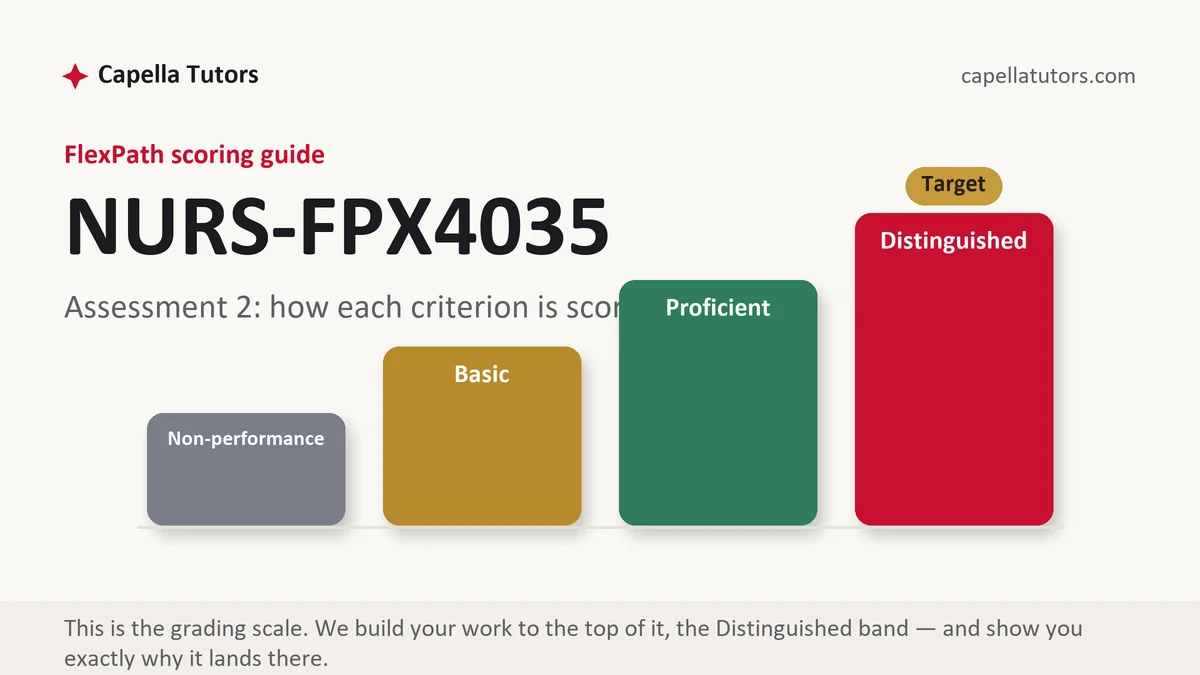
How NURS FPX 4035 Assessment 2 is scored
Each criterion in the FlexPath scoring guide resolves to one of four columns, and on this deliverable the columns read like a quality department's hiring bar:
| Level | What it means on a root-cause analysis and improvement plan |
|---|---|
| Distinguished | Causes ranked and defended, every intervention mapped to a cause it answers, and an aim a dashboard could track, with at least one barrier anticipated and met. The columns name these extras explicitly; write to them. |
| Proficient | The causal chain holds and the plan is coherent, but the cause-to-intervention mapping stays implicit and the measures lack a denominator or a date. |
| Basic | A narrative of the event plus good intentions: education proposed for everything, aims that cannot be counted, causes listed without rank or defense. |
| Non-performance | The analysis or the plan is missing a required limb, most often the measurement piece, which many students treat as optional. It is not. |
Your scoring guide decides the exact deliverable shape and any required tool, so read it before you commit to a format. What stays constant is the internal logic: event, causes, interventions, measures, one unbroken chain.
The NURS FPX 4035 Assessment 2 method, step by step
-
Map every criterion to a section of the plan
Copy the criteria out of your courseroom and give each one a heading with its Distinguished text underneath. On this assessment the criteria usually split between analysis and plan; knowing which sections serve which criterion stops the common failure of writing a brilliant RCA and a starved plan.
-
Anchor the analysis in one traceable event
Carry forward the problem from your earlier work in the course if it still fits, or choose an event with visible anatomy: something went wrong, a defense should have caught it, and the defense was absent or bent. De-identify completely, then write the event as sequence, not story, because the RCA will interrogate each step.
-
Run the root-cause tool visibly
Unless your guide names a tool, pick the one the event fits, a fishbone for an event with several contributing categories, five-whys for a single causal chain, and use it on the page. Name the tool, show the categories or the chain, and rank what you find. Analysis the evaluator can watch happening scores; analysis asserted as finished does not.
-
Match each intervention to a cause you found
This is the joint where most drafts crack. If your analysis traced the failure to interruption load and ambiguous task ownership, then your plan must answer interruption load and ambiguous task ownership, not propose an in-service and hope. State each mapping in one sentence, cause to intervention to expected effect, with a current source carrying the effect claim.
-
Write the aim as numerator, denominator, timeframe
An aim with all three parts can be audited; an aim missing any of them is a wish. Borrow whatever your organization already counts so the measure is collectable, name who collects it and how often, and set a target that is ambitious but arguable. Then add the barrier paragraph: the one thing most likely to stall the plan, and your answer to it.
-
Audit the chain, then submit early
Before submitting, walk the full chain backwards: does every measure track an intervention, does every intervention answer a ranked cause, does every cause trace to the event? Fix any orphan. Score yourself against all four columns per criterion, revise what falls short, and submit with days to spare so an evaluation cycle fits inside your plan for the week.
A structure that maps to the criteria
Targets below are the planning weights our team uses for a typical 4035 RCA-and-plan; treat your scoring guide as the final word on emphasis and length.
| Section | What it must do | Guide |
|---|---|---|
| Introduction | Name the event, the setting, and the promise: causes found, interventions matched, results measured. | ~120 words |
| The event as sequence | The de-identified anatomy of what happened, step by step, with the failed or absent defenses marked. | ~200 words |
| Root-cause analysis | The named tool applied visibly, causes ranked and defended, human factors in, blame out. | ~350 words |
| Evidence-based interventions | Each ranked cause answered by an intervention the literature supports, mapping stated, source strength weighed. | ~300 words |
| The improvement plan and measures | Who does what by when with what resources, the aim in numerator-denominator-timeframe form, one barrier anticipated. | ~300 words |
| Conclusion and references | The chain restated as closed, current APA, citations and references matched in both directions. | as needed |
Annotated sample excerpt
Here is a short passage from an original model our team wrote for this deliverable type, annotated to show why each move earns its keep. Learn it, then write yours.
The near-event reached the operating room with three defenses already spent: the consent listed the correct side, but the booking form did not, and the discrepancy survived both the preoperative call and the chart check because neither step requires the two documents to be read together.1 Applying a five-whys chain to the site-marking pause, the analysis reaches conditions rather than conduct: a booking form autofilled from a prior encounter, a verification script that asks the patient to confirm the procedure but not the side, and a time-out norm in which the surgeon speaks and the circulating nurse confirms silence as agreement.2 Ranked by contribution, the autofill defect leads, because it manufactures the error the later defenses were left to catch.3
- 1The event is written as a sequence of defenses, which hands the RCA its work: every spent defense is a why waiting to be asked.
- 2The tool is named and the causes it surfaces are all system properties, forms, scripts, norms, exactly the register the criterion pays for.
- 3Ranking with a stated reason is the Distinguished move; a flat list of causes reads Proficient at best.
The full premium sample for your exact assessment, written fresh to your scoring guide and issue, is free to request. Study it, revise it into your own voice, and submit work you understand.
The five mistakes that cost Distinguished
- The universal in-service. Education proposed for causes your own analysis traced elsewhere breaks the paper's logic, and evaluators check the mapping first.
- Unranked causes. Five causes listed flat force the plan to answer everything and therefore nothing; rank them and let the plan follow the ranking.
- The unmeasurable aim. If nobody could pull your aim from a dashboard in six months and declare it met or missed, it is not an aim yet.
- Analysis that stops at conduct. "The nurse skipped verification" is a symptom; the condition that made skipping normal is the cause.
- Measures with no owner. A metric nobody is assigned to collect will read as decoration, because that is what it would be in practice.
Pre-submission checklist
- Every criterion has a section, headed and answered in its own terms
- The root-cause tool is named and applied on the page, not merely cited
- Causes are ranked, defended, and free of individual blame
- Each intervention states the cause it answers and the source behind it
- The aim carries a numerator, a denominator, a timeframe, and an owner
- Chain audited end to end, self-scored per criterion, submitted early
Want the RCA and the plan built for you?
Send the scoring guide plus any safety pattern from your unit, de-identified is fine. The pod returns a premium original root-cause analysis and improvement plan, measures written to be collectable, inside 24 to 48 hours, with two QA passes first and free revisions until every criterion reads Distinguished. This is the assessment the rest of 4035 leans on; get it right once.