This manual is for NURS FPX 4035 Assessment 1, start to submission. Assessment 1 of NURS FPX 4035 opens Capella's safety and quality course with a safety-problem analysis: one failure from clinical practice, examined at the level of the system that produced it. You pick the failure, size it with data, and hold the analysis on processes rather than people, because that discipline is what every criterion in this course is written to reward. Below sits the method our tutors run for this deliverable, a section structure keyed to the criteria, and an annotated excerpt from an original model. Want it handled instead? A premium original sample for this exact assessment arrives in 24 to 48 hours, revised free until the scoring guide says Distinguished. Capella's catalog lists the course as NURS-FPX4035, and some courserooms print NURS4035; both point to this same Assessment 1. In current courserooms this assessment typically appears as "Enhancing Quality and Safety".
One honesty note before the manual: Capella revises courses and scoring guides over time, so always write to the exact scoring guide attached to your assessment in the courseroom. The course identity above is verified on capella.edu; the method and structure below are our tutors' approach to it, not Capella's official rubric text.
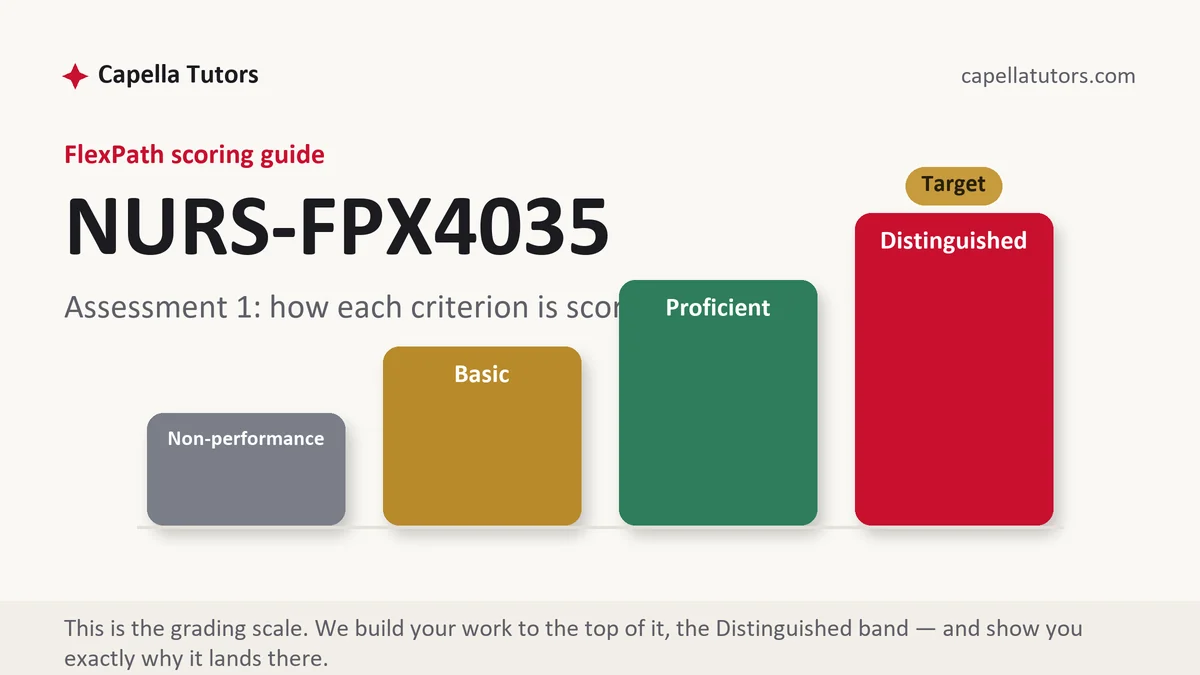
How NURS FPX 4035 Assessment 1 is scored
FlexPath grades without letters. Every criterion lands on one of four levels, and reading those levels as writing instructions is the whole trick:
| Level | What it means on a safety-problem analysis |
|---|---|
| Distinguished | The failure is sized with real numbers, traced to ranked system conditions, and the analysis names what its own data cannot yet prove. Each criterion writes its extra move into the column; do it on purpose. |
| Proficient | The problem is described accurately and connected to the system, but the causes arrive unranked and the data stays general. Competent, not yet complete. |
| Basic | An essay about why safety matters, with the actual failure appearing as illustration instead of subject. Sincere conviction, nothing a criterion can pay for. |
| Non-performance | A required element never shows up, most often the data that sizes the problem or the system-level cause analysis itself. |
Treat this deliverable as the foundation it is. The failure you analyze here usually travels the rest of 4035, feeding the root-cause and improvement work in the later assessments, so a well-chosen problem now saves you three rewrites later.
The NURS FPX 4035 Assessment 1 method, step by step
-
Pull the criteria into an outline before anything else
Open the scoring guide in your courseroom and copy each criterion into a blank document as a heading, with its Distinguished description pasted underneath. That skeleton is the assignment. Prose that answers no criterion earns nothing, however good it sounds at 2 a.m.
-
Choose a failure your unit already documents
The strong candidates live in your incident-report system: a transfer that arrived without report, a specimen mislabeled under time pressure, a critical result that sat unread. Pick a pattern you have witnessed, strip every identifier, and check it has room for system analysis. A one-off fluke gives you nothing to trace; a recurring failure is a process showing you its design.
-
Size the problem with numbers, not adjectives
"Handoffs are often incomplete" cannot be graded; "one in five ED-to-ICU transfers lacked a completed report last quarter" can. Borrow the counts your quality department already keeps, and where you lack unit data, use published rates and say so. The Distinguished column consistently pays for measurable over emphatic.
-
Trace the failure to system conditions
Keep asking why until the answer is a property of the system: interruption load, ambiguous ownership of a task, a form that hides the field that matters, a workaround the unit quietly adopted. If your chain of whys ends at a person who should have tried harder, you stopped early. Interventions attach to conditions, never to blame, and the criteria are written in that doctrine.
-
Use the literature to frame, not to decorate
Three to five current peer-reviewed sources from the Capella library, CINAHL or PubMed, plus the infrastructure layer, AHRQ or Joint Commission material, for definitions and scale. Give each source one named job for one criterion, and write the citation into the sentence doing the work. A reference list of safety platitudes reads as Basic from across the room.
-
Grade your own draft before the evaluator does
Take the finished draft back to the guide and score every criterion honestly at one of the four levels. Anything short of Distinguished gets one focused revision pass, usually adding the named extra move. Then submit early in the week; evaluations can take two business days, and momentum in FlexPath is money.
A structure that maps to the criteria
These word targets are planning numbers our tutors use for a typical 4035 problem analysis, not Capella requirements; your scoring guide decides where the weight goes.
| Section | What it must do | Guide |
|---|---|---|
| Introduction | Name the failure, the setting, and the stakes, and state in one sentence that the analysis will run at system level. | ~150 words |
| The event, de-identified | What happened, what the process was supposed to do, and where it bent, pattern rather than occurrence, all identifiers gone. | ~250 words |
| The problem in data | Local counts where you have them, published rates where you do not, each number sourced and each one doing work. | ~250 words |
| System-level examination | The conditions that produce the failure, ranked by contribution, human factors included, individuals never indicted. | ~350 words |
| Implications for improvement | What the analysis makes possible next: the causes an improvement effort would have to answer, previewed without overpromising. | ~200 words |
| Conclusion and references | The argument closed in current APA, every citation matched both ways, sources within roughly five years. | as needed |
Annotated sample excerpt
Below is an original excerpt from our team's model for this deliverable, shown so you can see the register that reaches the top of the guide. Study the moves, then make your own.
An ICU nurse can recite the admission process from memory and still receive a patient whose vasopressor titration history arrives twenty minutes after the patient does.1 Across the last quarter on a twelve-bed intensive care unit, roughly one in five transfers from the emergency department landed without a completed handoff report, and three of those gaps preceded a delayed intervention documented in the chart.2 This analysis treats that transfer failure as a system problem rather than a staffing lapse, because a gap that recurs across different nurses, different shifts, and both directions of a busy corridor is a process announcing its own design.3
- 1Starts inside the failure, concrete and clinical, before any definition of handoff appears. The evaluator is on the unit by the second clause.
- 2Sizes the problem with a denominator and a consequence, which is exactly the measurability the Distinguished column keeps asking for.
- 3Declares the system-level thesis in one sentence and gives the reason for it, so the whole cause analysis that follows arrives pre-justified.
The full premium sample for your exact assessment, written fresh to your scoring guide and issue, is free to request. Study it, revise it into your own voice, and submit work you understand.
The five mistakes that cost Distinguished
- Ending at a person. An analysis whose deepest cause is an individual's inattention has not reached a cause; the criterion grading root thinking will read it as Basic.
- The invented incident. Hypothetical failures produce generic analyses; real patterns, de-identified, produce the specificity evaluators reward.
- Adjectives where numbers belong. "Frequent", "serious", and "significant" cannot be audited; rates and counts can.
- Passion instead of structure. Paragraphs about how much safety matters contain no gradable content, however true they are.
- Identifiers left in. A room number or a date can trace to a patient, and evaluators notice; describe the pattern, not the occurrence.
Pre-submission checklist
- Each scoring-guide criterion owns one clearly labeled section
- The failure is real, recurring, and stripped of every identifier
- At least one number with a denominator sizes the problem
- The deepest causes named are system conditions, ranked, blame-free
- Every source has a stated job, citations matched to references in current APA
- Self-scored against all four levels, submitted early in the week
Rather start the course with backup?
Send your scoring guide and, if you have one, the safety pattern from your unit. A pod of eight, research analyst and two QA reviewers included, returns a premium original safety-problem analysis inside 24 to 48 hours, revised free until it sits in the Distinguished column. The problem you choose here carries the whole course; choose it with help.