This manual is for NHS FPX 6008 Assessment 4, start to submission. Hand it to us and a premium original sample arrives inside 24 to 48 hours, written to the scoring guide and revised free until every criterion clears. Writing it yourself is the better preparation for the practicum courses, so here is the method. Assessment 4 of NHS FPX 6008 usually asks you to advocate rather than analyze. The deliverable is commonly a proposal aimed at whoever controls a payment or coverage rule, arguing for a specific change and showing what it would do for the organization, the clinicians, and the patients. Your scoring guide decides the audience and the length. The criteria reward a request written tightly enough that a staffer could act on it, and evidence honest enough to survive the reader's own analyst. Capella's catalog lists the course as NHS-FPX6008, and some courserooms print NHS6008; both point to this same Assessment 4. In current courserooms this assessment typically appears as "Lobbying for Change".
One honesty note before the manual: Capella revises courses and scoring guides over time, so always write to the exact scoring guide attached to your assessment in the courseroom. The course identity above is verified on capella.edu; the method and structure below are our tutors' approach to it, not Capella's official rubric text.
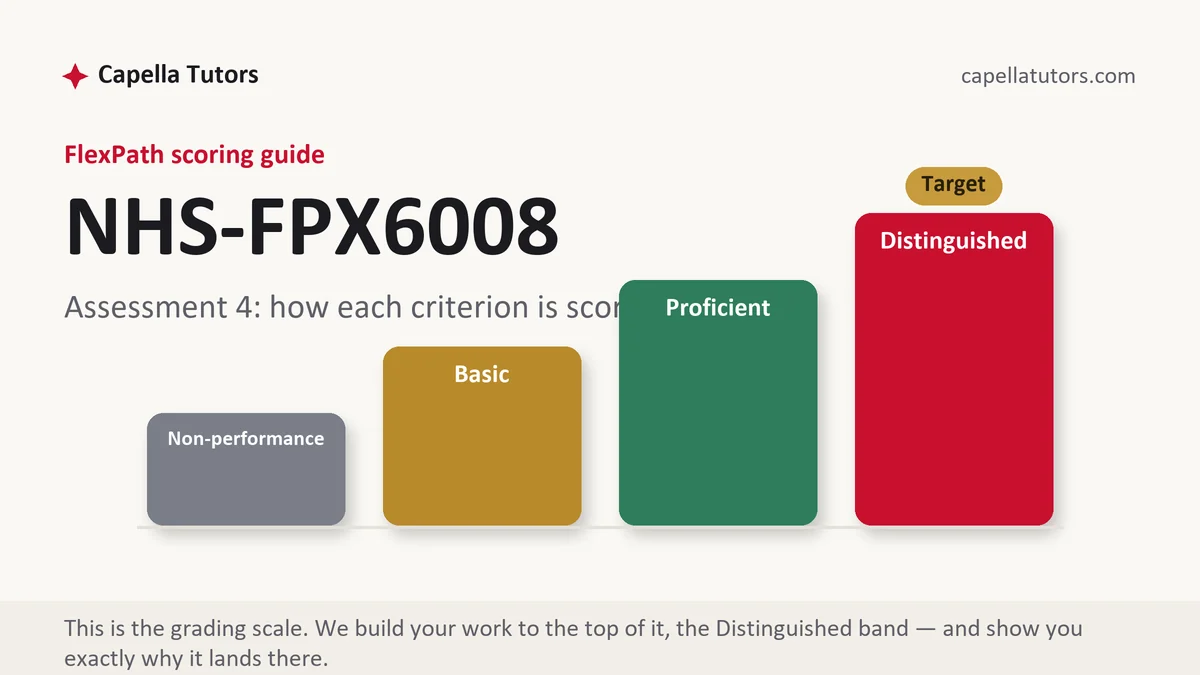
How NHS FPX 6008 Assessment 4 is scored
Each criterion stands alone in FlexPath and lands on one of four levels. The wording of those levels is the specification for the document:
| Level | What it means on an advocacy proposal |
|---|---|
| Distinguished | The ask names the provision and the change, the benefit is argued in separate ledgers for the organization, the clinicians, and the patients, the evidence is carried with its limits admitted, and the reader's strongest objection is answered in the reader's own terms. Each criterion adds a further requirement, and your scoring guide is the authority on it. |
| Proficient | A well-sourced and well-organized case for a real change, but the ask stays general and the objection is acknowledged rather than met. |
| Basic | An argument that something is unfair. Sincere, unquantified, addressed to nobody in particular, and impossible to act on. |
| Non-performance | A required element is missing, most often the benefit analysis for one of the named audiences. Evaluators score the omission and not the tone of the writing. |
Advocacy is a genre with rules, and the most useful one is that you are writing to somebody who will pay for what you are asking. That reader is not moved by indignation and is moved by a number, a control they can verify, and a request smaller than the maximum you could have made. Asking for less than everything, and conceding a specific safeguard the other side wants, is how a proposal survives contact with the person who has to fund it, and the top column in this course is describing exactly that discipline.
The NHS FPX 6008 Assessment 4 method, step by step
-
Identify the decision-maker and the instrument
A payment rule changes through a specific mechanism: a payer contract negotiation, a state statute or insurance regulation, or a federal rule open for comment in a published docket. Name the mechanism first, because it determines the document. A comment letter, a legislative one-pager, and a proposal to a payer contracting team are three different genres, and the scoring guide usually cares which one you produced.
-
Write the ask as a change to specific language
Say which provision you want amended, what the new text or rate should be, and which requirement you want removed. Extend the audio-only provision to chronic-disease follow-up at 85 percent of the in-person rate is actionable; improve telehealth reimbursement is not. If a staffer could not turn your paragraph into an amendment, the ask is not finished.
-
Argue the benefit in three ledgers, kept separate
The organization's ledger holds revenue, cost, and capacity effects. The clinician ledger holds workload, documentation burden, and the time an encounter actually consumes. The patient ledger holds access, out-of-pocket exposure, and outcomes. Quantify each one separately, because a proposal that blends them invites the reader to suspect double counting, and an equity argument backed by travel distance or broadband availability lands harder than the same argument made in principle.
-
Bring the evidence and concede its limits
Use the peer-reviewed telehealth and health services literature, in journals such as Health Affairs, JAMA Network Open, and Telemedicine and e-Health, and read it honestly. Much of it is observational, some of it is confounded by who chooses a virtual visit in the first place, and the question of whether virtual access substitutes for in-person care or adds to it remains contested. Saying so, then reasoning from mechanism and from your own local data, reads as competence. Overstating a contested finding hands the reader's analyst an easy rebuttal.
-
Answer the objection in the reader's currency
A payer's first question is whether this increases total utilization, and its second is whether the service can be audited. Answer both. Offer the documentation standard that makes duplicate billing detectable, name the utilization guardrail you would accept, and show the comparison against what the current rule already costs in missed follow-up. An objection met with a concession is more persuasive than an objection met with enthusiasm.
-
Self-score against the guide, then submit early in the week
Check that every audience named in the criteria has its own section, that every figure carries a source and a year, and that the ask appears in the first paragraph as well as the last. Mark each criterion yourself, rework the shortfalls, and submit at the start of the week so a two-day evaluation window does not become a five-day wait.
A structure that maps to the criteria
The word targets below are planning figures from our own advocacy drafts. Your scoring guide decides the audience, the length, and the format the proposal has to take.
| Section | What it must do | Guide |
|---|---|---|
| The ask | The provision, the change requested, and the body with power to make it. | ~200 words |
| Why now | The local data and the trend that make the current rule fail in this setting. | ~250 words |
| Benefit to the organization | Revenue, cost, and capacity effects, kept separate and quantified. | ~250 words |
| Benefit to clinicians and patients | Workload, access, and outcome effects, each with its own evidence. | ~300 words |
| Objections answered | The reader's strongest counterargument, met in the reader's own terms. | ~300 words |
| Close, next steps, references | What you want from this reader in the next month, and current APA 7 throughout. | ~200 words |
Annotated sample excerpt
A model excerpt from our team, written in the register a payment decision-maker reads. Take the structure, then make the request your own setting can support.
Request: extend the audio-only reimbursement provision now limited to behavioral health so that it covers chronic-disease follow-up visits at 85 percent of the in-person rate, and remove the requirement for an in-person visit within the preceding twelve months.1 Two facts drive it. Thirty-one percent of our diabetes and heart-failure patients live in the three rural counties where fixed broadband is unavailable at the household level, and the completed-visit rate for that group runs 22 percentage points below the rate for our video-eligible patients.2 We are not asking for parity with in-person payment. We are asking for a rate that covers the clinician time an audio visit actually consumes, and we will accept a documentation standard that makes duplicate billing detectable.3
- 1The ask names the provision, the rate, and the clause to strike. An advocacy criterion is scored on whether a staffer could turn the paragraph into an amendment.
- 2Two local numbers, one about infrastructure and one about outcomes. Access arguments made at the level of principle lose to arguments that arrive with a completed-visit gap attached.
- 3Asks for less than the maximum and concedes a control the payer wants, which is what a negotiating document does. Note that the concession is specific enough for the reader to verify.
The full premium sample for your exact assessment, written fresh to your scoring guide and issue, is free to request. Study it, revise it into your own voice, and submit work you understand.
The five mistakes that cost Distinguished
- An ask nobody can enact. Improve coverage names no provision and no rate. Write the change as text somebody could adopt.
- One ledger doing all the work. A proposal that argues only the organization's revenue gives the reader nothing to defend publicly. Argue all three audiences separately.
- Contested evidence stated flatly. Whether virtual visits substitute for or add to in-person care is genuinely unsettled. Overstating it invites the rebuttal that ends the conversation.
- No guardrail offered. Every payment expansion carries a utilization risk. Naming the control you would accept is what makes the request credible.
- Indignation instead of arithmetic. Unfairness is a premise, not an argument. The reader funds numbers, and the criteria are written about the numbers.
Pre-submission checklist
- The decision-maker and the instrument named before anything is argued
- The ask written as specific language, including any clause to be removed
- Three ledgers argued separately, each quantified with sourced figures
- Evidence limits conceded where the literature is observational or contested
- The reader's strongest objection answered, with a guardrail or documentation standard offered
- Every figure carrying a source and a year, APA 7 verified, self-scored before submitting
Want the advocacy proposal written to the right reader?
Tell us who holds the decision and send the scoring guide. The draft comes back addressed to that reader, with the ask written as adoptable language and the objections answered, inside 24 to 48 hours and revised free until every criterion clears.