This manual is for NHS FPX 6004 Assessment 3, start to submission. Hand it over and a premium original sample, agenda and objectives and evaluation plan included, arrives inside 24 to 48 hours with free revisions until the guide is met. Building it yourself starts here. Assessment 3 of NHS FPX 6004 usually asks you to teach the policy you have been working with. The deliverable is commonly a training session or a set of session materials for the staff who have to carry the policy out, and your scoring guide decides whether that means an agenda, slides, a facilitator guide, or a recorded segment. The criteria are written about implementation rather than about instruction in the abstract: whether the objectives can be assessed, whether the activities rehearse the actual decision, and whether you have a plan for the people who arrive unconvinced. Capella's catalog lists the course as NHS-FPX6004, and some courserooms print NHS6004; both point to this same Assessment 3. In current courserooms this assessment typically appears as "Training Session for Policy Implementation".
One honesty note before the manual: Capella revises courses and scoring guides over time, so always write to the exact scoring guide attached to your assessment in the courseroom. The course identity above is verified on capella.edu; the method and structure below are our tutors' approach to it, not Capella's official rubric text.
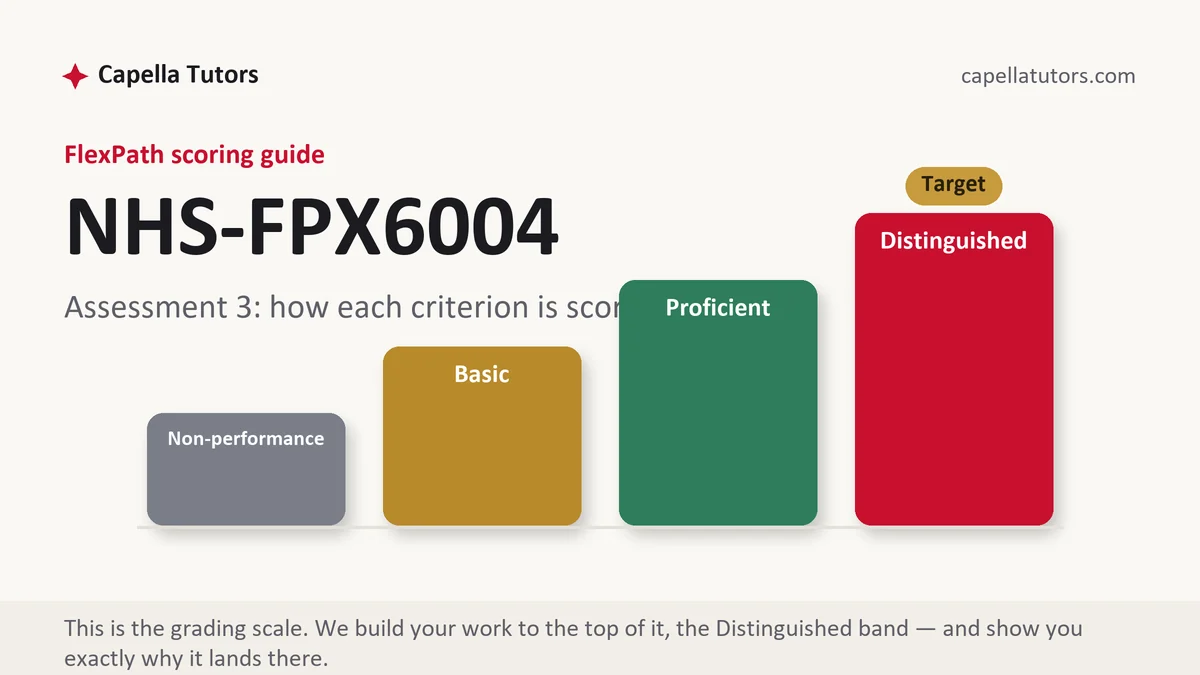
How NHS FPX 6004 Assessment 3 is scored
Each criterion in the guide is scored on its own against four levels, and the descriptions are written as a specification rather than as feedback:
| Level | What it means on a training session for policy implementation |
|---|---|
| Distinguished | Objectives are observable and each one names its own check, the legal content is translated from a cited rule into plain instruction, the activity rehearses the decision staff will actually face, and evaluation runs at both knowledge and practice level. Each criterion adds a further demand, and your scoring guide is the authority on it. |
| Proficient | A complete, well-organized session with sound content, but the objectives are stated in terms nobody can measure and the evaluation stops at a satisfaction survey. |
| Basic | A lecture plan. Definitions delivered, no rehearsal, and a plan to send a follow-up email as the only measurement. |
| Non-performance | A required component is missing, most often the evaluation plan or the barrier and buy-in section. Absence, not thinness, is what puts a criterion at the floor. |
Adults in a mandatory session are a specific audience: experienced, busy, and reasonably suspicious that the new rule was written by somebody who has not worked a Saturday. The training criteria reward writers who plan for that room rather than for a compliant one. Name the resistance you expect, answer it inside the agenda rather than in a footnote, and give the learners something they get to keep, whether that is a decision card, a bookmark, or a shorter path to an answer they currently have to hunt for.
The NHS FPX 6004 Assessment 3 method, step by step
-
Name the learners and the behavior that has to change
Write one sentence per learner group stating what they do today and what they will do after the session. Front-desk staff, clinic nurses, collaborating physicians, and the practice manager need different things from the same policy. A training criterion asking about audience is asking for that analysis, not for a description of the training room.
-
Write objectives with a check attached to each
Understand the scope of practice cannot be assessed and therefore cannot satisfy an objectives criterion. State the observable action, the condition, and the threshold: route three of three sample orders correctly, locate the governing rule in under two minutes, state which prescribing actions require a written agreement in this state. Then name the instrument that verifies each one, in the same sentence if you can.
-
Pin the legal content to the rule, at section level
Implementation training goes wrong when the facilitator paraphrases a rule they have not read. Cite the nurse practice act and the board regulations that interpret it, by section, and read them at the source, because scope, supervision requirements, and prescriptive authority vary substantially between states and a clinician who moves carries none of it with them. Then translate: one plain sentence per obligation, in the words a staff member would use, with the citation kept in the facilitator notes rather than on the wall.
-
Design activities that rehearse the decision, not the definition
The gap between knowing a rule and applying it under time pressure is the thing a session has to close. Give the room three or four short cases drawn from the situations that actually arise, have them route each one, then debrief on the two that split the group. Case-based rehearsal and immediate feedback are what the continuing education literature in the Journal of Continuing Education in Nursing and Nurse Educator consistently associates with transfer to practice, and citing that evidence for your design choice is itself a criterion-level move.
-
Evaluate at two levels, and plan for the unconvinced
Level one runs in the room: the scored activity, not a satisfaction form. Level two runs in practice, thirty to ninety days out, using data the site already collects, which is what makes the plan believable. Then address buy-in directly. State what the learners will object to, who among them carries informal authority, and what the session concedes or fixes in exchange for cooperation. Barriers named specifically read as competence; barriers described as resistance to change read as a placeholder.
-
Rehearse it, self-score it, then submit early
Walk the agenda against a clock and against the guide at the same time, confirming that every criterion has its own visible section and that no segment runs longer than the attention it can hold. Fix whatever falls short of the top column, then submit at the start of the week, since evaluation can take two business days and this deliverable often needs one pass.
A structure that maps to the criteria
The word targets below are planning figures from our own facilitator guides. If your scoring guide names a duration, a slide count, or a recording requirement, it decides.
| Section | What it must do | Guide |
|---|---|---|
| Audience and purpose | Who is in the room, what they will do differently, and why these groups were chosen. | ~150 words |
| Learning objectives | Observable, assessable statements, one per behavior the policy requires. | ~150 words |
| The legal content, translated | The rule being implemented, cited by section, restated as plain instruction. | ~300 words |
| Agenda and activities | Time-boxed segments, with the rehearsal that makes the decision practicable. | ~300 words |
| Evaluation of learning | The instrument used in the room and the practice-level indicator afterward. | ~250 words |
| Buy-in, barriers, resources | What the learners will resist, how the session answers it, and what the session needs. | ~250 words |
Annotated sample excerpt
An original model from our team, showing what an assessable objective set looks like when a criterion asks for one. Study the form, then write yours to your own policy.
By the end of the session each participant will: state which of the four prescribing actions on the handout require a written collaborative agreement in this state and which do not, route three of three sample orders correctly on the decision card, and locate the board rule governing supervision in under two minutes using the bookmark provided.1 The knowledge check is the decision card itself, scored in the room, because a criterion asking how learning will be evaluated wants an instrument rather than a promise to follow up.2 Practice-level evaluation runs at thirty days: the share of new orders routed without a compliance query, pulled by the practice manager from the query log that already exists.3
- 1Three objectives, each an observable action with a threshold. Understand the scope of practice cannot be assessed, and an objectives criterion is scored on whether it can be.
- 2Names the instrument and the moment of measurement in one sentence, which is what separates a training plan from a training wish.
- 3Adds a second level of evaluation using data the site already collects. Reusing an existing log is the detail that makes an evaluation plan credible to the people who would have to run it.
The full premium sample for your exact assessment, written fresh to your scoring guide and issue, is free to request. Study it, revise it into your own voice, and submit work you understand.
The five mistakes that cost Distinguished
- Objectives nobody can measure. Understand, appreciate, and be aware of are unassessable verbs, and they take the objectives criterion down with them.
- Law delivered as definitions. Reciting the rule teaches nothing about the Tuesday afternoon order that sits on the boundary. Rehearse the decision instead.
- A satisfaction survey called evaluation. How the room felt is not learning. A scored instrument plus one practice indicator is.
- Federal citations where state rules govern. Scope and supervision are state law. Training built on a national summary can be confidently wrong, which is worse than being incomplete.
- Resistance mentioned but not answered. Naming the objection is half a criterion. Saying what the session concedes, fixes, or escalates is the other half.
Pre-submission checklist
- Each learner group described by what it does today and what it will do after
- Every objective observable, with its verification instrument named
- The governing state rule cited by section and translated into one plain sentence per obligation
- At least one case-based rehearsal of the decision the policy actually changes
- Evaluation at two levels, the second using data the site already collects
- Expected objections named with the session's answer, APA 7 checked, self-scored before submitting
Want the training session built for you?
Send the scoring guide and the policy you are implementing. A premium original session, with assessable objectives, a rehearsal activity, and a two-level evaluation plan, comes back in 24 to 48 hours and is revised free until every criterion clears.