This manual is for MHA FPX 5068 Assessment 3, start to submission. Informatics Infrastructure asks you to recommend how an organization can evaluate and strengthen its health information systems: specific analytical tools for evaluating informatics systems, the management and leadership practices that make those tools effective, how to align the organization's strategy and culture with its informatics goals, the factors that affect that alignment, and how management should communicate its strategic plans and goals. The grade turns on specificity. Naming real evaluation tools and frameworks, and showing how leaders would use them, scores above general statements about data and technology. Below is the method our tutors use, a structure that maps to the criteria, and an annotated sample excerpt. Prefer to hand it off? A premium original sample for this exact assessment comes back in 24 to 48 hours, revised free until it meets the guide. Capella's catalog lists the course as MHA-FPX5068, and some courserooms print MHA5068; both point to this same Assessment 3. In current courserooms this assessment typically appears as "Informatics Infrastructure".
One honesty note before the manual: Capella revises courses and scoring guides over time, so always write to the exact scoring guide attached to your assessment in the courseroom. The course identity above is verified on capella.edu; the method and structure below are our tutors' approach to it, not Capella's official rubric text.
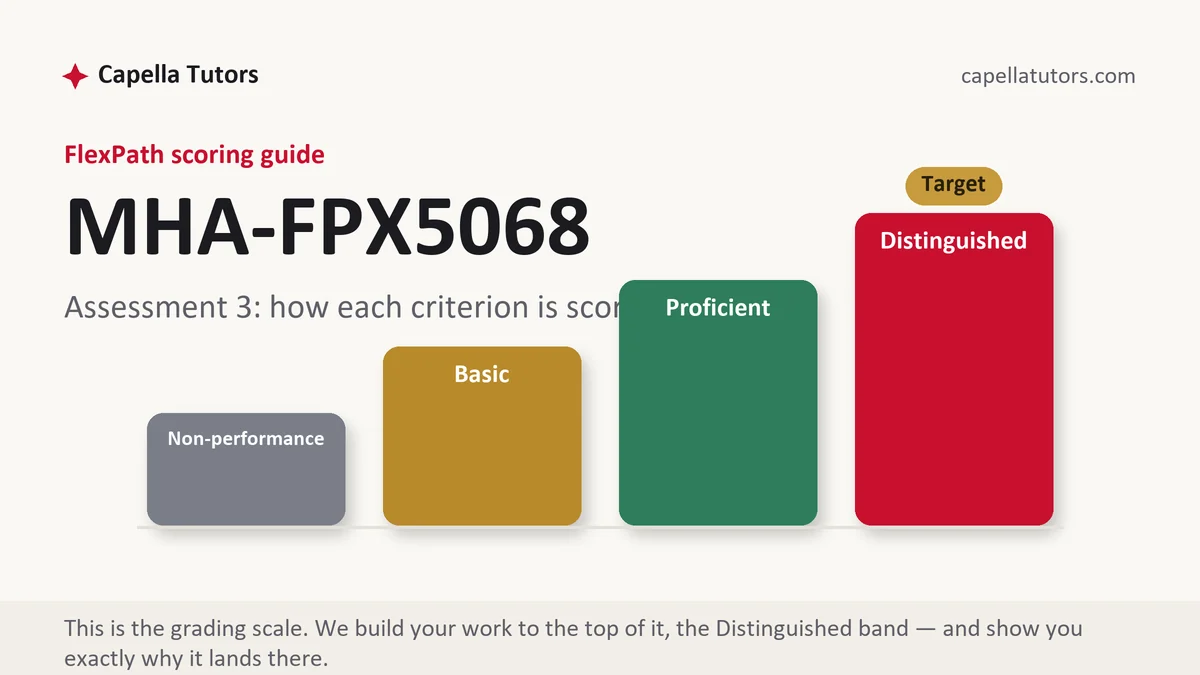
How MHA FPX 5068 Assessment 3 is scored
FlexPath does not use letter grades. Each criterion in the scoring guide lands on one of four levels, and the level descriptions are the real writing brief:
| Level | What it means on an informatics infrastructure paper |
|---|---|
| Distinguished | Specific analytical tools are named and explained, management practices are tied to using them, strategic alignment and culture are addressed with evidence, modifying factors are identified, and communication of plans is concrete. |
| Proficient | All parts are present, but tools and practices are described generally. |
| Basic | The paper discusses informatics broadly with little about tools or alignment. |
| Non-performance | The analytical tools, the alignment discussion or the communication plan is missing. |
Use the organization in your scenario and its strategic goals as the reference point for alignment.
The MHA FPX 5068 Assessment 3 method, step by step
-
Name analytical tools
Dashboards, key performance indicators, usability testing, system audit logs, and frameworks such as the HIMSS adoption models.
-
Explain how management uses them
Who reviews results, how often, and what decisions follow.
-
Align strategy
Connect informatics goals to the organization's strategic plan.
-
Build a supportive culture
Training, clinical involvement and data literacy.
-
Identify modifying factors
Budget, regulation, workforce, vendor capacity.
-
Communicate plans
How leaders share strategy and goals with staff, with feedback loops.
A structure that maps to the criteria
Word counts are planning targets our tutors use, not Capella rules; follow the length and format your scoring guide states.
| Section | What it must do | Guide |
|---|---|---|
| Analytical tools for evaluating informatics systems | Tools and frameworks. | ~150 words |
| Management and leadership best practices | How tools are used well. | ~125 words |
| Strategic alignment and culture | Aligning goals and building support. | ~150 words |
| Modifying factors | What affects alignment. | ~100 words |
| Communicating strategic plans | How leaders share goals. | ~100 words |
| References | Current APA. | as needed |
Annotated sample excerpt
An original model excerpt from our team, written to show the register that reaches the top of the guide. Learn the moves, then write your own version.
A system's value cannot be judged by uptime alone, so the evaluation should combine three kinds of evidence: usage data from audit logs, which show whether clinicians actually use features such as order sets; outcome indicators on a quality dashboard, such as medication error rates; and usability testing with frontline staff.1 Maturity frameworks such as HIMSS's adoption models add a fourth lens by comparing the organization's capabilities with a recognized scale, which helps leaders prioritize investments.2 The tools only matter if a named group reviews them, so the recommendation is a quarterly informatics review at the quality committee, where each finding leads to an owner and a decision.3
- 1Combines specific tools that measure different things.
- 2Adds a recognized framework and explains its use.
- 3Ties the tools to a governance practice, which is what makes them effective.
The full premium sample for your exact assessment, written fresh to your scoring guide and topic, is free to request. Study it, revise it into your own voice, and submit work you understand.
The five mistakes that cost Distinguished
- Vague tools. Name specific tools and frameworks.
- Tools without management. Say who uses the results and how.
- Ignoring culture. Address how staff are brought along.
- No modifying factors. Name what can help or block alignment.
- Communication as an afterthought. Plan how strategy is shared.
Pre-submission checklist
- Specific analytical tools explained
- Management practices for using them
- Strategic alignment and culture
- Modifying factors identified
- Communication of strategic plans
- Current APA references
Want the infrastructure paper written?
Send the scoring guide and the scenario. Our team returns a premium original paper in 24 to 48 hours, revised free until it meets the guide.