This manual is for MHA FPX 5068 Assessment 1, start to submission. Merit-Based Incentives and Daily Operations asks you to explain the Merit-based Incentive Payment System (MIPS), created under the Medicare Access and CHIP Reauthorization Act of 2015, and how it affects the daily operations of a health care organization: its performance categories, how scores translate into payment adjustments, and what it changes for clinicians, staff, technology and reporting. The grade turns on operations. A summary of the program scores lower than an explanation of what MIPS changes on a Tuesday morning in a clinic. Below is the method our tutors use, a structure that maps to the criteria, and an annotated sample excerpt. Prefer to hand it off? A premium original sample for this exact assessment comes back in 24 to 48 hours, revised free until it meets the guide. Capella's catalog lists the course as MHA-FPX5068, and some courserooms print MHA5068; both point to this same Assessment 1. In current courserooms this assessment typically appears as "Merit-Based Incentives and Daily Operations".
One honesty note before the manual: Capella revises courses and scoring guides over time, so always write to the exact scoring guide attached to your assessment in the courseroom. The course identity above is verified on capella.edu; the method and structure below are our tutors' approach to it, not Capella's official rubric text.
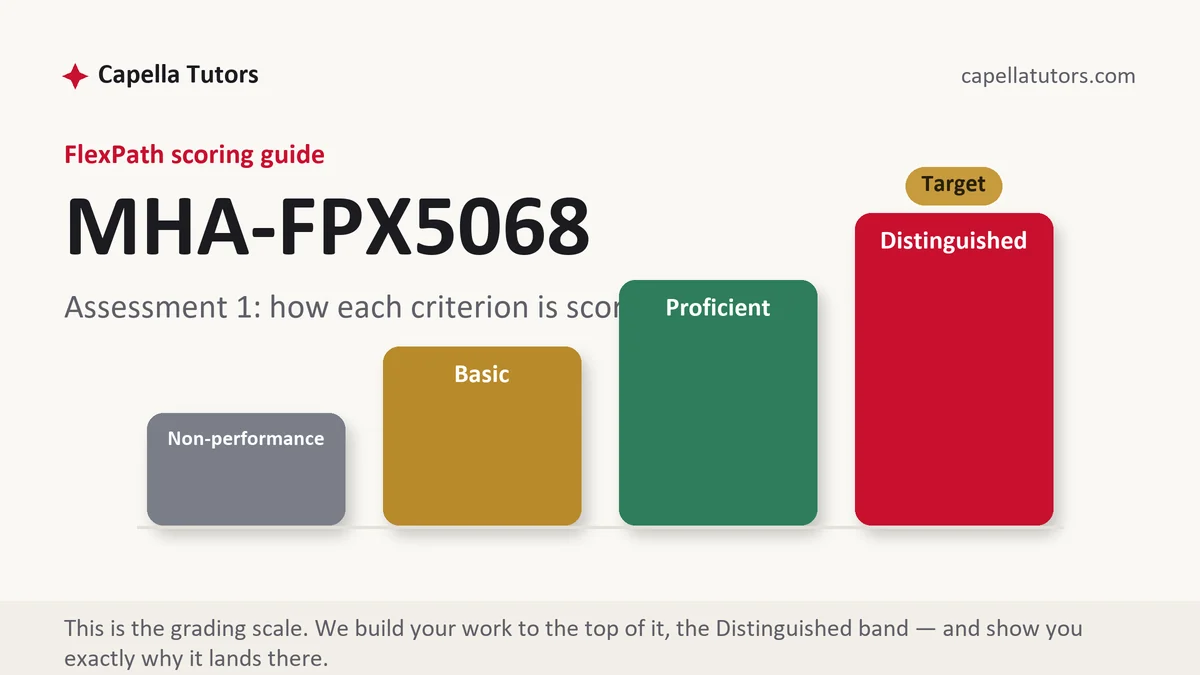
How MHA FPX 5068 Assessment 1 is scored
FlexPath does not use letter grades. Each criterion in the scoring guide lands on one of four levels, and the level descriptions are the real writing brief:
| Level | What it means on a MIPS paper |
|---|---|
| Distinguished | MIPS and its categories are explained accurately, the link between performance and payment is clear, effects on workflows, staffing, technology and reporting are specific, and recommendations for managing the program are supported. |
| Proficient | The program is explained accurately, but operational effects are general. |
| Basic | The paper summarizes MIPS with little about daily operations. |
| Non-performance | The performance categories or the operational effects are missing. |
Check current CMS guidance for the performance categories and their weights, since they change by performance year.
The MHA FPX 5068 Assessment 1 method, step by step
-
Explain MACRA and MIPS
Why the program exists and who must participate.
-
Describe the performance categories
Quality, Promoting Interoperability, Improvement Activities and Cost, with current weights from CMS.
-
Link score to payment
How the composite score leads to positive, neutral or negative payment adjustments.
-
Trace effects on daily operations
Documentation, quality measure tracking, EHR use, staff roles and reporting deadlines.
-
Identify challenges
Administrative burden, small practice capacity, data quality.
-
Recommend
How a manager can organize the work to perform well.
A structure that maps to the criteria
Word counts are planning targets our tutors use, not Capella rules; follow the length and format your scoring guide states.
| Section | What it must do | Guide |
|---|---|---|
| Introduction | MACRA, MIPS and the purpose of the paper. | ~100 words |
| How MIPS works | Categories, weights and payment adjustment. | ~200 words |
| Effects on daily operations | Workflow, staffing, technology and reporting. | ~200 words |
| Challenges and recommendations | Problems and how to manage them. | ~150 words |
| Conclusion and references | Close, then current APA. | ~75 words |
Annotated sample excerpt
An original model excerpt from our team, written to show the register that reaches the top of the guide. Learn the moves, then write your own version.
In a primary care clinic, MIPS turns quality measures into daily tasks: if the clinic reports on diabetes control and depression screening, then every relevant visit needs the A1c result and the screening documented in structured fields, not in free text, or the measure will not count.1 That means front-desk staff flag patients due for screening, medical assistants complete the questionnaire before the provider enters, and someone reviews the measure dashboard each month to catch gaps before the reporting deadline.2 Because the payment adjustment depends on the whole year's performance, a clinic that leaves this work to December usually finds it cannot recover the missed visits.3
- 1Shows how a measure becomes a documentation requirement.
- 2Traces the work to specific roles in the clinic.
- 3Explains why timing matters for payment.
The full premium sample for your exact assessment, written fresh to your scoring guide and topic, is free to request. Study it, revise it into your own voice, and submit work you understand.
The five mistakes that cost Distinguished
- Summarizing the program only. Show its effect on operations.
- Outdated weights. Use current CMS guidance.
- Ignoring staff roles. Say who does the work.
- No challenges. Address burden and data quality.
- No recommendations. Tell a manager what to do.
Pre-submission checklist
- MACRA and MIPS explained
- Performance categories with current weights
- Score to payment link
- Specific effects on daily operations
- Challenges and recommendations
- Current APA references
Want the MIPS paper written?
Send the scoring guide. Our team returns a premium original paper in 24 to 48 hours, revised free until it meets the guide.